 Rumah sakit perlu memiliki perencanaan penanggulangan bencana rumah sakit yang baik untuk meminimalisir kekacauan saat terjadi bencana. Rumah sakit juga harus siap menghadapi masalah kesehatan yang muncul pada pengungsi pasca bencana. Laboratorium klinik di rumah sakit memiliki peran penting dalam kondisi bencana. Laboratorium harus memiliki persiapan pra bencana dan pasca bencana. POCT memiliki potensi yang sangat besar sebagai alat pemeriksaan laboratorium darurat baik di rumah sakit maupun di lokasi bencana untuk menjaga keselamatan pasien. POCT didefinisikan sebagai alat tes diagnostik laboratorium yang digunakan dalam situasi bencana secara efektif. Rumah sakit harus mempersiapkan POCT untuk mengatasi keterbatasan sumber listrik, SDM, dan situasi bangunan yang tidak memungkinkan menggunakan laboratorium diagnostic analyzer. POCT tersebut cocok untuk dibawa kemana saja baik di dalam rumah sakit maupun ke lokasi bencana dengan menggunakan kendaraan. Keuntungan menggunakan POCT adalah hasil pemeriksaan cepat bermanfaat bagi dokter yang merawat pasien, sehingga dapat menganalisis perkembangan kondisi pasien. Penggunaan POCT tidak perlu menggunakan tenaga khusus yang berpendidikan ilmu laboratorium tetapi dapat dilakukan oleh tenaga kesehatan lainnya.
Public health emergency preparedness (PHEP): a framework to promote resilience
 Keadaan darurat dan bencana berdampak pada kesehatan masyarakat. Penyakit menular terus berkembang, pandemi COVID-19 yang baru saja dihadapi menyebabkan morbiditas dan mortalitas dengan penyebaran penyakit yang sangat cepat. Mendefinisikan kesiapsiagaan berdasarkan evidence based masih menjadi tantangan, karena kurangnya bukti untuk menginformasikan pengurangan risiko bencana (PRB) untuk kesehatan masyarakat.Sebelum terjadi pandemi, peningkatan pengetahuan masih berfokus penanganan penyakit menular dalam scope endemi atau kasus luar biasa. Kesenjangan pengetahuan yang ada dengan kerangka kerja PHEP seharusnya seimbang untuk mencerminkan konteks dinamis dan sosial dari kedaruratan kesehatan masyarakat dan sistem kesehatan masyarakat yang kompleks. Intervensi berorientasi ketahanan untuk PHEP telah diusulkan dengan mempertimbangkan kompleksitas konteks darurat dan kompleksitas latar belakang yang harus memandu strategi dalam membingkai ulang PHEP. Makalah berikut menyajikan kerangka kerja yang diturunkan secara empiris dan diinformasikan secara teoritis untuk kesiapsiagaan darurat untuk menginformasikan praktik badan kesehatan masyarakat lokal/regional. Hasil yang ditampilkan mendeskripsikan elemen penting dari sistem kesehatan masyarakat yang tangguh dan bagaimana elemen tersebut berinteraksi sebagai sistem adaptif yang kompleks. Kerangka kerja ini mengidentifikasi 11 elemen penting dari sistem kesehatan masyarakat yang tangguh dan bagaimana elemen tersebut berinteraksi sebagai sistem adaptif yang kompleks. Kerangka kerja berkaitan dengan semua aspek manajemen darurat – meliputi kesiapan, respons dan pemulihan – dan promosi kapasitas adaptif untuk mendukung ketahanan di antara lembaga kesehatan masyarakat lokal/regional.
ARCH Project and the Global Initiatives of Disaster Health Management
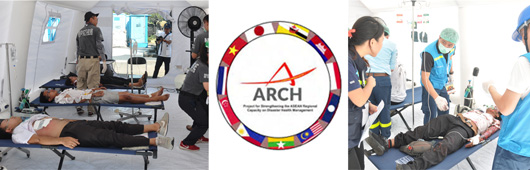 Program penguatan the ASEAN Regional Capacity on Disaster Health Management (ARCH Project) bertujuan untuk memperbaiki kapasitas disaster health management (DHM), kapasitas dalam konteks level individu, emergency medical team (EMT), dan kolaborasi regional. Sejak awal proyek ARCH, Regional Collaboration Drill (RCD) telah dilakukan sebanyak empat kali hingga saat ini di Thailand, Vietnam, Filipina, dan Indonesia masing-masing pada 2016, 2017, 2018, dan 2019. Terdapat 2 project working group (PWG) yang diatur untuk memfasilitasi perwakilan negara ASEAN untuk mendiskusikan kegiatan dan output ARCH Project. PWG 1 berperan untuk merancang dan merencanakan RCD (misalnya mengembangkan skenario, prosedur evaluasi, materi) dan mengembangkan draft standar operasional prosedur regional DHM. PWG 2 berperan untuk merancang dan mengembangkan kurikulum pelatihan (misalnya tujuan, tema, metodologi, pelatih, dan lain-lain) serta materi yang diperlukan untuk mendukung pelatihan. Dalam proses penguatan mekanisme koordinasi dan kolaborasi regional ASEAN di DHM, proyek ini terus menangkap tren internasional seputar DHM, serta berupaya memberikan kontribusi pada pengembangan sistem dan global tools. Peningkatan akademik di ASEAN akan memiliki dampak dan kontribusi yang signifikan dalam jaringan penelitian global tentang DHM.
Webinar Series Pembahasan Undang-Undang Kesehatan #9 Keberadaan Urusan Bencana Kesehatan di UU Kesehatan 17 Tahun 2023

Reportase
Webinar Series Pembahasan Undang-Undang Kesehatan #9
Keberadaan Urusan Bencana Kesehatan di UU Kesehatan 17 Tahun 2023
21 Agustus 2023
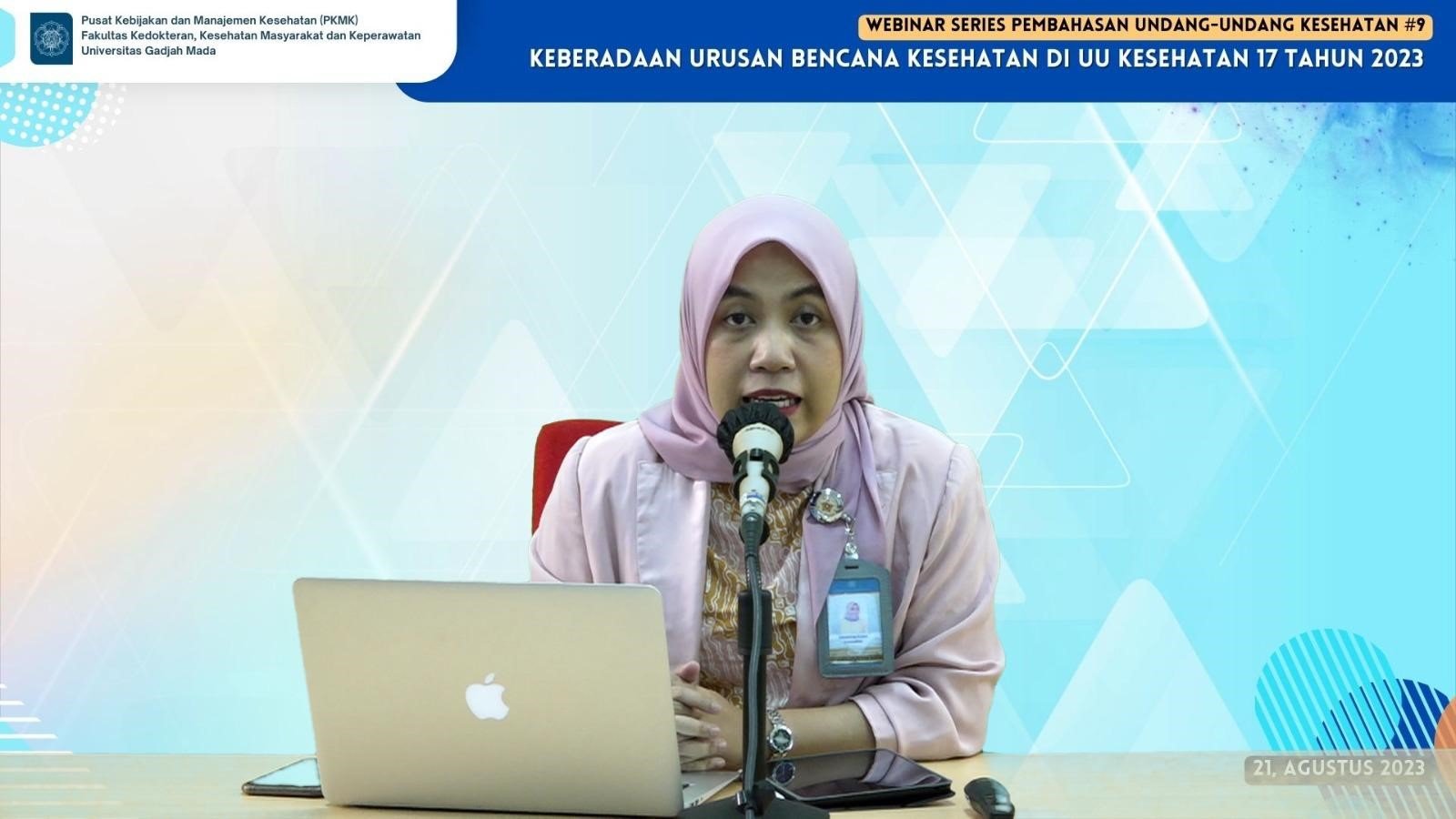
PKMK – Urusan bencana telah menjadi perhatian oleh sektor kesehatan sejak diterbitkannya Undang-Undang Nomor 36 Tahun 2009 dan peraturan lain sebelumnya. Penanganan manajemen bencana kesehatan di Indonesia juga terus berkembang dan mengambil pembelajaran pada setiap penanganan bencana alam maupun non alam, termasuk situasi andemi COVID-19 lalu hingga saat ini. Kehadiran UU Kesehatan Nomor 17 Tahun 2023 dalam ekosistem urusan bencana kesehatan menjadi menarik dan penting untuk dibahas. Kali ini, PKMK FK-KMK UGM mengadakan webinar seri #9 dengan topik utama “Keberadaan Urusan Bencana Kesehatan di UU Kesehatan Nomor 17 Tahun 2023”.
Kegiatan ini dipandu oleh Ns Maryami Yuliana Kosim, S.Kep., M.Kep., Ph.D dan diisi oleh Madelina Ariani, MPH selaku Kepala Divisi Manajemen Bencana Kesehatan PKMK FK-KMK UGM. Dalam pembahasannya, Madelina menyampaikan bahwa perbedaan besar yang terlihat dari UU baru ini adalah keberadaan nomina bencana sebanyak 41 kata dan cantumannya yang tersebar di 8 bab berbeda. Hal ini berubah dari UU lama, yakni UU Nomor 36 Tahun 2009 yang mencantumkan nomina bencana hanya di bab 6 sebanyak 14 kata. Selain itu, di UU baru, juga terdapat nomina krisis kesehatan, di mana hal ini menjadi krusial karena akan mempengaruhi konsep bencana dan penanggulangannya. Pembahasan kemudian dilanjutkan dengan menunjukkan perbedaan-perbedaan dalam beberapa pasal yang tercantum dalam UU baru dan lama, serta kebaruan pasal.
Forum dilanjutkan dengan sesi diskusi dimana salah satu peserta, Madahan Lalu selaku perwakilan Dinkes NTB menyebutkan bahwa UU baru ini membawa semangat baru dan menghidupkan optimisme dalam perbaikan sistem penanggulangan bencana di Indonesia. dr. Bella Donna, M.Kes melanjutkan dengan memberikan semangat kepada semua aktivis bencana kesehatan. Bella mengingatkan bahwa meski memberikan rasa optimis, forum juga harus mengawal lanjutan dari UU ini, yakni produk turunannya. Bella menambahkan bahwa selanjutnya forum dilaksanakan 2 pekan sekali untuk terus mengkritisi kebijakan ini.
Diskusi berjalan baik dengan antusiasme peserta yang tinggi, terutama yang mengkritisi soal nomina-nomina kebencanaan dalam peraturan baru dan definisinya. Selain itu, beberapa peserta yang terdiri dari birokrat dan praktisi lapangan juga menggarisbawahi persoalan seputar ambulans gratis, sistem pendanaan dalam penanggulangan bencana, dan kerahasiaan dalam hal rekam medis pasien bencana.
dr. Hendro Wartatmo, Sp.B-KBD turut menyampaikan optimisme dalam ekosistem bencana kesehatan dalam UU baru. Meski sempat menuai kontroversi, terutama dalam hal organisasi profesi dan pendidikan spesialis, bencana kesehatan tidak terpengaruh dan justru mendapat peluang bagus dalam UU ini. Namun, beberapa hal tetap harus dikritisi. Terminologi dalam bencana kesehatan harus disamakan persepsinya. Bagaimana peran masyarakat dalam kondisi kebencanaan belum diatur khusus dalam UU, artinya turunannya harus ada yang mengatur. Bidang pendanaan juga harus diperjelas agar tidak saling tumpang tindih atau justru tidak ada yang menaungi. Webinar ini juga menjadi awal lahirnya Community of Practice atau Masyarakat Praktisi di bidang Bencana Kesehatan. Ke depan akan diadakan webinar seri lanjutan khusus membahas urusan bencana kesehatan beserta turunannya.
Reporter: dr Alif Indira (Divisi Manajemen Bencana Kesehatan PKMK UGM)
Reportase: Bimtek Primary Health Care Disaster Plan (PHCDP)

Bimtek Primary Health Care Disaster Plan (PHCDP)
Selasa, 15 Agustus 2023
Pukul 09.00-13.30 WIB

Dok. PKMK FK-KMK UGM : Sesi pemaparan materi dan review dokumen Puskesmas Disaster Plan
PKMK – Divisi Bencana PKMK FK-KMK UGM hadir menjadi pemateri dalam kegiatan Bimbingan Teknis Primary Health Care Disaster Plan (PHCDP) atau dikenal juga dengan Puskesmas Disaster Plan yang diadakan oleh Dinas Kesehatan Kabupaten Sleman untuk Puskesmas se- Kabupaten Sleman pada Selasa, 15 Agustus 2023. Materi dan pendampingan disampaikan oleh Madelina Ariani, SKM., MPH. Kegiatan ini diikuti oleh 25 orang perwakilan puskesmas.
Kegiatan diawali dengan penjelasan mengenai sejarah penyusunan dan komponen-komponen di dalam PHCDP. Puskesmas memiliki peranan penting dalam menunjang klaster kesehatan dalam kondisi pra, selama, dan pasca bencana. Puskesmas Seyegan, mewakili forum, mempresentasikan dokumen PHCDP yang telah disusun dengan supervisi Divisi Bencana PKMK FK-KMK UGM sejak 2020 lalu. Masukan diberikan untuk memperbaiki dokumen yang telah disusun dan menjadi bahan pembelajaran bagi Puskesmas lainnya yang belum menyusun atau masih dalam proses penyusunan dokumen. Luaran dari kegiatan ini adalah dokumen PHCDP yang dimiliki tiap Puskesmas se-Kabupaten Sleman sesuai dengan pedoman yang ada.
Reportase oleh dr Alif Indira
Tingkatkan Kewaspadaan Bencana, Tim PM ITB Batukaras Kembangkan Modul Siap Siaga Tsunami
BANDUNG, itb.ac.id – Indonesia merupakan negara yang terdiri dari banyak pulau serta terletak di wilayah ring of fire. Posisi yang berada dalam lingkaran ini membuat Indonesia sering mengalami bencana seperti gempa bumi hingga gunung meletus.
Gempa bumi yang terjadi di dekat laut dapat menyebabkan bencana lain, yakni tsunami. Oleh karena itu, perlu adanya edukasi terhadap generasi muda untuk menciptakan masyarakat yang tangguh jika terjadi tsunami.
Pada bulan Juli lalu, Tim Pengabdian Masyarakat (PM) ITB berhasil menggembangkan modul pelatihan yang berjudul “Siap Siaga Tsunami”. Tim penyusun modul ini dipimpin oleh Dr. rer. nat. Wiwin Windupranata, S.T, M.Si., peneliti Kebencanaan Pesisir, Kelompok Keahlian Hidrografi, Fakultas Ilmu dan Teknologi Kebumian (FITB).
Dalam kata pengantar modul tersebut, beliau menjelaskan bahwa modul pelatihan ini dirancang untuk memberikan kesiapsiagaan dini kepada anak-anak tingkat SD dalam menghadapi bencana tsunami. “Kita memang tidak bisa memprediksi kapan tsunami akan terjadi, tetapi kita bisa selalu siaga,” ujarnya.
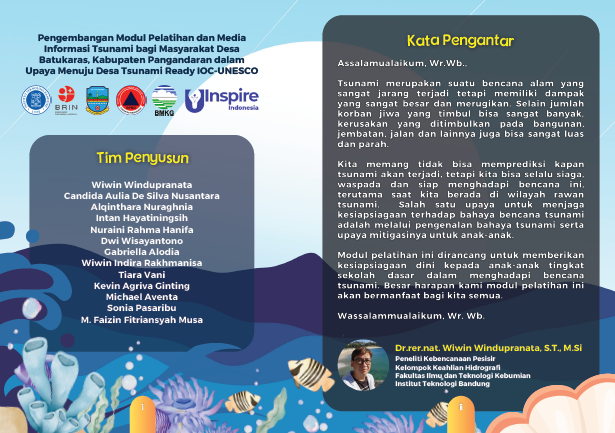
Secara umum modul pelatihan ini berisi tentang pengertian gempa bumi serta kaitannya dengan tsunami. Selain itu, modul pelatihan ini dilengkapi dengan langkah mitigasi yang dapat dilakukan ketika terjadi kedua bencana tersebut.
Di akhir modul pelatihan tersebut, terdapat peta evakuasi bencana dari sekolah hingga tempat evakuasi dan lagu Mitigasi Gempa Tsunami yang merupakan adaptasi lagu “Becak” oleh Ibu Sud.
Pada hari Senin (17/7/2023), Tim PM ITB melakukan kunjungan ke SD Negeri 2 Batukaras untuk mengedukasi siswa SD sekaligus menyerahkan modul pelatihan ini kepada sekolah yang diwakili Kepala Sekolah, Rohana Kudus.
Wiwin berharap modul siap siaga ini dapat semakin meningkatkan pemahaman anak-anak terhadap gempa bumi dan tsunami. “Modul Siap Siaga yang disusun dan dirancang untuk anak-anak ini diharapkan mampu mempermudah pemahaman anak-anak di Desa Batukaras mengenai bencana gempa dan tsunami,” ungkapnya.
“Serta bagaimana upaya mitigasi yang bisa dilakukan sehingga bisa meningkatkan tingkat kesiapsiagaan mereka terhadap bencana gempa dan tsunami,” jelas beliau.
Tsunami merupakan suatu bencana alam yang sangat jarang terjadi, namun dapat menimbulkan dampak yang besar. Kabupaten Pangandaran sendiri mengalami bencana tsunami pada 17 Juli 2006 silam.
Sebagai informasi, pelaksanaan kegiatan pengabdian masyarakat ini bertepatan dengan genap 17 tahun sejak bencana tersebut terjadi.
China lanjutkan upaya mitigasi bencana banjir dan topan
Beijing (ANTARA) – Pihak berwenang China, Sabtu (12/8), mengadakan konferensi video untuk membahas situasi hujan, air, bencana geologis, serta sisa pengaruh Topan Khanun.
Pertemuan itu diselenggarakan Kantor Pusat Pengendalian Banjir dan Bantuan Kekeringan China bersama Kementerian Manajemen Kedaruratan China, serta dihadiri oleh Administrasi Meteorologi China, Kementerian Sumber Daya Air China, dan Kementerian Sumber Daya Alam China.
Pertemuan tersebut menyusun rencana untuk mengantisipasi banjir dan topan, terutama di daerah-daerah utama, seperti Tianjin, Liaoning, Chongqing, dan Shaanxi.
Ketinggian air di sejumlah area di sekitar Sungai Songhua masih tercatat di atas batas peringatan, sedangkan banjir masih terjadi di Cekungan Sungai Haihe.
Sejak Minggu (13/8) hingga Senin, hujan lebat mengguyur wilayah bagian timur laut, barat laut, dan barat daya China, dengan beberapa daerah diperkirakan akan mengalami cuaca konvektif yang parah.
Pertemuan itu mendesak provinsi-provinsi terkait agar meningkatkan patroli, pertahanan, dan tim penyelamat darurat, serta menyelidiki dan menyingkirkan risiko secara ilmiah sekaligus mempercepat perbaikan tanggul.
China masih memberlakukan tanggap darurat level II untuk banjir di Tianjin; tanggap darurat level III untuk banjir di Beijing, Hebei, Heilongjiang, dan Jilin; serta tanggap darurat level IV untuk banjir dan topan di Liaoning.
Tim kerja yang dikerahkan pada tahap awal akan terus membantu langkah-langkah penanggulangan banjir dan topan setempat di daerah-daerah yang disebutkan di atas.
UGM Buka Peluang Kerja Sama dengan Kabupaten Pati dalam Pengembangan Perikanan dan Mitigasi Bencana
Universitas Gadjah Mada membuka peluang kerja sama dengan kabupaten Pati, Jawa Tengah, dalam bidang riset pegembangan perikanan, energi terbarukan, mitigasi bencana dan keberlanjutan program penerjunan mahasiswa KKN-PPM. Hal itu mengemuka dalam pertemuan Wakil Rektor Bidang Kemahasiswaan, Pengabdian kepada Masyarakat dan Alumni UGM, Dr. Arie Sujito, dan anggota Komisi V Senat Akademik UGM dengan Kepala Bappeda Pati, Dr. Muhtar, Selasa (8/8), di kantor Bupati Pati, Kabupaten Pati, Jawa Tengah.
Arie Sujito mengatakan UGM membuka peluang kerja sama dengan berbagai pemda di seluruh Indonesia dalam membangun kolaborasi berbagai bidang dalam rangka mengaktualisasi dan mengimplementasi hasil riset dan pengetahuan dari kampus untuk bisa diaplikasikan di tengah masyarakat. “Upaya UGM membuat kolaborasi dengan pemda, tidak hanya dari perspektif teori, namun banyak laboratorium pengetahuan yang disinergikan dengan kegiatan KKN dan kolaborasi riset,” kata Ari.
Kabupaten Pati menurut Arie Sujito menjadi salah satu daerah strategis dalam pengembangan wilayah pesisir utara Jawa. Banyak potensi yang bisa dikembangkan dan bisa dikerjasamakan antara kedua belah pihak. “Tantangan kita ke depan soal krisis energi dan pangan serta isu lokalitas sehingga diperlukan kerja sama yang kuat antara kampus dan pemda untuk menggali potensi yang bisa dikolaborasikan dan kita tidak ingin kehilangan momentum apalagi UGM memiliki banyak pusat studi,” ujarnya.
Sementara Kepala Bappeda Kabupaten Pati, Dr. Muhtar, mengatakan pemerintah Kabupaten Pati menyambut baik uluran kerja sama yang ingin dilakukan oleh UGM. Pihaknya juga menyampaikan apresiasi atas atensi yang diberikan oleh UGM yang sudah memilih Pati sebagai lokasi kegiatan KKN. Ia menyampaikan bahwa kegiatan KKN di Pati ditempatkan di dua kecamatan yakni Kecamatan Juwana dan Tambakromo. “Keduanya memiliki karakteristik berbeda, Juwana sebagai sentra perkembangan perikanan dan kuningan sedangkan Tambakromo untuk sektor pertanian dengan segenap dinamika permasalahannya,” ujarnya.
Ia menyebutkan di kecamatan Tambakromo sering terkena bencana banjir karena ada luapan sungai dan banjir bandang, Oleh karena itu, ia berharap agar UGM bisa memberikan solusi atas persoalan tersebut. “Kehadiran teman mahasiswa KKN dari UGM bisa mengatasi masalah di Pati dan bisa mengoptimalkan sumber daya dan potensi yang ada di Pati,” jelasnya.
Soal angka kemiskinan dan stunting, Muhtar menyebutkan persentase jumlah penduduk miskin di Pati berada di angka 9,33 persen merupakan angka kemiskinan terendah kesembilan dari 35 Kabupaten/Kota di Jawa Tengah. Sementara untuk jumlah kemiskinan ekstrem sekitar 0,86 persen. Sedangkan persentase stunting mencapai 5,46 persen dari total balita.“Kehadiran mahasiswa KKN atas bimbingan DPL (Dosen Pembimbing Lapangan) bisa berkolaborasi dengan kebijakan dari Kabupaten Pati dalam penanganan kemiskinan ekstrem dan penanganan stunting yang sudah menjadi perhatian pemerintah.
Sedangkan Anggota Komisi V Senat Akademik UGM, Prof. Drs. M. Mukhtasar Syamsuddin, M.Hum., Ph.D., menuturkan tema program kerja KKN-PPM UGM sekarang ini umumnya berkolaborasi dengan pemda yang menyesuaikan dengan kebutuhan daerah.”Dengan orientasi pada kebutuhan daerah, kita bisa memanfaatkan dan mewujudkan capaian program pembangunan strategis daerah sehingga kerja sama ini memberikan manfaat bagi kedua belah pihak,” ujarnya.
Dalam KKN, kata Mukhtasar, pelaksanaan program kerja menekankan pada pendekatan interdisiplin dan multidisplin sebab tidak bisa satu persoalan di masyarakat diselesaikan dengan pendekatan satu disiplin ilmu. “Sekarang ini semua persoalan tidak bisa diselesaikan dengan satu disiplin ilmu sehingga perlu kolaborasi dan sinergi yang efektif serta dilakukan mahasiswa saat di lapangan meski waktunya sangat terbatas,” pungkasnya.
Penulis : Gusti Grehenson
Reportase Webinar Pelatihan dan Pendampingan Penyusunan Dokumen Perencanaan Penanggulangan Bencana di Rumah Sakit (Hospital Disaster Plan/HDP)

Reportase Webinar
Pelatihan dan Pendampingan Penyusunan Dokumen Perencanaan Penanggulangan Bencana di Rumah Sakit (Hospital Disaster Plan/HDP)
{tab title=”Hari 1″ class=”blue”}
Senin, 7 Agustus 2023
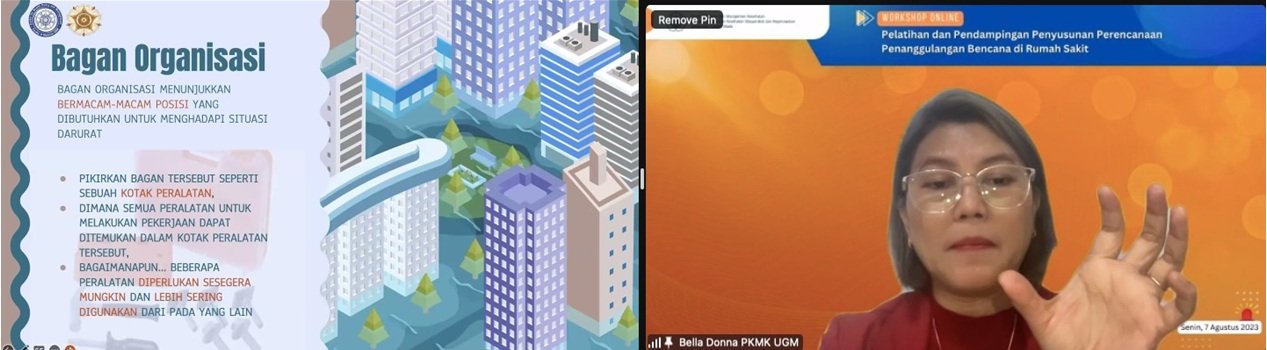
Dok. PKMK FK-KMK UGM “Penyampaian Materi Komponen HDP dan Sistem Pengorganisasian”
PKMK-Yogya. Peserta pelatihan sebanyak 25 orang yang berasal dari RSAB Harapan Kita, RSUD Cibinong, RSU Handayani, RS Immanuel Way Halim, dan RSUD Sumedang. Pertemuan pertama fokus pada review dokumen HDP yang sudah dimiliki rumah sakit dan penyampaian materi tentang komponen HDP dan sistem pengorganisasian. Moderator yang bertugas Happy R Pangaribuan, MPH membuka sesi dengan menyampaikan tujuan dan metode pelatihan dimana masing-masing rumah sakit akan didampingi langsung oleh fasilitator dalam penyusunan dokumen HDP. dr. Hendro Wartatmo, Sp.B-KBD menyampaikan pengantar dan membuka acara dengan menekankan bahwa rumah sakit melalui pelatihan ini dapat menyusun dokumen HDP tidak hanya untuk keperluan akreditasi semata, namun benar-benar menjadi satu dokumen yang operasional dan efektif digunakan rumah sakit saat menghadapi bencana.
Selanjutnya masing-masing rumah sakit menyampaikan dokumen HDP, sistem pengorganisasian saat bencana dan SOP yang sudah ada. Secara keseluruhan rumah sakit sudah memiliki dokumen, namun yang menjadi kendala dan tantangan RS adalah dokumen disusun berdasarkan referensi pencarian dari Google atau rumah sakit lainnya; belum disosialisasikan kepada bidang terkait sehingga isi dokumen belum dapat dengan maksimal serta rotasi pegawai juga menjadi tantangan bagi rumah sakit. Beberapa rumah sakit sudah pernah melakukan simulasi.

Dok. PKMK FK-KMK UGM “Pendampingan Penugasan Penyusunan Pengorganisasian”
dr. Bella Donna, M.Kes menjelaskan apa saja yang dibutuhkan dalam menyusun HDP berdasarkan penilaian akreditasi HDP; komponen HDP, Konsep pengorganisasian ICS dan Kartu Tugas. Penyusunan pengorganisasian saat bencana bukan pembentukan organisasi yang baru tetapi pengembangan organisasi sehari-hari. Bella Donna menampilkan bagaimana pengembangan pengorganisasian tersebut menggunakan metode crosswalk artinya susunan posisi posisi yang memiliki tugas harian yang ditemukan dalam kartu tugas. Misalnya jika dalam tugas sehari-hari berperan untuk mengurus logsitik medis maka pada struktur pengorganisasian bencana juga melakukan tugas manajemen logistik medis. Sistem pengorganisasian menggunakan pendekatan konsep Incident Command System akan membagi habis tugas pada setiap personil, terdapat kejelasan alur komando dan komunikasi serta memungkinkan pengembangan operasi bila diperlukan.
Sesi diakhiri dengan mebagi peserta menjadi 3 room, didampingi oleh narasumber dan fasilitator Madelina Ariani, MPH ; Gde Yulian Yogadhita, Apt, M. Epid ; Happy R Pangaribuan, MPH dan dr. Bella Donna, M.Kes. Dalam ruangan zoom fasilitator dan peserta fokus mengerjakan sistem pengorganisasian dan tupoksi. Pendampingan penyusunan akan berlanjut via jarak jauh dan komunikasi terbangun melalui WhatsApp. Pertemuan selanjutnya akan dilaksanakan pada 18 Agustus 2023.
Reporter : Happy R Pangaribuan, MPH
Div. Manajemen Bencana Kesehatan PKMK FK-KMK UGM
{tab title=”Hari 2″ class=”red”}
Senin, 21 Agustus 2023

Dok. PKMK FK-KMK UGM “Pemaparan materi analisis risiko bencana”
Pertemuan kedua fokus membahas analisis risiko bencana dengan menggunakan tools HSI dan HVA. Namun sebelumnya masing-masing RS menyampaikan bagaimana progress penugasan penyusunan struktur organisasi dan tupoksi, seluruh sesi dimoderatori oleh Gde Yulian Yogadhita, Apt, M.Epid. Rumah sakit menyampaikan beberapa pertanyaan dan hal yang belum dipahami selama menyusun struktur organisasi, diantaranya terkait bagaimana menyusun struktur supaya lebih mudah dipahami pembaca dengan menuliskan jabatan pada struktur organisasi. Perbaikan ke depannya adalah penyusunan tupoksi tersinkronisasi dengan semua bidang yang ada di struktur organisasi, harus jelas siapa melakukan apa dan koordinasi kepada siapa. Terkait pelimpahan wewenang untuk komandan dan penanggung jawab masing-masing bidang bisa dilakukan sampai 3 layer, namun tetap tergantung pada kapasitas rumah sakit. Pematangan penyusunan struktur organisasi masih berlanjut melalui pendampingan jarak jauh dengan fasilitator.
Pada sesi analisis risiko Madelina Ariani, MPH mengawali materi dengan menekankan kembali mengapa dokumen HDP ini penting untuk disusun dan bagaimana analisis risiko menjadi satu komponen penting yang harus dihitung dan dituliskan dalam dokumen. Melalui analisis risiko, rumah sakit akan mendapatkan jenis bencana yang menjadi prioritas penanganan bencana, yang menjadi prioritans untuk pengembangan skenario dan perhitungan kapasitas kebutuhan penanganan bencana tersebut. Banyak tool yang dapat digunakan untuk analisis risiko bencana di rumah sakit diantaranya tools Hazard and Vulnerability Asseement (HVA) dan Hospital Safety Index (HSI). Kedua tools tersebut tujuannya sama untuk menganalisis risiko bencana apa yang menjadi prioritas penanganan. Pada modul 4 form checklist HSI mengidentifikasi manajemen emergensi dan bencana, modul inilah yang menjadi komponen atau penting dimasukkan dalam dokumen hospital disaster plan. Madelina Ariani, menjelaskan tabel ceklist HSI dan bagaimana cara menghitungnya.

Dok. PKMK FK-KMK UGM “Pendampingan penugasan Analisis Skenario”
Sesi diakhiri dengan membagi peserta menjadi 3 room, didampingi oleh narasumber dan fasilitator Madelina Ariani, MPH ; Gde Yulian Yogadhita, Apt, M. Epid ; Happy R Pangaribuan, MPH dan dr. Bella Donna, M.Kes. Dalam ruangan zoom ,fasilitator memberi kesempatan kembali untu peserta review singkat revisi penugasan struktur pengorganisasian, dilanjutkan dengan menampilkan HVA dan HSI yang sudah pernah dihitung rumah sakit. Pendampingan penyusunan akan berlanjut via jarak jauh dan komunikasi terbangun melalui WhatsApps, diharapkan rumah sakit selesai dulu mengerjakan penugasan struktur pengorganisasian, tupoksi kemudian melanjutkan penugasan analisis risiko.
Reporter : Happy R Pangaribuan, MPH
Div. Manajemen Bencana Kesehatan PKMK FK-KMK UGM
{/tabs}
Senin, 21 Agustus 2023

Dok. PKMK FK-KMK UGM “Pemaparan materi analisis risiko bencana”
Pertemuan kedua fokus membahas analisis risiko bencana dengan menggunakan tools HSI dan HVA. Namun sebelumnya masing-masing RS menyampaikan bagaimana progress penugasan penyusunan struktur organisasi dan tupoksi, seluruh sesi dimoderatori oleh Gde Yulian Yogadhita, Apt, M.Epid. Rumah sakit menyampaikan beberapa pertanyaan dan hal yang belum dipahami selama menyusun struktur organisasi, diantaranya terkait bagaimana menyusun struktur supaya lebih mudah dipahami pembaca dengan menuliskan jabatan pada struktur organisasi. Perbaikan ke depannya adalah penyusunan tupoksi tersinkronisasi dengan semua bidang yang ada di struktur organisasi, harus jelas siapa melakukan apa dan koordinasi kepada siapa. Terkait pelimpahan wewenang untuk komandan dan penanggung jawab masing-masing bidang bisa dilakukan sampai 3 layer, namun tetap tergantung pada kapasitas rumah sakit. Pematangan penyusunan struktur organisasi masih berlanjut melalui pendampingan jarak jauh dengan fasilitator.
Pada sesi analisis risiko Madelina Ariani, MPH mengawali materi dengan menekankan kembali mengapa dokumen HDP ini penting untuk disusun dan bagaimana analisis risiko menjadi satu komponen penting yang harus dihitung dan dituliskan dalam dokumen. Melalui analisis risiko, rumah sakit akan mendapatkan jenis bencana yang menjadi prioritas penanganan bencana, yang menjadi prioritans untuk pengembangan skenario dan perhitungan kapasitas kebutuhan penanganan bencana tersebut. Banyak tool yang dapat digunakan untuk analisis risiko bencana di rumah sakit diantaranya tools Hazard and Vulnerability Asseement (HVA) dan Hospital Safety Index (HSI). Kedua tools tersebut tujuannya sama untuk menganalisis risiko bencana apa yang menjadi prioritas penanganan. Pada modul 4 form checklist HSI mengidentifikasi manajemen emergensi dan bencana, modul inilah yang menjadi komponen atau penting dimasukkan dalam dokumen hospital disaster plan. Madelina Ariani, menjelaskan tabel ceklist HSI dan bagaimana cara menghitungnya.

Dok. PKMK FK-KMK UGM “Pendampingan penugasan Analisis Skenario”
Sesi diakhiri dengan membagi peserta menjadi 3 room, didampingi oleh narasumber dan fasilitator Madelina Ariani, MPH ; Gde Yulian Yogadhita, Apt, M. Epid ; Happy R Pangaribuan, MPH dan dr. Bella Donna, M.Kes. Dalam ruangan zoom ,fasilitator memberi kesempatan kembali untu peserta review singkat revisi penugasan struktur pengorganisasian, dilanjutkan dengan menampilkan HVA dan HSI yang sudah pernah dihitung rumah sakit. Pendampingan penyusunan akan berlanjut via jarak jauh dan komunikasi terbangun melalui WhatsApps, diharapkan rumah sakit selesai dulu mengerjakan penugasan struktur pengorganisasian, tupoksi kemudian melanjutkan penugasan analisis risiko.
Reporter : Happy R Pangaribuan, MPH
Div. Manajemen Bencana Kesehatan PKMK FK-KMK UGM
Reportase Pelatihan Potensi Pembentukan Emergency Medical Team (EMT) AHS UGM untuk Mendukung Kebijakan Tenaga Cadangan Kesehatan (TCK)

Reportase
Pelatihan Potensi Pembentukan Emergency Medical Team (EMT) AHS UGM untuk
Mendukung Kebijakan Tenaga Cadangan Kesehatan (TCK)
{tab title=”Hari 1: 2 Agustus 2023″ class=”blue”}

Dok. Pokja Bencana FK-KMK UGM: pembukaan oleh Dekan FK-KMK UGM
PKMK – Fakultas Kedokteran, Kesehatan Masyarakat, dan Keperawatan Universitas Gadjah Mada bersama jejaring Academic Health System (AHS) Universitas Gadjah Mada mengadakan Pelatihan “Potensi Pembentukan Emergency Medical Team (EMT) AHS UGM untuk Mendukung Kebijakan Tenaga Cadangan Kesehatan (TCK)” pada 2-3 Agustus 2023 di Ruang Diskusi Lantai 2 Gedung Tahir Foundation FK-KMK UGM.
Pada hari pertama (2/8), dilakukan pembukaan acara oleh Dekan FK-KMK UGM, dr. Yodi Mahendradhata, M.Sc., Ph.D., FRSPH. Yodi menyampaikan ungkapan terima kasih atas kehadiran perwakilan jejaring AHS UGM dalam forum kali ini dan mengajak seluruh komponen menyambut baik kebijakan Tenaga Cadangan Kesehatan (TCK) yang telah dicanangkan pemerintah untuk penanggulangan bencana dan krisis kesehatan melalui transformasi sistem kesehatan pasca pandemi. Harapannya, tim medis AHS UGM yang selama ini selalu hadir pada kejadian bencana dapat terdata dengan baik, dapat bekerjasama dan bekerja dengan standar yang sama untuk masing-masing personal dalam respon kebencanaan. Oleh karena itu, melalui Pokja Bencana FK-KMK UGM, program peningkatan kapasitas anggota AHS yang terdiri dari rumah sakit dan dinas kesehatan di DIY dan Jawa Tengah ini dilakukan.
Materi pertama disampaikan oleh dr. Hendro Wartatmo, Sp.B-KBD dengan judul Sepak Terjang AHS UGM dalam Bencana. AHS UGM telah terlibat dalam penanggulangan bencana sejak 2018 di Gempa Lombok, disusul sebulan kemudian gempa, tsunami, dan likuifaksi Sulawesi Tengah, dan di akhir tahun terjadi tsunami Selat Sunda yang melanda Kabupaten Lampung Selatan dan Banten, kemudian ada respon erupsi Semeru hingga Gempa Mamuju dan Kabupaten Cianjur. Jika ke depannya akan memperbaiki kerjasama dan tata kerja, maka tetap ada tim medis dan manajemen yang akan dikuatkan ke depannya. AHS UGM tidak akan membentuk satu tim khusus dari rumah sakit, tetapi masing-masing rumah sakit sudah mendata kesiapan timnya sehingga kapanpun terjadi bencana sudah siap untuk digabungkan dengan tim dari rumah sakit lain dan universitas atas nama AHS UGM.
Sejalan dengan tekad AHS UGM untuk dapat memperbaiki alur penerjunan tim penanggulangan bencana, Pusat Krisis Kebencanaan Kementerian Kesehatan RI hadir menjelaskan kebijakan terbaru, yakni terkait Tenaga Cadangan Kesehatan (TCK). Konsep TCK, ungkap Dr. Sumarjaya, SKM, MM,MFP, C.F.A, tidak seperti tim cadangan dalam sepak bola. TCK dimaksudkan untuk memaksimalkan potensi existing resources dan mengakomodir bantuan kemanusiaan dari berbagai pihak dan elemen masyarakat agar tepat sasaran, tertata, dan inklusif.
Puskris Kemenkes RI kemudian juga menjelaskan alur pendaftaran TCK, sistem dashboard TCK dan situasi kondisi sebaran TCK saat ini. Meski masih dalam tahap pengembangan, laman TCK diharapkan dapat menjadi rujukan bank data sumber daya nasional. Sehingga, cita-cita membentuk National Command Center yang ideal dapat tercapai. Dinas Kesehatan Kota Yogyakarta menanggapi dengan usulan agar akses kepada bank data juga dapat diberikan kepada masing-masing pemangku kebijakan di daerah.

Dok. Pokja Bencana FK-KMK UGM: situasi kelas saat diskusi
Sutono, S.Kp., M.Sc., M.Kep melanjutkan dengan penjelasan terkait persiapan dalam penerjunan Emergency Medical Team (EMT). AHS UGM telah banyak berpengalaman dalam penerjunan tim dalam misi bencana. Namun, tim yang dikirimkan selalu bersifat insidentil dan tidak dipersiapkan secara kontinu, sehingga mindset yang terbentuk ketika tim terjun selalu berbeda. Dalam paparan, beliau menjelaskan terkait perbedaan jenis dan kelas EMT berdasarkan WHO maupun peraturan nasional.
Salah satu luaran utama pelatihan ini untuk dapat membentuk EMT tingkat 1 tipe Menetap (fixed-type 1 EMT). Selama jangka waktu 5 tahun hingga 2027, direncanakan akan dilakukan pelatihan intensif kepada 10 rumah sakit jejaring AHS UGM secara bertahap dan bergiliran. Sesuai kesiapan masing-masing rumah sakit dan rencana pelaksanaan dari dana hibah milik AHS UGM. Pelatihan akan melibatkan tim Pokja Bencana FK-KMK UGM dengan para pakarnya yang telah banyak berkiprah di bidang ini.
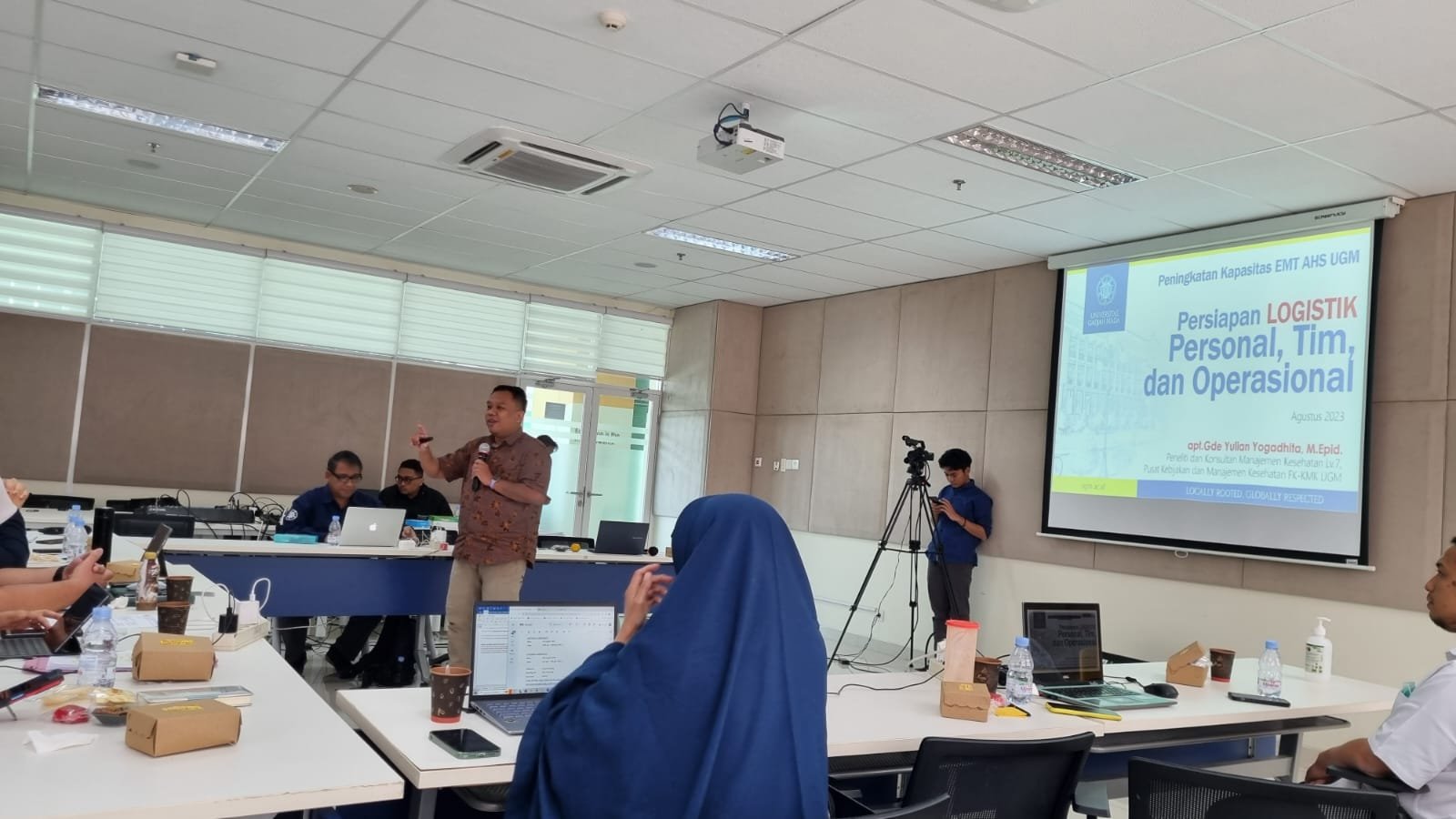
Dok. Pokja Bencana FK-KMK UGM: Gde Yulian sedang menyampaikan materi
Selanjutnya, dijelaskan mengenai persiapan logistik EMT yang disampaikan oleh Gde Yulian Yogadhita, Apt., M.Epid. Tidak seperti dugaan umum, logistik EMT yang pertama kali harus dipastikan justru logistik non medis yang berkaitan dengan individu, tim dan operasional. Untuk dapat membentuk EMT berstandar internasional, bahkan dibutuhkan 3 tahun dalam memenuhi prinsip keselamatan dan keamanan dalam penerjunan EMT. Beliau menyebutkan, bahwa prinsip persiapan logistik telah dijelaskan di dalam pedoman milik Puskris Kemenkes RI dan harus disiapkan secara matang dan seksama. Titik berat ini akan menjadi salah satu konten utama pelatihan berkesinambungan dalam pembentukan EMT AHS UGM.
Sebagai penutup pelatihan hari pertama, Madelina Ariani, SKM., MPH., mengajak rekanan rumah sakit jejaring AHS UGM menilai potensi dan kapasitas EMT masing-masing rumah sakit dengan kuesioner yang telah dibuat. Dari asesmen yang dilakukan, diharapkan rumah sakit jejaring mengetahui dan memahami kondisi EMT yang dimiliki. Tim pelatih juga akan menggunakan hasil asesmen untuk stratifikasi kesiapan EMT dari 10 rumah sakit jejaring, dan melakukan penjadwalan pelatihan bertahap bergiliran hingga 2027 mendatang.
Kegiatan ini diteruskan pada sesi kedua, 3 Agustus 2023, yang akan lebih membahas permasalahan teknis operasional EMT.
Reportase oleh dr. Alif Indira dan Madelina A.
{tab title=”Hari 2: 3 Agustus 2023″}

PKMK – FK-KMK UGM bersama jejaring AHS UGM kembali melanjutkan kegiatan pelatihan hari kedua (3/8/2023) bertempat di Ruang Diskusi Lantai 2 sisi Utara Gedung Tahir Foundation, FK-KMK UGM. Berbeda dengan hari pertama, kali ini kegiatan pelatihan berisi tentang hal-hal teknis terkait Emergency Medical Team (EMT).
Materi pertama, disampaikan oleh dr. Bella Donna, M.Kes dengan materi “Aktivasi HEOC (Health Emergency Operation Center/ Pusat Pengendali Operasi Kesehatan) dan Kaitannya dengan EMT”. Klaster kesehatan adalah pusat tempat koordinasi dan manajemen seluruh komponen kesehatan dalam situasi bencana. Pembentukan klaster kesehatan telah dilakukan sebelum ada bencana. Aktivasi klaster kesehatan dilakukan pada masa respon bencana. Salah satu tugas klaster sebagai HEOC/Pusdalopskes yang menjalankan fungsi komando, kolaborasi, koordinasi, dan pemberi layanan pada situasi bencana. EMT yang hadir dari berbagai latar belakang bekerja pada subklaster pelayanan kesehatan dan melayani secara klinis. Penempatan EMT akan diatur oleh HEOC, setelah melakukan pelaporan dan pendaftaran. Selesai melaksanakan tugasnya, EMT harus melakukan laporan kepada HEOC. Dalam menjalankan tugasnya, EMT harus sesuai dengan TUPOKSI dan SOP yang terstandar.
Saat EMT hadir ke lokasi bencana, terkadang belum memahami alur dan berkas-berkas yang harus disiapkan. Sesi pelatihan dilanjutkan dengan pengenalan formulir EMT dan HEOC oleh Madelina Ariani, S.KM., MPH. Formulir EMT terbagi menjadi 3; yakni formulir kedatangan, operasi harian, dan kepulangan. Sedangkan formulir HEOC terdiri dari formulir penerimaan relawan, formulir layanan kesehatan, formulir logistik, dan sub-sub klaster. Tujuan keberadaan formulir ini adalah agar segala kegiatan, personil yang ada, dan logistik yang dibawa atau digunakan dapat terdata dan terdistribusi dengan baik serta terlaporkan ke HEOC yang mengatur kegiatan penanggulangan bencana di daerah. Peserta dikenalkan dengan form-form ini agar mengetahui fungsi dan manfaatnya, serta memudahkan pada saat pengisian serta pembagian tugas analisis serta pelaporan pada saat dilapangan.
Setelah memahami konsep EMT dan HEOC, forum diajak untuk sedikit mundur ke belakang, yakni momen sebelum hadir ke lokasi bencana dan merencanakan penerjunan tim. Momen tersebut merupakan “Rapid Health Assessment” yang materinya dituturkan oleh dr. Agung, Widianto, Sp.B-KBD. RHA adalah kegiatan mengumpulkan, mengolah, serta menganalisa data yang dilakukan secara langsung di lokasi bencana dengan tujuan menilai permasalahan kesehatan, potensi risiko, kebutuhan kesehatan, dan membuat rekomendasi dalam rangka respon cepat penanggulangan krisis kesehatan. RHA harus dilakukan setelah terdapat informasi kejadian bencana, sebelum merencanakan pengiriman EMT. RHA menjadi langkah krusial yang penting diperhatikan. Tidak hanya itu, RHA juga menjadi tugas lain dari EMT dalam membantu memotret masalah kesehatan masyarakat di lapangan dan menyampaikannya kepada HEOC.
Materi sesi siang, dibuka dengan “Persiapan Kepulangan EMT dan Manajemen Post Penugasan” yang disampaikan oleh dr. R. Wahyu Kartiko Tomo, Sp.B. Ketika telah menyelesaikan misi, diperlukan persiapan exit report dan dokumentasi pasca kegiatan. Prinsip EMT yang hadir bukan sebagai pengganti tapi membantu tim yang sudah ada, maka exit report harus dapat disampaikan ke fasilitas kesehatan setempat untuk rencana pelayanan selanjutnya. Dokumen tersebut, di sisi lain, juga dapat dijadikan pembelajaran dan evaluasi atau perbaikan tim ke depannya. Tomo menambahkan, hingga saat ini masih minim penelitian kebencanaan padahal impact yang dihasilkan bisa besar. Sehingga beliau mendorong penulisan dokumen pasca bencana menjadi suatu karya ilmiah yang dapat dipublikasikan. Tomo juga menyoroti soal perkembangan teknologi informasi dan komunikasi yang ke depan akan banyak membawa perubahan dalam manajemen bencana.
Sesi terakhir, diisi oleh dr. Yudha Mathan Sakti, Sp.OT(K)., mengenai “Penyusunan Rencana Operasi Harian EMT”. Sebelum menerjunkan tim, hal paling penting yang disiapkan adalah asesmen yang bagus. Data yang didapatkan harus dapat divalidasi dengan baik. Prinsip persiapan operasi EMT antara lain; (1) mengerti mau melakukan apa, (2) aplikasi, (3) exit plan, (4) refleksi. Persiapan diri, logistik medis dan non medis, rencana operasional harian, bahkan surat penugasan menjadi penting. Jangan sampai tim yang terjun tidak bisa mandiri, karena apa pun yang dihadapi, tim tidak boleh bergantung pada lingkungan yang ada. Yudha menyatakan, “Satu-satunya hal yang boleh kita minta saat di situasi bencana adalah pekerjaan”.
Pelatihan ditutup dengan post test dan sesi foto bersama. Tim Pokja Bencana PKMK FK-KMK UGM juga mengumumkan bahwa tindak lanjut pelatihan adalah penguatan EMT rumah sakit jejaring AHS UGM yang dilakukan secara bertahap dan akan dimulai dari RSUP dr. Soeradji Tirtonegoro Klaten dan RSUD Wates yang mengajukan diri untuk didampingi secara intensif ke depannya.
Reportase oleh dr. Alif Indira dan Madelina A.
{/tabs}