Skip to content

Category: Berita Internasional

Senate advances $36.5 billion disaster relief package

https://media.salon.com/2017/09/puerto-rico10.jpg

The Senate on Monday gave a preliminary OK to a $36.5 billion hurricane relief package that would provide Puerto Rico with a much-needed infusion of cash and keep the federal flood insurance program from running out of money to pay claims.

The 79-16 procedural vote set the stage for a final vote, most likely on Tuesday.

The measure also provides $18.7 billion to replenish the Federal Emergency Management Agency’s rapidly dwindling emergency disaster accounts. On Monday, FEMA announced more than $500 million in aid to Puerto Rico, including $285 million to help restore power and water services to the devastated island. An additional $16 billion would permit the financially troubled federal flood insurance program to pay an influx of Harvey-related claims.

But the bill rejects requests from the powerful Texas and Florida congressional delegations for additional money to rebuild after hurricanes Harvey and Irma. Florida Democrat Bill Nelson, whose state’s citrus industry endured significant losses during Irma, sought to add $3 billion in immediate agriculture assistance to the measure, but was denied by Majority Leader Mitch McConnell, R-Ky., who said money for crop losses would be in subsequent aid measures.

Senate passage on Tuesday would send the measure to President Donald Trump for his signature.

There was urgency to move the measure swiftly — rather than add more money to it at this time — because the government’s disaster response and flood insurance reserves are running out. Democrat Sen. Patrick Leahy of Vermont said that would happen “in a matter of days” without action.

Still, members of the Texas and Florida delegations in Congress are unhappy because the measure failed to address extensive requests for additional hurricane rebuilding money. Texas, inundated by Harvey in August, requested $19 billion, while Florida sought $27 billion.

“I’m pretty disappointed with what the House sent over,” Texas GOP Sen. John Cornyn said last week. But later, after speaking to both Trump and White House budget director Mick Mulvaney, Cornyn said he was promised that the White House would issue another disaster aid measure next month for Texas, Florida and Puerto Rico. A fourth, and perhaps final, measure is likely to anchor a year-end spending bill.

“The victims of these hurricanes can continue to count on our support,” McConnell said.

Up to $5 billion of the measure’s total could be used to assist Puerto Rico’s central government and various municipalities that are suffering unsustainable cash shortfalls as Maria has choked off revenues and strained resources. An additional $150 million would help Puerto Rico with the 10 percent match required for FEMA disaster relief.

5 former presidents call for unity at hurricane relief concert in Texas

More than one-fourth of the island’s residents don’t have potable running water and only 17 percent have electricity, according to FEMA. Just 392 miles of Puerto Rico’s 5,073 miles of roads are open. Conditions in the U.S. Virgin Islands are bad as well, with widespread power outages.

But Trump last week graded his response to the Puerto Rico disaster a 10 on a scale of 10.

“President Trump seems more concerned about claiming credit for a job well done than the actual situation on the ground deserves, particularly in Puerto Rico,” Leahy said. “This is the hard part of governing,” he added. “We dig in for the long haul, we stop patting ourselves on the back.”

The measure currently before the Senate contains $577 million for wildfires in the West that forced agencies to tap other reserves for firefighting accounts and FEMA money.

Republicans delayed action last year on modest requests by President Barack Obama to combat the Zika virus and help Flint, Mich., repair its lead-tainted water system. But they are moving quickly to take care of this year’s alarming series of disasters, quickly passing a $15.3 billion relief measure last month and signaling that another installment is coming next month.

Damage is still being assessed and final cost estimates for recovering and rebuilding from this year’s hurricane season are not in yet. Some House conservatives are becoming restive at the high price tag for the disasters, which come as the deficit is growing.

Managing mental health in the midst of disaster

An inmate firefighter monitors flames as a house burns in the Napa wine region in California on October 9, 2017, as multiple wind-driven fires continue to whip through the region. 

After a disaster, a major network of disaster counselors and mental health professional spring into action. Their task? Aid people with the sometimes long and invisible recovery that takes place following a traumatic event.

It could be after a natural disaster, like a hurricane or wildfire. Or a tragedy, like a mass shooting or crime. Either way, there’s an important personal recovery that needs to take place — and people whose job it is to help.

Psychologist James Halpern was a first responder at both 9/11 and the Sandy Hook school shooting, which left 20 children dead. He’s co-author of the book “Disaster Mental Health Interventions: Core Principles and Practices.” He’s also a professor emeritus and founding director of the Institute for Disaster Mental Health at SUNY New Paltz.

Halpern joined Marketplace Weekend host Lizzie O’Leary to talk about the role of mental health professionals following a disaster.Below is an edited transcript of the conversation.

Lizzie O’Leary: We are reflecting on the five year anniversary of the Sandy Hook shooting. That’s something you responded to. Can you walk us through what happens as a mental health first responder? You know, in that case what do you do?

James Halpern: I was with the families on the second day of the event. There was considerable fear and considerable chaos. We tried to provide some calm and safety. But they also asked us questions like, “How could this have happened to me? How could this have happened to my wonderful child?” And those are not real questions for us counselors. Those are cries or laments. What we can do is offer kindness and compassion and support. But some of the questions they asked, which had to do with how they supported their other children, were real questions. About whether or not the kids could watch these events on TV. And the answer is no. Whether or not it was good for those young children to be interviewed by the press. The answer is no. So, some combination of what might be considered crisis counseling and compassion and support.

O’Leary: What sort of disasters have you responded to and do people like you respond to?

Halpern: Sorry I’m laughing, but yeah, I mean disasters are so common and getting more common, it seems. You know, the United States, people don’t appreciate, has the most extreme weather in the world. So in addition to the kind of floods and fires that are most typical, we have a hurricane season. We have a tornado season. We have a wildfire season that seems to be expanding. Of course, we’ve got earthquakes, explosions, transportation accidents, plane crashes, epidemics, anything that involves considerable human suffering beyond a person.

O’Leary: Listening to the breadth of what you’re talking about, what does it cost to provide mental health care for so many people in such a variety of situations? And who pays for that? 

Halpern: In the early stages of disaster, crisis counseling is typically free. There are 5,000 mental health professionals deployed around the country by the Red Cross. These are psychologists, social workers, mental health counselors, who give up their time and energy to provide that kind of pro bono service. There’s also county, state, federal workers who, similarly, can be at shelters or family assistance centers. Now, over time some significant minority can develop long-term symptoms. And those folks are treated by professionals with health care, Medicare, Medicaid, private insurance. And depending on the nature of the disaster it can be supported by the federal government. For instance, if the disaster was a crime, like the Las Vegas shooting or 9/11, then there’s support from crime victims services for long-term care.

O’Leary: You know, I’m thinking about Puerto Rico. I just came back from a trip reporting on the island and that’s a place with significant devastation. I would imagine that the kinds of mental health services required over time change dramatically as we move farther out from the event itself.

Halpern: Most folks experience significant but transient symptoms. They’re OK and don’t need that long-term help. On the other hand, there’s some considerable research from the gulf oil spill where it leads to long-term economic dislocation, job loss. You see significant depression that needs to be addressed.

O’Leary: There’s a study from the National Institute of Mental Health that says it would have cost about $12.5 billion to provide what they call “comprehensive mental health care for 24 months” to the people affected by Hurricanes Katrina and Rita. Make the economic argument for me, the cost benefit analysis, of why that money is worth spending on mental health.

Halpern: These are disaster survivors who certainly bear no blame for being in the middle of these kinds of events. They are suffering. There is job loss. And those treatments work. We can reduce, then, long-term problems in substance abuse, in family violence, and family conflict, and individual suffering. There’s enormous benefit that we get when people are functioning effectively.

O’Leary: Do you think as a country we have made any collective strides in understanding that mental health is something worth spending money on?

Halpern: I think there is much less stigma now. It can be a struggle to find resources to cover those invisible wounds. I think easier, probably, to find resources for injuries and illnesses than for those invisible scars.

O’Leary: Is it hard to find the people who need help, after all a disaster can scatter survivors all over the place?

Halpern: Yes. I think that we could do better at providing more comprehensive screening, which would not be very costly. And there are, in fact, check lists where we can identify folks who are likely to have serious mental health problems.

O’Leary: What’s the impact on the people who do this work? I would imagine this is not easy.

Halpern: There are of course the obvious physical hazards. But for all responders, including mental health counselors, there’s listening to stories of trauma repeatedly, which can result in compassion fatigue. Or burnout. Or vicarious trauma, that you can begin to feel traumatized yourself just by hearing those stories secondhand. And, again, I think that that puts all responders at risk, and why it’s so important for all of those responders, and all of us as counselors to have very careful self care plans.

Debts add to disaster for climate-hit nations

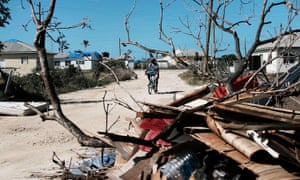
Antigua and Barbuda after Hurricane Irma.

For many countries impacted by the negative impacts of climate change, much more money is leaving in debt payments than they receive in grants to cope with climate impacts (Theresa May: It’s Britain’s duty to help nations hit by climate change, 12 December).

Even before this autumn’s devastating hurricanes, Caribbean countries were suffering under unsustainable debts caused by the legacy of colonialism, unjust trade rules, harsh austerity measures imposed in return for bailouts, and past disasters. Now countries such as Antigua and Barbuda, and Dominica, are expected to keep paying debts while struggling to rebuild.

One of the main “solutions” proposed to this cycle of climate-induced disasters and indebtedness is climate risk insurance. This fundamentally unjust measure places the financial burden of climate impacts on people who have done the least to cause the problem of climate change, while ensuring that creditors keep being paid in the event of climate disasters. Instead, debt cancellation is needed to make debts sustainable, and all assistance to adapt to – and rebuild from – climate disasters must be in the form of grants, not loans.
Sarah-Jayne Clifton
Director, Jubilee Debt Campaign

Theresa May’s article failed to explain how the fight to limit climate change is helped by fracking, by the building of Hinckley Point with its absurd overpricing of the cost of each unit of electricity (another example of Conservatives milking citizens to benefit commerce), by the third runway at Heathrow or by her government’s refusal to include environmental costs in the calculation of the value of gross national product, another example of said welfare state.

Her stock answer to demands for more being spent on (for example) the NHS is that increased interest payments on borrowing cannot be borne because they will prejudice future generations, yet the threat to future generations from the effects of climate change is immeasurably greater. Moreover, May has no qualms in leaving future generations with the burden of guarding spent nuclear fuel for hundreds of years. The inadequacy of her policies is plain.
Ian Tysh
Wealden Green party, East Sussex

Flooding persists in 7 southern provinces

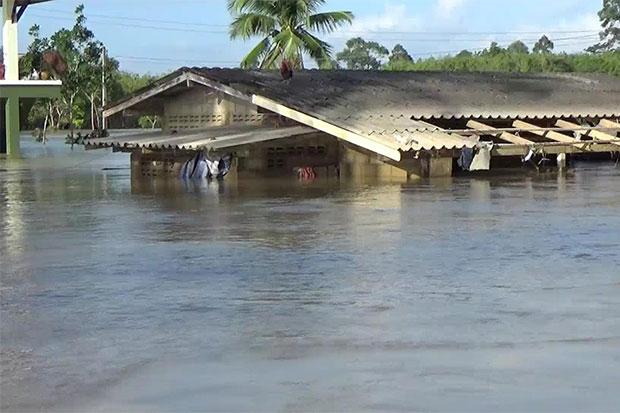
Floods persist in seven southern provinces, with more than 900,000 people affected by inundations that have resulted in 22 deaths over the past 15 days.

The northeastern monsoon that began on Nov 25 has brought flooding to 11 southern provinces: Pattani, Yala, Songkhla, Phatthalung, Trang, Satun, Chumphon, Narathiwat, Nakhon Sri Thammarat, Surat Thani and Krabi, 

The floods, which have claimed 22 lives so far, still persist in seven provinces, with 903,603 people from 3,077 villages in 56 districts enduring hardship, Chayapol Thitisak, director-general of the Department of Disaster Prevention and Mitigation, said on Saturday.

The seven provinces are Pattani, Songkhla, Phatthalung, Trang, Chumphon, Nakhon Sri Thammarat and Surat Thani, he said.

In Pattani, Nong Chik and Muang districts are still inundated. In Songkhla, the affected areas are Sathing Phra, Khuan Niang, Singha Nakhon, Krasae Srin, Bang Klam and Ranot districts. In Phatthalung, Khuan Khanun, Sri Banphot, Sri Nakharin, Kong Ra, Pak Phayun, Pa Phayom, Pa Bon, Khao Chaison, Bang Kaew and Tamot are affected.

In Trang, Muang, Na Yong, Wang Wiset, and Kantang districts are still inundated. In Chumphon, flooding remains in Lamae, Muang, Thung Tako, Pathiu, Phato, Sawi and Lang Suan.

In Nakhon Sri Thammarat, water levels remain high in eight districts: Cha-uat, Bang Khan, Chian Yai, Chulabhorn, Thung Song, Pak Phanang, Sichon, Na Bon, Chawang, Nop Phi Tham, Hua Sai, Chalerm Prakiat, Phommakhiri, Thung Yai, Chang Klang, Ron Phibun, Tha Sala and Tham Phannara.

In Surat Thani, seven districts — Phrasaeng, Wiang Sa, Khian Sa, Ban Na San, Ban Na Doem, Phunphin and Don Sak — are flooded.

Fire and fear stretch across Southern California as wildfires roar from Ventura to San Diego

CARPINTERIA, Calif. — Fire continued to tear across Southern California on Thursday, surrounding communities and shrouding much of the region in searing flame and thick, choking smoke.

And where there was no fire, there was fear.

Fear of what could come next as wildfires ravaged the state for a fourth day. Fear of what could happen if the winds shifted, if the flames moved, if new blazes erupted and were strengthened by the powerful gusts already fueling the infernos burning across the region.

Tens of thousands of people fled their homes, running from fires without any idea of when they could return or what they might find when they do. They grabbed pets, clothes and mementos before hurrying off in search of shelter.

Veteran firefighters described the blazes as unlike anything they had ever encountered. Thousands of firefighters and other first responders fanned out to save lives, protect homes and shepherd people to safety, joined by reinforcements that flocked in from other parts of the country.

Authorities had not reported any deaths due to the blazes by Thursday, but they spoke bluntly about the danger that remained through week’s end. While the most severe winds are forecast to slacken Friday and Saturday, lessening the fire danger some, the National Weather Service cautions the risk of fires will remain elevated through Sunday as conditions remain abnormally dry and breezy.

“We are a long way from being out of this weather event,” Ken Pimlott, director of Cal Fire, said at a briefing Thursday. “In some cases, the worst could be yet to come in terms of the wind.”

The National Weather Service warned that if new fires do begin, “very rapid spread and extreme fire behavior is likely.” Blazes began Thursday across Southern California, including one in San Diego County, where the Lilac Fire grew to 1,000 acres in just a few hours and prompted mandatory evacuations. Officials warned it was growing dangerously fast and said it threatened 1,000 structures and had damaged some others.

The massive Thomas Fire, the state’s biggest active blaze, burned across 150 square miles in Ventura County on Thursday. The blaze “continues to burn actively with extreme rates of spread,” authorities warned.

Flames from that fire surrounded Ojai, the popular winter retreat that is home to about 8,000 people, on Thursday morning, officials said. Most of the Ojai Valley had been placed under a mandatory evacuation order.

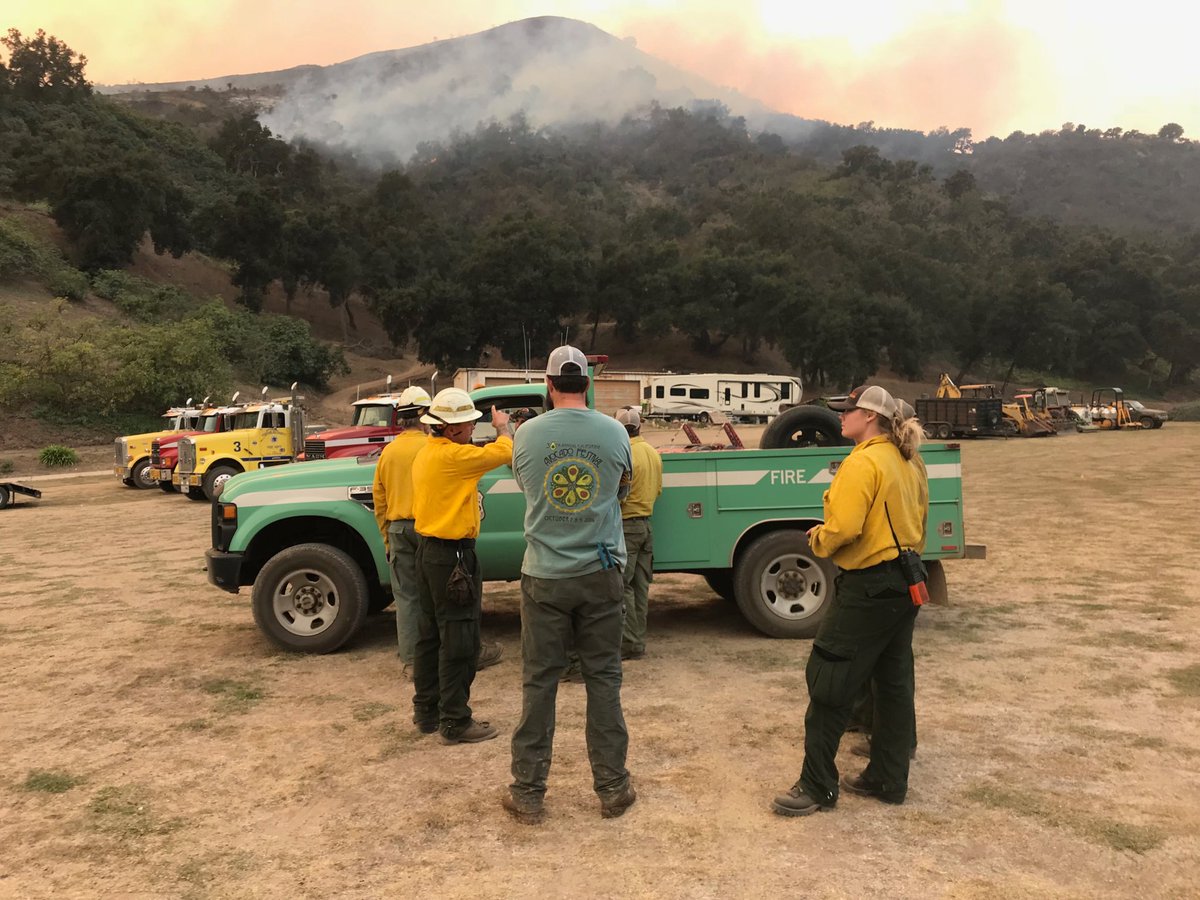
More than 100 firetrucks from several states had parked at the Ventura County Fairgrounds, firefighters standing or sitting aside their equipment as they took breaks from battling fires in nearby Ojai the night before, winds whipping in off the ocean as they rested.

“This breeze is nothing,” said Shane Nollsch, who had traveled from Lyon County, Nev., arriving at 3 a.m. Wednesday. “Yesterday, you had to chew the air before you breathed it.”

Chris Mason, a firefighter from Carson City, Nev., said those who came to help had to adjust to different terrain and a new environment. Different winds. Different fuels.

“It’s a sharp learning curve,” Mason said. “Fire is coming down the mountain at you, especially at night, when it’s hard to see and you don’t know where the streets are.”

La Conchita, a tiny town hard against coastal Highway 101 northwest of Ventura, was threatened by flames early Thursday. The town most commonly faces danger from mudslides, but those same cliffs that give way with rain are now a rich “fuel bed” for the wildfires. Fire crews managed to keep the blaze from the town’s edge, but new lines, fanned by off-shore winds, remained a peril.

That blaze — the Thomas Fire — extended dozens of miles from near Santa Paula in Ventura County to the edge of Carpinteria, a city of 13,000 people, a stiffening wind posing the most threat. Gusts picked up flames low on coastal mountain slopes and drove them up and over hills toward several towns along the Pacific Ocean.

Santa Barbara County began urging evacuations, ordering hundreds of people to leave areas along the Pacific Ocean between the larger cities of Santa Barbara and Ventura.

Along Rincon Mountain Road a few miles south of Carpinteria, fire crews fought several lines of flames overnight Wednesday and throughout Thursday, focused on protecting homes and ranches. A dozen Ventura County fire engines staged along the road near midday, the fire burning in the avocado and citrus orchards along the ridge-line above.

Tall stands of eucalyptus shook with the strengthening wind, which was driving the flames toward several multimillion-dollar homes, a brewery and a small vineyard. Two helicopters buzzed overhead, tailing “bambi buckets” beneath. The buckets open from the bottom, scooping up loads of water from the Pacific and Lake Casitas to drop near threatened homes and buildings. In all, about 30 homes were in immediate danger.

Fred Burris, a Ventura County Fire Department battalion chief, was finishing a 24-hour shift that included helping to protect La Conchita. Only one outbuilding was lost early Thursday, he said, but new fire lines were popping up along a 15-mile stretch of Highway 150 between Ojai and Carpinteria.

“We’re basically defending an area with homes and ranch infrastructure, seeing a new fire emerge along this stretch, then splitting off resources to send there – that’s the strategy,” said Burris, a 36-year veteran of the department. “Everyone says, ‘Yeah, this is the worst,’ but it really is the high-water mark for me. We’ve never seen a fire with this much speed and range.”

The California National Guard said it had mobilized more than 1,300 personnel to help confront the wildfires.

In Los Angeles County, firefighters responded to threats on multiple fronts. The Rye and Creek fires continued burning through a combined 29 square miles north of Los Angeles, while the Skirball Fire’s smaller reach forced evacuations in ritzy Bel Air and caused the University of California Los Angeles to cancel classes on Thursday, just two days before final exams.

Los Angeles Mayor Eric Garcetti (D) said the “erratic and unpredictable” wind gusts will continue through Saturday, warning that the winds could whip through with speeds as high as 70 mph.

“These conditions, combined with the heat that is now … coming to the area, the dryness, the amount of vegetation in some of the areas still that have not burned, makes this still a very threatening environment,” he said.

In the Sunland area of Los Angeles near the Creek Fire, Ken Villegas, a horse farm owner, said earlier in the week he saw the flames jump from across the street and enter his property, burning some of his foliage but no structures.

“It was crazy,” the 56-year-old said with a laugh. “The wind was blowing so hard it would’ve knocked you over.”

Warning of “extreme” fire behavior, authorities said those fighting the Creek Fire were facing multiple difficulties because of the winds, poor access to the fire, and steep, rugged terrain.

To the southwest, the Skirball Fire’s continued impact could be seen traveling down Interstate 405, the famously congested roadway shut down by the flames a day earlier. Mountains to the east of the 405 that had been swathed in flame were charred, while those on the freeway’s west side were spared.

About 10 miles south of Carpinteria, Richard Floyd watched flames burn down a steep hillside toward his aunt’s 32-acre avocado orchard, flaring with the wind gusts. For hours, the fire was close enough to his cabin, set in a bowl between hills, that you could hear it crackle and pop.

Helicopters dropped water on the hillside above the orchard for more than an hour, two working in tandem: As one dropped a load and swung south to refill in Lake Casitas, the second could be seen in the near distance.

The crews were “doing great, just great,” Floyd said. But the flames persisted and he remained uneasy.

Berman reported from Washington. Noah Smith in Los Angeles; Soo Youn in Ventura, Calif.; and Travis Andrews, J. Freedom du Lac, Jason Samenow and Dan Lamothe in Washington contributed to this report.

Floods, landslides kill 11 on Indonesia’s main Java island

An official says rain-triggered landslides and floods have killed 11 villagers on Indonesia’s main island of Java.

National Disaster Mitigation Agency spokesman Sutopo Purwo Nugroho says nine people were buried by landslides before dawn Tuesday in two villages in the East Java district of Pacitan.

Sutopo says two other people drowned in floods that inundated thousands of houses in 13 villages in the same district.

He said torrential rain since Monday has caused rivers in the area to overflow their banks.

Seasonal rains cause frequent floods in Indonesia, where many of the 260 million people live in mountainous areas or fertile, flood-prone plains near rivers.

Annual Disaster Statistical Review 2016: The numbers and trends

In 2016, 342 disasters triggered by natural hazards were registered, below the 2006-2015 annual average (376.4). After a peak in disasters in 2015 (395), this decrease could be a sign of, either a return to a declining trend in the annual number of disasters since 2005, or a precursor of a possible stabilization in the annual number of disasters. Last year, the number of deaths caused by natural disasters (8,733) was the second lowest since 2006, largely below the 2006-2015 annual average (69,827). Inversely, the number of people reported affected by natural disasters (564.4 million) was the highest since 2006, amounting to 1.5 times its annual average (224 million). The estimates of natural disaster economic damages (US$ 154 billion) place last year as the fifth costliest since 2006, 12% above the 2006-2015 annual average.

The decrease in the number of reported natural disasters in 2016 was mostly due to the number of meteorological disasters (96), which was the lowest since 2006 at 21.4 % below the 2006-2015 annual average (122.1). The number of hydrological disasters (177) was 6.9% below its decadal average (190.1) and the number of geophysical disasters (31) was close to its 2006-2015 annual average (31.6). Inversely, the number of climatological disasters (38) was the fourth highest since 2006, 16.6% above its annual average (32.6).

Each year since 2006, the number of hydrological disasters still took the largest share in natural disaster occurrences in 2016 (51.8%, for an average proportion of 50.5% for the period 2006-2015), followed by meteorological disasters (28.1% versus a decadal mean proportion of 32.4%), while climatological disasters (11.1% versus an annual mean proportion of 8.7%) overpassed geophysical disasters (9.1% for a 2006-2015 mean proportion of 8.4%).

Over the last decade, China, the United States, India, Indonesia and the Philippines constitute the top five countries that are most frequently hit by natural disasters. In 2016, with 34 natural disasters reported, China experienced its fifth highest number of natural disasters of the last decade, 15.3% above its 2006-2015 annual average of 29.5. The country was affected by a variety of disasters types, including 16 floods and landslides, 13 storms, 3 earthquakes, 1 extreme temperature episode and 1 drought. The number of natural disasters in the United States (26) was the fourth highest since 2006, 22.5% above its decadal annual average (21.5). The number of disasters in India (17) and Indonesia (15), both, were close to their 2006-2015 annual average (respectively, 16.2 and 14.1). Inversely, with 11 natural disasters, the Philippines experienced their lowest number of disasters since 2006, 39.2% below their annual average of 18.1.

In 2016, the number of people killed by disasters (8,733) was the second lowest since 2006, far below the 2006-2015 annual average of 69,827 deaths. However, thistakes into account two years with more than 200,000 people reported killed, mainly attributable to mega catastrophes: the cyclone, Nargis, in Myanmar in 2008 (138,366 deaths) and the earthquake in Haiti in 2010 (222,570 deaths). Yet, even after the exclusion of these disasters, the number of deaths in 2015 remains far below a recomputed 2006-2015 annual average of 33,733 deaths.

At a more detailed level, it appears that, in 2016, floods killed the most people (4,731), however 17% below a 2006-2015 annual average of 5,709. Storms accounted for 1,797 deaths, almost 10 times less than their annual average of 17,371, and earthquakes killed 1,315 people, a number equivalent to 4% of an annual average of 35,712. Deaths from wildfires (39), landslides (361) and extreme temperatures (490) were, respectively, 48%, 62% and 94% below their annual averages.

Amongst the top ten countries for disaster mortality in 2016, six are classified as low-income or lower-middle income economies (see World Bank income classification), and accounted for 23.9% of global reported disaster mortality. Three disasters killed more than 500 people in 2016: an earthquake in Ecuador (676 deaths), Hurricane Matthew in Haiti (546 deaths), and a flood in DPR Korea (538 deaths).

The total number of people affected by disasters in 2016 (569.4 million) was the highest since 2006, far above its 2006-2015 annual average (224.1 million). This increase is mainly explained by the human impact of drought in India, which affected 330 million people in both 2015 and 2016, the highest number affected by a natural disaster ever reported. This drought makes the number of people affected by climatological disasters in 2016 (393.3 million) the highest since 2006, representing more than 4.2 times its 2006-2015 annual average. Two other droughts in Ethiopia and China affected at least 10 million people, each. Meteorological disasters affected 95.8 million people in 2016, the highest number reported since 2006 for this disaster type, which represents 2.4 times the annual average. The greater part of this number is attributable to the storm Jonas or ‘Snowzilla’ which affected 85 million people in the USA in January 2016, a number which is the second largest ever reported for meteorological disasters after the 100 million people affected by a sand/dust storm in China in 2002. The 78.1 million people affected in 2016 by hydrological disasters are near the annual average of 82.6 million. One flood in China affected 60 million people. Since 2006, only three floods in China in 2007, 2010 and 2011 affected more people, with 105, 134 and 68 million affected, respectively. The number affected by geophysical disasters (2.2 million) was the third lowest since 2006, 75.2% below the 2006-2015 annual average. An earthquake in Ecuador affected the most people (1.23 million) in April, which is far from the 40 million reported for the Sichuan earthquake in China in 2008. Seven of the top ten countries, in terms of number of people affected by disasters, were low or lower-middle income countries, accounting for 63.8% of these people in 2016.

The estimated economic losses from natural disasters in 2016 (US$ 153.9 billion) was the fourth highest since 2006, almost 12% above the annual 2006-2015 damages average (US$ 137.6 billion).
This increase in total costs is related, in part, to the US$ 59 billion damages reported for hydrological disasters, an amount representing 1.74 times the annual average. Of this amount, US$ 22 billion are attributable to a flood in China, while US$ 10 billion to another flood in the USA.

Another part of this increase in disasters costs is attributable to the US$ 16 billion damages caused by climatological disasters, which corresponds to 1.69 times the annual average. One wild fire in Canada made US$ 4 billion damages, the third highest ever reported for such disasters, while one drought in China cost US$ 3 billion. The cost of meteorological disasters (US$ 46.6 billion) in 2016 remained close to the 2006-2015 annual average (US$ 48.4 billion). On the other hand, damages from geophysical disasters (US$ 32.8 billion) appeared significantly below their annual average (US$ 46.1 billion). However, this average is strongly influenced by the cost of the tsunami in Japan in 2011. When removed from the average, the 2016 costs from geophysical disasters is then 30.6% above the revalued average (US$ 25.1 billion). When looking at the top ten countries for economic damages, all countries were high or upper-middle income economies which accounted for 55.9% of the total economic losses.

The four costliest natural disasters in 2016 were a flood in China (US$ 22 billion), the Kumamoto earthquake in Japan (US$ 20 billion), a flood and Hurricane Matthew in the USA (US$ 10 billion, each). Thirty-two other disasters resulted in damages between US$ 1 and 5 billion, for a total of US$ 69.1 billion. Together, these disasters had a total cost of US$ 131.1 billion, a share of 85.1% of all reported damages in 2016.

Looking at the distribution of disaster occurrences across continents in 2016, it is similar to its average for years 2006 to 2015. Asia was most often hit (46.7%), followed by the Americas (24.3%), Africa (16.9%), Europe (8.2%), and Oceania (3.8%). However, the share of Asia is, in 2016, above its 2006-2015 annual average (41.3%), while the share of Europe in the distribution is below its annual average (13.1%). When considering UN regions, with 57 disasters reported, East Asia was the most hit, followed by Southeast Asia (54 disasters), and South Asia (40). East Africa suffered 29 disasters, while North and South America experienced 28 and 23 disasters, respectively. All other regions suffered less than 20 disasters. None of these numbers deviate significantly from their 2006-2015 annual average.
As during the previous decade, hydrological disasters were, in 2016, the most frequent in all continents, except Oceania where more meteorological disasters were reported. In all UN regions, floods were the most frequently reported disaster type, with the exception of the Caribbean, North America, East Asia, Western Europe and Polynesia, where storms predominate.

In Asia, Europe and Oceania, the share of people killed by disasters remained near their 2006-2015 annual average. However, in Africa it increased to 14.7% compared to an annual average of 4.4%. Inversely, the share of Asia in the 2016 total number of deaths (20%) was clearly below its annual average (34.2%). The UN regions with the highest numbers of deaths, East Asia (2,271), South Asia (2,210), South America (760), East Africa (716) and the Caribbean (614) were also those with the highest annual averages of people killed. However, the 676 deaths reported in Southeast Asia in 2016 are significantly below their annual average of 17,396 and remain significantly lower even when the number of deaths from cyclone Nargis in Myanmar in 2008 is removed from the average computation. The same phenomenon can be observed for the 66 deaths in Eastern Europe in 2016: their number remains significantly below the average, whether or not the more than 50,000 deaths from a heat wave in Russia in 2010 are considered for average calculation.

During the previous 2006-2015 decade, floods were the first cause of disaster deaths in all African UN regions, in Central and South America, as well as in Central, South and West Asia. Storms produced the highest numbers of deaths in North America, the Caribbean, Southeast Asia, Melanesia, and Micronesia. Extreme temperatures were the deadliest disasters in Eastern, Northern and Western Europe, and in Australia and New Zealand, while earthquakes caused the most deaths in East Asia, Southern Europe and Polynesia. In 2016, the regional deadly impacts of floods are slightly different. All African and Asian UN regions, and Western Europe saw floods killing the most people. Storms resulted in the most fatalities in North and Central America, the Caribbean, Australia and New Zealand, and Melanesia. Earthquakes caused the most deaths in South America and in Southern Europe. Finally, in Eastern Europe, extreme temperatures continued to kill the most people.

In 2016, 17.3% of people affected by disasters, worldwide, lived in the Americas, a share which is significantly above its 2006-2015 mean proportion (5.1%). Inversely, the shares of Asia (74.9%)and Africa (7.7%) were below their annual average of 82.3% and 12.9%, respectively. The contributions of Europe and Oceania in the total number of people affected (0.02% and 0.09%, respectively) are marginal as well as their 2006-2015 average contribution (0.30% and 0.22%, respectively). The UN regions with the most people affected in 2016 were East Africa (31.8 million affected), North America (85.2 million), South Asia (337.9 million), Southern Europe (78,687), and Melanesia (364,770). The major impact of one storm in North America and one drought in South Asia propelled these two regions to first rank last year, while for years 2006-2015, South America and East Asia were the most affected regions. In seven regions, some disasters had a large impact and the number of people reported affected by disasters in 2016 was equal to its annual average multiplied by 56 in North America, by 27 in Micronesia, by nine in the Caribbean, by almost six in South Asia and South Africa, by almost three in North Africa, and by almost two in Eastern Africa.

In Africa, almost each year, droughts affect hundreds of thousands or millions people in every region. This was still the case in 2016, with a total of more than 41 million people affected, which is 1.74 times the annual average. In East, North, and South Africa, the impacts of drought were severe: the number of people affected last year represented 2, 3 and 7 times, respectively, the 2006-2015 annual averages. Inversely, in West Africa, the number of people affected by droughts was half the annual average, while no drought occurred in Central Africa. The number of people affected by floods, the second most prominent disaster on the continent, was below its annual average of 30% in North Africa, but increased to 85-90% of the annual average in Central, South, and West Africa. In East Africa, it remained close to the annual average.

In the Americas, 2016 was the worst year for people living in the Caribbean. In this region, 3.6 million people were affected by a single drought- more than three times the number affected by previous droughts; 2.5 million were affected by storms- or 10.2 times the annual average, and 1.9 million were affected by floods- or 37 times the annual average. In North America, one winter storm affected 85 million people, the second highest ever reported for a storm. Such an impact can dwarf the 96,452 people affected by wildfires, which was the second highest since 2006, and the 95,350 people affected by floods- the fourth highest since 2006. In Central America, 2 million people were affected by droughts- almost twice the annual average, and 500,000 people were affected by floods- which is 10% below the annual average. The number of people affected by other types of disasters were significantly below their annual average. In South America, more than 1.2 million people were affected by earthquakes, almost three timesthe annual average. The 130,000 people affected by volcanic activities was the third highest since 2006. On the other hand, the hundreds of thousands affected by droughts or floods were, respectively, 78% and 86% below their annual averages. Despite these grand figures, a total of almost 2.5 million people were affected by natural disasters in South America in 2016- 64% below the annual average.

In Asia, 345 million people were affected by droughts, with one long-lasting drought in India (South Asia), affecting, in both 2015 and 2016, 330 million people, which is the highest number ever reported of people affected by natural disasters. This number increases the total number of people affected in Southern Asia to almost six times its annual average, while the more than 6 million people affected by floods in this region represents only 33% of the annual average. In East Asia, more than 62 million people suffered from floods- 1.3 times the 2006-2015 annual average. Of these, one alone affected 60 million people in China. In Southeast Asia, more than 4.5 million people were affected by droughts, of which 2.5 million in Cambodia and 1.75 million in Vietnam amounted to 1.7 times the 2006-2015 annual average. In this region, the more than 5 million affected by floods was 30% below the annual average, and the 4 million affected by storms was 60% below the 2006-2015 average. In Central Asia, the 12,905 people affected by disasters, of which 12,750 were affected by one flood in Tajikistan, correspond to only 3% of the annual average. In West Asia, 91,634 people were affected by natural disasters, a number equivalent to 12% of the annual average. Among these people, 30,665, half of the annual average, were affected by a flash flood in Yemen, and 60,137- almost three times the annual average, by one wildfire in Israel.

In Europe, the total number of people reported affected by disasters (93,192) was equivalent to only 14% of its 2006-2015 annual average. People affected were unavailable for droughts, extreme temperatures, landslides, and storms. Among people affected by floods, the 14,481 living in Eastern Europe were equivalent to only 6.9% of the 2006-2015 annual average, while the 47,253 in Southern Europe amounted to 33.5% of the annual average, and the 24 reported affected in Western Europe resulted in a small 1.2% proportion of the annual average. The same equivalent of 1.2% of the annual average was found for the 1,161 people affected by wild fires in Southern Europe. Inversely, the 30,273 people affected by earthquakes in the same region in 2016 represented 1.48 times the annual average.

In Oceania, the total number of 487,332 people affected by disasters is almost equal to the 486,705, 2006-2015 annual average. Looking at UN region, the figure is more complex. Two droughts in Micronesia affected a total of 121,000 people, which is more than 18 times the number affected by a previous drought in this region. In Australia-New Zealand, 50 people affected by an earthquake amounted to 0.08% of the annual average, while the 580 people affected by to floods were equivalent to 1.4% of the annual average. In Melanesia, the 9,770 people affected by an earthquake represent 14.3 times the annual average, while the 355,000 affected by two storms are equal to 6.8 times the annual average. In Polynesia, the 392 people reported affected by storms were equivalent to only 14% of the annual average.

In 2016, the worldwide US$ 153.93 billion reported costs of natural disasters were distributed as follows among the continents: US$ 78.89 billion in Asia, US$ 57.26 billion in the Americas, US$ 10.79 billion in Europe, US$ 5.14 billion in Oceania, and US$ 1.66 billion in Africa. In proportion, this distribution does not differ significantly from its 2006-2015 annual average.
Due to the very poor reporting of damage costs in Africa, it is only possible to mention available information. In 2016, two disasters made almost 500 million US$ damages each: one long-lasting drought in Ethiopia with estimated costs of US$ 467 million in 2016, and one earthquake in Tanzania which resulted in US$ 458 million damages. In the whole African continent, only three disasters had higher costs since 2006: one flood in Algeria in 2011 (US$ 823 million damages), another flood in Nigeria in 2012 (US$ 517 million damages), and one wildfire in South Africa in 2008 (US$ 477 million damages). Still in 2016, five disasters cost between US$ 100 to 180 million for a total of US$ 672 million.

In the Caribbean, the US$ 4.6 billion total damages from Hurricane Matthew in Cuba and Haiti are, by far, the highest costs from storms reported in this region since 2006. They are also the second highest damages ever reported after the more than US$ 7 billion cost of Hurricane Georges in Cuba, the Dominican Republic, and Puerto Rico in 1998.

In Central America, costs from disasters (US$ 158 million) were notably low, amounting to only 5.7% of the 2006-2015 annual average (US$ 2.77 billion). The costliest disasters were one drought in El Salvador and one storm in Mexico which resulted in 50 million US$ damages in total.

In North America, the US$ 48.04 billion damages reported in 2016, are the fourth highest since 2006 and is equivalent to 1.4 times the 2006-2015 annual average. This increase in costs in 2016 was particularly obvious for floods (US$ 15.45 billion) and wildfires (US$ 5.5 billion), which had the highest cost since 2006, attaining, respectively, 4.3 and 4.4 times the annual average. The US$ 27.08 billion damages from storms represented 56.4% of all costs in North America, and were the fourth highest since 2006, but were still only 7% above the annual average.

In South America, the US$ 3.79 billion damages of 2016 were the fourth highest since 2006. The earthquake in Ecuador cost US$ 2 billion, or 52.8% of the total losses from damages reported for the region. Such an amount was the second highest since 2006, however, far below the more than US$ 32 billion in damages of the 2010 earthquake in Chile. Of the US$ 1.34 billion damages from floods, almost three quarter are attributable to one flood in Argentina, which cost US$ 1 billion.

One drought, alone, cost US$ 450 million in Bolivia, the third highest amount since 2006, however, far below the US$ 5 billion in damages from a 2014 drought in Brazil.

In Asia, disasters resulted in a total of US$ 78.89 billion in damages, the third highest amount of losses since 2006- 20% above the 2006-2015 annual average. No damages were reported for the two disasters which occurred in Central Asia. In East Asia, the highest costs were reported for floods which resulted in a total of US$ 32.26 billion in damages and earthquakes, a total of US$ 21.02 billion. For floods, it was the highest amount of damages reported since 2006, representing 3.4 times the 2006-2015 annual average, with US$ 22 billion in damages from a flood in China being the highest amount of losses from floods since 2006. Damages from earthquakes were the third highest since 2006, but with the cost of the Kumamoto earthquake in Japan (US$ 20 billion) equaling less than a tenth of the cost of the tsunami in 2011 (US$ 221 billion). Storms resulted in US$ 8.03 billion in damages with the costliest storms occurring in China, from typhoons Ferdie/Meranti (US$ 2.3 billion) and Butchoy/ Nepartak (1.51 US$). These last two costs were far below the US$ 6.84 billion damages reported for the tropical storm Fitow, also in China, in 2013.

Also in China, one drought cost 3 billion US$, the second highest amount reported for this disaster since 2006, after the 3.46 billion US$ from a previous drought in this country in 2006. A cold wave cost 1.6 billion US$ in China, however, this amount, also the second highest since 2006, is far below the 23.4 billion US$ in damages from severe winter conditions in China in 2008. One landslide cost 700 million US$ in China, which is the second highest cost since the 830 million US$ from another landslide in China in 2010.

In Southeast Asia, the 5.54 billion US$ damages were 42% below the annual average. The costliest disasters were two long-lasting droughts in Vietnam and Thailand – the second and third droughts with amounts of damages reported in this region – of which the last year damages were estimated at 2.25 and 1.1 billion US$, respectively . One flood made 500 million US$ damages in Vietnam, an uncommon amount in comparison with the 42.3 billion US$ losses from the flood in Thailand in 2011. The typhoon Aere resulted in 350 million US$ in losses in Vietnam- also far from the 10.21 billion US$ from Typhoon Haiyan/Yolanda in the Philippines in 2013. In Indonesia, an earthquake resulted in 100 million US$ in damages, far below the 3.68 or 2.46 billion US$ losses from two other earthquakes in the same country in 2006 and 2009, respectively.

Disaster Relief Costing U.S. $200 Million Per Day, FEMA Says

http://media.graytvinc.com/images/810*442/Harvey+Damage+CNN+VAN.jpg

The United States is spending more than $200 million every day on disaster relief following a trio of hurricanes and a deadly wildfire event that struck over the past two months, the head of the Federal Emergency Management Agency said.

On Tuesday, FEMA Administrator Brock Long told a Senate oversight committee that the agency has never seen a challenge of this magnitude in its history following the catastrophic hurricanes Harvey, Irma and Maria, and the infernos that destroyed thousands of structures in Northern California. Long referred to the fires, which killed dozens of people, as the worst devastation he has ever seen.

Long thanked the legislators for the $52 billion in emergency relief allocated so far, but said recovering from the recent spate of disasters will be tremendously expensive.

Long said he also needs additional legal authority from Congress to build the power grid in Puerto Rico back better than it was before.

FEMA has yet to authorize full disaster help for Puerto Rico

Two weeks after Hurricane Maria tore through Puerto Rico, the situation on the island remains dire: Only 5 percent of the electrical grid has been repaired, only 17 percent of cellphone towers are working, and more than half of residents don’t have running water.

But the Federal Emergency Management Agency has not authorized every disaster response tool it has at its disposal — including aid for more permanent repairs on the island’s roads, bridges, water control facilities, public utilities, and government buildings. FEMA authorized this level of aid for Texas 10 days after Hurricane Harvey flooded the Houston area with 4.5 feet of rain.

The government of Puerto Rico already asked for this kind of aid: Under FEMA rules, the governor of the affected state is supposed to put in a formal request for this kind of extra help. A spokesperson for FEMA in Puerto Rico told Vox that the commonwealth just submitted the paperwork Tuesday morning, but didn’t say how soon the aid might be authorized.

President Trump could speed up the process if he cared to. The Stafford Act, which gives FEMA authority to carry out emergency missions, also gives the president broad discretion in guiding the agency’s efforts: The president “may provide accelerated federal assistance and federal support where necessary to save lives, prevent human suffering, or mitigate severe damage” even without “a specific request.”

If Trump wanted to, in other words, he could fast-track FEMA’s response in Puerto Rico. He could even authorize the federal government to rebuild the island. But there’s no sign that he intends to.

Funding infrastructure repairs is part of FEMA’s mission

After the president declares a major disaster zone at a governor’s request, FEMA generally provides initial emergency help for local governments and individuals. This is known as A-B public assistance. The idea is that a natural disaster caused so much damage that state and local governments are not equipped to help people on their own.

This is the kind of assistance that Florida, Texas, Puerto Rico, and the US Virgin Islands all got within a day or so after recent hurricanes. Emergency responders from multiple federal agencies and nonprofits are deployed to the area to rescue disaster victims and meet their basic needs: food, water, shelter, and medical care. Part of the aid involves getting critical infrastructure to operate.

There are also extended categories of help known as C-G assistance. Unlike the initial emergency response, this level of help is more about reconstruction. FEMA provides grants to local governments to rebuild damaged infrastructure at a reasonable cost. Local governments can then hire contractors and utility crews to fix schools, sewage plants, government offices, etc. The federal government will pay at least 75 percent of the cost, but the president could decide to cover it all. After Hurricane Katrina, FEMA spent $9.9 billion rebuilding the New Orleans area as part of this program.

Puerto Rico needs this kind of help right away.

Fixing damaged infrastructure has been an insurmountable challenge for responders in Puerto Rico. The hurricane completely wiped out the island’s cellphone towers and electrical grid, so it’s been immensely hard for emergency responders to provide basic help. They have struggled to contact remote towns, and many roads are still impassable. It took days to open shipping ports and the international airport.

A few days after the storm, a Department of Energy responder told Vox that damage to the electrical grid would cost billions of dollars to repair, with nearly 80 percent of transmission lines down and 100 percent of the wires connecting homes and businesses wrecked. “We cannot do this whole thing on our own,” he told me at the time.

Restoring power, communications, and running water isn’t the kind of work that emergency responders can do. Puerto Rico needs utility crews and government contractors from the US mainland. So far, that’s not happening, and it won’t until FEMA authorizes the C-G categories.

Texas is already getting this aid

On September 4, 10 days after Harvey flooded the Texas coast, FEMA authorized the category C-G response for 27 counties in the state, including the Houston area. A few days later, it agreed to fund 90 percent of those costs, instead of the standard 75 percent. The current rebuilding efforts includes restoring city parks, public buildings, roads, and bridges that were damaged by the excessive rain and flooding in the area.

On Wednesday, it will be two weeks since Hurricane Maria inflicted even worse damage on Puerto Rico. FEMA has yet to authorize the same level of response. President Trump doesn’t seem inclined to do more for the island, possibly because of the enormous cost: There are no official damage estimates yet, but fixing the electric grid alone will cost billions of dollars, according to the Department of Energy.

Puerto Rico is in no position to rebuild on its own. The island’s government is broke, and declared a form of bankruptcy in May. Puerto Rico can no longer borrow money and will probably need the US government to pay most of its reconstruction costs.

Under the Stafford Act, the president could decide to do just that:

In any major disaster, the president may direct any Federal agency, with or without reimbursement, to utilize its authorities and the resources granted to it under Federal law (including personnel, equipment, supplies, facilities, and managerial, technical, and advisory services) in support of State and local assistance response and recovery efforts.

Yet the president is not inclined to help Puerto Rico. Trump has repeatedly pointed to the fiscal crisis on the island as the root of the problem, and has painted Puerto Ricans as lazy people who want the government to do everything.

Under the law, FEMA is supposed to treat Puerto Rico like a US state. Instead, Trump and the agency are leaving the island to struggle on its own.

The disaster preparedness dilemma

At this point, nobody in T&T can say they didn’t know what would happen. The consequences of natural disaster in nations both well prepared and marginally ready are writ large across headlines and leading broadcasts the world over the last two weeks.

Despite our most vocal protestations that “God is a Trini,” that fundamental absurdity that’s been underwritten by the incidental geographical fact that our islands lie just outside the normal path of hurricanes forming in the mid-Atlantic, we know that we are not ready for the destruction that massive earthquakes and higher category windstorms bring to a small landmass.

The evidence is there in the results of any sustained rainfall on these islands, the muddy floods that quickly swamp our deepest drainage systems, the rapid rising of filthy water into homes and covering roadways.

One quick glance at the overcrowded poles that loom over our heads should be enough to let us know that the destruction that’s bedeviled the islands of this archipelago and the coastal cities of the US will extract a terrible cost from this country, when, and not if it happens.

The images and video clips from Mexico, Barbuda and Dominica are particularly terrible.

In Mexico, one solid looking building shakes once, twice, then simply disappears in a rising cloud of dust. Overhead images of Barbuda show an island simply wiped clean of human habitation. The occasional stubborn structure still stands; its walls stripped.

In Dominica, trees clog the streets, ripped from the earth or cracked in mid-trunk, they are shorn of their bark and their solid cores shredded.

If these scenes seem unimaginable, then it’s because disaster preparedness is the business of imagining the darkest possible outcomes of nature’s fury and planning for them effectively.

On Thursday, the Telecommunications Authority (TATT) will host a forum to discuss one element of those preparations, the emergency communications plan.

This arises from the call for consultation on the National Emergency Communications Plan, which is currently soliciting responses and advice from the national community on the measures proposed for managing communication during official disaster response.

The document itself is broadly sensible in its approach to discussing the elements of a failsafe communications structure in the wake of a disaster event in which little in the way of telecommunications infrastructure is left standing.

Communication before a disaster can make use of all the existing facilities that we take for granted, free-to-air broadcasting, social media, even, as the document rather hopefully notes, faxes.

It’s after the event that more serious consideration has to be brought to bear.

The day-long communications blackout in Dominica is one example of what can happen when modern transmission and relay systems are destroyed.

The Office of Disaster Prevention and Management (ODPM) owns and operates two VHF land mobile radio networks and one high-frequency radio station in Trinidad while the Tobago Emergency Management Agency (TEMA) owns and operates one VHF network and one HF station in Tobago.

The system is tested daily, but coverage is, according to the consultation document, “limited by geographical and propagation constraints and therefore some areas of the country cannot be accessed by these networks.”

The areas which cannot be covered are not listed in the consultative document.

Both agencies can create a wide area network (WAN) with the Ministry of National Security to coordinate emergency efforts and this system is presumed to also be regularly tested.

The document sensibly proposes an upgrade to the existing system with provisions for both a secure communications centre capable of withstanding disaster conditions and mobile transmission repeaters that can be deployed to improve signal strength in the wake of a disaster.

The document also seeks to establish a nationwide public safety WAN capable of transferring high-bandwidth data, allowing roving emergency responders to share real-time voice, video and data. There is no cost suggested for this First World system in the document.

More useful, as shown by the value of amateur licensed (HAM) radio operators in the immediate aftermath of Dominica’s tragedy, is the need to clearly establish proper protocols for the use of the frequencies allocated for amateur use, inclusive of the Citizen’s Band.

Regional experience over the last two weeks also proves that the first formal communications to be restored on even a limited basis is SMS based text messaging. Protocols for managing the limited bandwidth available in such circumstances should also be part of the emergency communications plan.

The plan also rather hopefully insists that “television broadcasters shall upgrade their facilities so that they are resilient to natural disasters and adopt improved technologies to facilitate efficient public notifications and warnings.”

This simply isn’t going to happen if it isn’t made a condition of the award or renewal of a broadcast license.

Ditto for the insistence that: “Cellular Mobile Operators shall maintain at least two transportable cells on wheels which shall be deployed with at least one in Trinidad and one in Tobago. These are to be reserved for emergency relief operations.”

In the medium term, looking beyond the immediate provisions of this plan, a firm proposal to move overhead cables to fortified underground routing in appropriate geographic locations would represent the bold thinking needed for forward looking local disaster preparedness in our communications infrastructure.