Natural disasters displace three times more people than conflicts

A young girl with her family in camp for people displaced by the war in Syria. Photograph: Getty Images

More than 31 million people – one person every second – were uprooted in their home country in 2016 because of conflicts and disasters, and numbers will grow unless the underlying causes like climate change and political turmoil are tackled, an aid group said on Monday.

Nearly 7 million people, mostly from sub-Saharan Africa and the Middle East, were displaced because of conflicts, according to data by the Internal Displacement Monitoring Centre (IDMC), which is part of aid agency Norwegian Refugee Council.

A further 24 million people, mainly in Asia, were forced to flee to another area of the country because of a natural disaster, such as storms, floods and wildfires, IDMC said in a report.

Unlike refugees, who seek asylum in other countries, internally displaced people (IDPs) remain in their own country and can’t claim international protection, IDMC says.

For this reason, IDPs are often overlooked until humanitarian crises spill across borders, said IDMC’s director Alexandra Bilak.

“It can easily fall off the agenda because national governments, in some cases, don’t want to acknowledge it and certainly don’t want anyone externally to start looking into the affairs in their sovereign state,” she said.

Conflicts

In 2016, conflicts uprooted the most people in the Democratic Republic of Congo, with 922,000 fleeing their homes, followed by Syria (824,000) and Iraq (659,000).

But natural disasters displaced three times as many people as conflicts, with more than 7 million people in China forced to leave their homes, followed by the Philippines at nearly 6 million and India at nearly two-and-a-half million.

Ms Bilak said policymakers urgently need to address the root causes of displacement and focus more attention on IDPs since they may well flee to other countries if their situation worsens.

“People who are displaced over long periods of time and facing huge threats to their daily safety and security will ultimately have to seek protection elsewhere if they’re not getting it in their country,” she said.


Millions of Syrians were displaced during the first years of the war, Ms Bilak said, and it wasn’t until 2014 and 2015 when they started to flee the country in huge numbers, triggering the biggest migration crisis since the second World War.

“Not enough is being spent on prevention and much more is being spent on the symptoms of these crises,” she said.

“With the impact of climate change, for example, in the future it is only going to lead to more extreme weather … which will put pressure on resources, which will lead to more conflicts and it contribute to that vicious cycle of displacement,” she said.

source: http://www.irishtimes.com/news/world/natural-disasters-displace-three-times-more-people-than-conflicts-1.3091785

Nepal’s earthquake disaster: Two years and $4.1bn later

The Nepalese government demolished the only earthquake shelter in Kathmandu, where hundreds sought temporary sanctuary after the 2015 earthquake [EPA/Narendra Shrestha]

On April 25, 2015, a powerful earthquake killed nearly 9,000 people and destroyed more than 824,000 homes in Nepal. Shortly after, the country’s Reconstruction Authority published a vision for “well-planned resilient settlements and a prosperous society”. But it is clearly falling short of that goal because of poor coordination between government and donors, a lack of understanding of local concerns, and a dearth of civic engagement.

Two years after a series of earthquakes devastated Nepal, barely 5 percent of the destroyed houses have been rebuilt, according to the National Reconstruction Authority. That 800,000 families still do not have their houses rebuilt is simply a disaster.  

Two winters without shelter

There is plenty of blame to go around for the slow reconstruction. The government bears responsibility for failing to work with ministries responsible for distributing reconstruction funds and some donors have been slow to pay out promised funds.

Immediately after the disaster, the international community came together to raise $4.1bn for Nepal’s reconstruction, which is less than half of the total cost of $9bn. Those funds, plus locally raised revenues, were meant to be disbursed in tranches to households needing to rebuild their homes.

The process, however, is onerous. Only 12 percent of the money has been distributed. Only 544,996 families have received their first payment, which is only 17 percent of the total government grants for house building. Just 20,889 homes had been rebuilt as of April 6, according to the National Reconstruction Authority.

Progress has been painfully slow for families who have now spent two winters without proper shelter. Many live in makeshift huts and bamboo tents.

Further, problems on the ground have been ignored. Shortages of water and other raw materials mean that even families that receive payouts are unable to begin building. Some families have had to travel for several days to reach local government offices to sign up for the compensation they have been promised. Others struggle to find materials and skilled workers to build walls. Still others have waited months for inspectors to check the foundation work so that the next tranche of funding can be released. 

Lack of information

Part of the problem has been lack of transparency and information for the general public on how the process of reconstruction should proceed. Whether it’s making sure that people understand the timeline for compensation disbursements or knowing where to go for help, the government must be transparent and proactive in communication. The lack of information has been a major challenge for many Nepalis, especially the poor and the disadvantaged.

Take Sunita Danuwar as an example. She is a single woman who was unable to access the rebuilding funds because she had no citizenship card. She had been married as a child and her husband left her for another woman. In Nepal, women obtain citizenship cards through their fathers or husbands. Having neither, Sunita was left unable to access government relief funds. It took more than a year and the assistance of a nonprofit organisation for Sunita to connect with a government official who helped her obtain a citizenship card.

Another man, Kabiraj Pariyar, waited for more than five months for an engineer to inspect his rebuilt foundation so that he could qualify for another government grant. It wasn’t until he connected with an advocate that he was able to get past this first step in rebuilding.

At the Accountability Lab, my colleagues and I set up a resource called Citizen Helpdesks to gather and disseminate details to close information gaps between the government, the media, donor organisations and communities. This has grown into a platform for feedback from citizens on a range of issues such as migration, government services and education. Armed with feedback from the Helpdesks and other groups working in Nepal, government should be more responsive and citizens can better understand their role in recovery.

Local elections coming

While it is encouraging that Pariyar and Danuwar found resources to help in their efforts to rebuild, the process can’t be this burdensome or slow. There is much more to be done and the biggest step forward may come in May, when Nepal will hold local elections for the first time in 20 years. These 34,203 directly elected representatives will give local communities a louder voice in national decisions. Their first priority should be completing the earthquake recovery.

These local elected officials have the independent authority to mobilise local resources to make faster decisions. They can monitor progress in reconstruction efforts, provide oversight on the quality of the work and guard against the misuse of funds. The local authority can solve problems raised by citizens by providing space to discuss issues within the village and municipal council. They are a strong connection between central government, citizens and donor agencies. They are the voices of citizen. 

In times of crisis, international aid is essential to help alleviate suffering. But the international community can bring about more lasting change by directing their support towards citizens and local organisations committed to solving the root problems of corruption and lack of information.

My hope is that when the next earthquake anniversary rolls around in 2018, all Nepali citizens will have rebuilt both their homes and their hope as they strive towards a more prosperous, safe and inclusive future.

Narayan Adhikari leads Accountability Lab’s work in Nepal, including designing an incubator that trains young people to build innovative solutions for accountability. He is a 2017

The views expressed in this article are the author’s own and do not necessarily reflect Al Jazeera’s editorial policy.

Peru: Reducing the effects of natural disasters

Peru: Reducing the effects of natural disasters

Peru has faced one of its hardest moments in history because of the heavy rains and floods that hit most of the northern region. More than 100 people died, around 158,000 are displaced and 210,000 homes are damaged. Additionally, Peru’s infrastructure was destroyed by the Niño’s landslides, it destroyed more than 260 bridges and more than 3000 km of roads collapsed.

Peru has learned a great lesson as it now knows the consequences of having faulty infrastructure and a poor emergency disaster response plan. Therefore, the government can consider those factors and create a better plan to rebuild the country appropriately.

The biggest issue to consider is that a lot of people live in the most vulnerable areas. For that reason, the government could implement a plan to relocate those hundreds of thousands of people living on the edge, exposed to landslides.

The reconstruction of Peru, has an estimated cost of $9 billion. The money will be invested in rebuilding destroyed cities and towns; in addition, the government will focus on building new infrastructure that can resist extreme weather conditions.

Organized and clear reconstruction projects can help the country to prevent human and material losses, but it is equally important to create an educational program for citizens to understand climate change and its effects.

How to Apply Lessons From a Natural Disaster to Crisis Management

IMG_0648

While many readers likely will never need to react to the type of crisis described below, the principles discussed can apply to a wide variety of crises. These include having crisis procedures in advance, updating and practicing them regularly and keeping emergency information handy, including third-party contacts, media and influencers. While the author works in a part of the country that is prone to the natural disasters described below and so raises the importance of crisis preparation, surveys show brands large and small lack plans for management of any kind of crisis. They do so at their peril.

Disaster drill slated at Smith Unit

An annual disaster drill, involving the Preston E. Smith State Prison Unit and all local emergency agencies, will be held next Wednesday morning, April 12, at the prison about two miles east of Lamesa.

    “We want to let the public know ahead of time because there will be radio traffic as we simulate a disaster involving an explosion in the boiler room at the prison,” Sergeant Jay Porterfield, PIO (public information officer) for the Smith Unit, said last week. “There could be reports of people who have been ‘killed’ or ‘seriously injured’ from the ‘explosion’.

    “We know a lot of people have scanners and listen to law enforcement channels, so we don’t want to start a panic and have people thinking some major disaster has happened.”

    The final planning meeting for the disaster drill will be held this Thursday, Porterfield said, but he expects the drill to get underway just around 8 a.m. or a little before 8 a.m. on April 12.

    The drill not only will involve Texas Department of Criminal Justice (TDCJ) personnel, Porterfield said, but also the Department of Public Safety, the Dawson County Sheriff Office, the Lamesa Police Department, Lamesa Fire Rescue, Medical Arts Hospital EMS and Medical Arts Hospital.


When disaster brings reconciliation

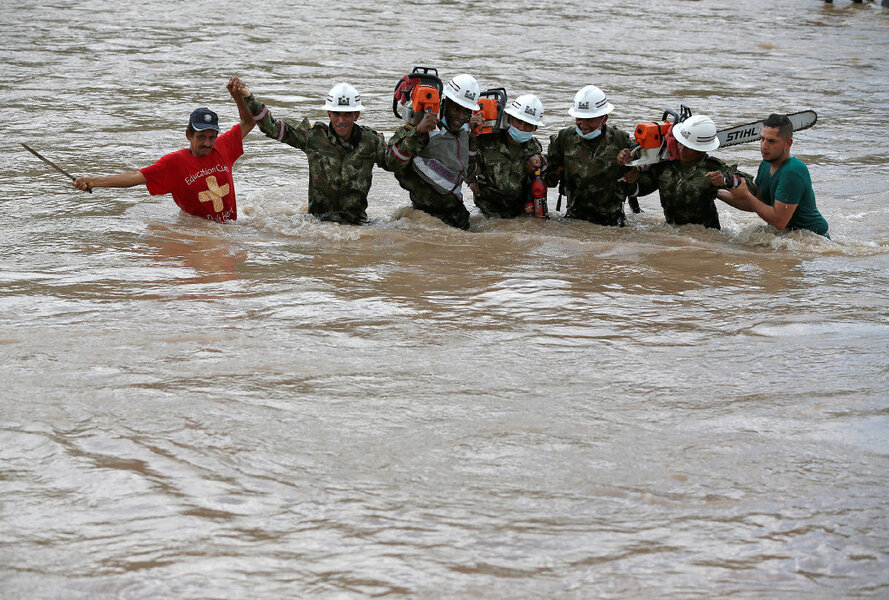
Natural disasters often create unexpected bonds between people, even long-time rivals, which can then alter the course of history. A good example was an offer made Monday by armed rebels in Colombia to assist in the recovery of a town hit by a flood over the weekend. At least 262 civilians were killed by the flooding and more than a thousand were made homeless. “We are ready to help,” stated the Revolutionary Armed Forces of Colombia (FARC).

Colombia’s government is in the midst of ending a half-century of war with the FARC. The tragedy in the town of Mocoa offered an opportunity for 400 rebels encamped nearby to show they are prepared to work with the government and forsake killing for cooperation. Their humanitarian gesture could help break down political barriers and provide an antidote to a long war.

Another example of disaster-related reconciliation occurred in 2004 when a tsunami struck the province of Aceh in Indonesia, killing some 130,000. The mass devastation and the aid provided by the Army forced a group of rebels to end its 30-year struggle for Aceh’s independence. The government and rebels signed a peace deal the next year.

In recent years, countries opposed to North Korea’s nuclear program have nonetheless offered food aid during a famine. The United States Navy has helped rescue stranded Iranian fishermen. A Russian tanker has brought an emergency supply of winter fuel to the isolated Alaskan city of Nome.

China and Japan, despite their rivalry in Asia, have offered aid to each other after recent disasters. Japanese teams searched for survivors after China’s 2008 earthquake while Chinese rescuers reciprocated after Japan’s 2011 earthquake and tsunami. After a 2005 earthquake in Pakistan, India delivered assistance to its longtime rival.

Yet these latter examples also illustrate the difficulty of resolving many geopolitical conflicts. Japan and China are at odds over an island dispute, while North Korea, Iran, and Russia are only winning more adversaries. India and Pakistan continue their estrangement

EMA builds county resource list for use in natural disasters

A countywide resource list is something Jeanna Barnes said the county has been wanting for a long time.

Yesterday, Barnes announced to the Pike County Commission that they have officially gotten a list together.

Barnes explained that the list details where resources such as barricades, signage and equipment can be found.

But it doesn’t just list items Barnes said.

“The list also inludes personnel,” Barnes said. “So we can see how many firefighters we have, how many police officers. We’ve gotten information from all the volunteer fire departments already.”

Right now the list is still just a physical copy, but Barnes said officials are working to get the list to be accesible digitally.

Things are still fluid right now with the resource list, Barnes told the commission.

When commissioners asked Barnes who has access to the list, she replied that it is currently available to those who ahd given information about resources to the EMA, but that access is something that could be changed depending on the wishes of the commission.

Not only can city and county agencies get involved to help the EMA, but local businesses as well.

Barnes said local business such as equipment companies can get added to the resource list so officals can quickly see where needed resources are at in the county and access them more quickly.

“When a natural disaster hits, resources are spread thin and we don’t want to wait for the State or FEMA to come in,” Barnes said. “We want to be as self-sustainable as we can be. This allows us to do that.”

6.0-magnitude earthquake hits off Solomon Islands

Solomon Islands

A 6.0-magnitude earthquake hit off the Solomon Islands in the early hours of Monday, the US Geological Survey said.

The quake struck at 02:43 am local time (1543 GMT Sunday) at a depth of 4.0 kilometres (2.5 miles), some 170 kilometres north-northeast of the capital city Honiara, the USGS said.

No tsunami warning was issued.

The Solomon Islands are part of the Pacific “Ring of Fire”, a zone of tectonic activity known for frequent quakes and volcanic eruptions.

In 2007 an 8.0-magnitude quake in the Solomon Islands claimed 52 lives and left thousands homeless when it created a 10-metre tsunami.


UN-backed forum in Montreal set to agree region-wide disaster risk reduction plan

 March 2017 – More than 1,000 delegates from across the Americas will meet this week at a United Nations-backed conference in the Canadian city of Montreal to agree a Regional Action Plan designed to reduce the loss of life due to disasters, both natural and man-made.

Officially known as the Fifth Regional Platform for Disaster Risk Reduction (DRR) in the Americas, the three-day event which opens Tuesday 7 March, is the first major conference in the region following up on the Sendai Framework for Disaster Risk Reduction, adopted in 2015 in the Japanese city of the same name.

Hosted by the Government of Canada in cooperation with the UN Office for Disaster Risk Reduction (UNISDR), the Regional Platform will mark the first opportunity for governments and stakeholders of the Americas to discuss and agree on a Regional Action Plan to support the implementation of the Sendai Framework for DRR 2015-2030 (Sendai Framework).

Sendai is a development framework, agreed by more than 180 countries, setting global but non-binding targets, to increase disaster preparedness, effective early warning systems and international cooperation, while at the same time reducing the impact of disasters on people, the economy, and the environment.

The platform in Montreal, which concludes on 9 March, will be the first opportunity for countries of the Americas to come together and discuss how they are going to put Sendai into practice.

“In Montreal, countries will adopt this Regional Action Plan [and] it will also provide the forum where countries will be able to discuss for the first time, how they are doing” said the head of the UN Office for Disaster Risk Reduction in the Americas, Ricardo Mena, in an interview with UN News.


The 2015 Sendai Framework was the first big intergovernmental agreement underpinning the UN-led 2030 development programme, along with the 2030 Agenda for Sustainable Development agreed by 193 countries later that year; the Addis Ababa Action Agenda on development finance; and the historic Paris Agreement on Climate Change.

Mr. Mena said there was a clear link between Sendai and the other pillars of the 2030 Agenda, citing the example of the Sustainable Development Goals (SDGs), specifically Goal, on ending extreme poverty. “Disasters usually bring more people into poverty; therefore you can see disasters as a driver of potential conflicts down the road and that’s why it becomes so important, so crucial, in having investments in reducing risks.”

Montreal Platform will be a ‘big tent’ gathering for diverse stakeholders

High-Level intergovernmental meeting on implementing the Sendai Framework across the Americas took place in Paraguay last June, but Montreal will “be a bigger tent,” said Mr. Mena.

“It’s a meeting where all the stakeholders – private sector, academia, science and technology, local authorities and civil society – are going to be participating in full force,” he said.

Noting that there are already “some quite positive signs” that implementation is well underway across the region, he cited the fact that UNISDR’s Americas office is already working with 10 countries “on the alignment of national DRR strategies and plans to the Sendai Framework spirit.”

“In some cases it’s revising existing strategies and plans, and aligning them to the Sendai Framework, in other cases it’s starting from scratch,” he added.

Mr. Mena said that getting national treasuries – and increasingly private sector investors – to think long-term about disaster risk, was the main challenge.

“Whatever is put into DRR is going to save money down the road. We know of the positive impact that DRR investments have.

“There is much more funding being put for disaster response activities, than for DRR activities […] The issue is how to integrate the DRR lens into every investment that you are about to do,” he added.

Minister in charge of Public Safety and Emergency Preparedness, Ralph Goodale, said Canada is “looking forward to working with our partners across all sectors of the emergency management community both domestically and among our hemispheric partners to develop an interactive and action-oriented agenda.”

Montreal’s mayor, Denis Coderre, said the city is looking forward to playing its part, and welcoming delegates from all parts of the continent. “Montreal is also one of the Rockefeller Foundation’s 100 Resilient Cities and actively integrates the principles of urban resilience in order to better prepare for the challenges of the 21st Century,” he said.


Disaster preparedness: Anybody listening?

We have been told: The Philippines is the most disaster-prone country in the world. So what has the government done to meet the challenge of protecting the people from typhoons, floods, tsunamis, earthquakes, fire and other calamities that occur every year, apart from designating school buildings to serve as “evacuation centers” for those displaced by typhoons, floods, fire, etc.?

In the 1970s, we filed a bill seeking the allocation of funds to build disaster shelters in coastal towns. More than 40 years later, Filipinos displaced from their homes still evacuate to rickety school buildings or are sheltered in second-hand tents to await relief goods—and disease, due precisely to the absence of necessary provisions that otherwise would be present in a shelter built for the purpose.

The head of the Philippine Institute of Volcanology and Seismology, Renato Solidum, has not been remiss in warning us about the “Big One,” a powerful temblor that may come at any time. He admonishes us to be prepared, not to sow fear and panic, but to be warned in order to be forearmed. He knows what he is talking about, and shouldn’t we be glad to have him around?

And at the risk of being called an alarmist, we repeat here (for the nth time) our suggestion to the government to set up an Earthquake Rescue Division to start in the metro area in coordination with local government units, which have ready personnel on call at any time. The rescue team should be composed of trained paramedics, members of the police and military, and volunteer doctors and nurses, with the government requiring representatives of medical companies that carry medicines and antiseptics (for corpses in body bags) that may be needed, and of construction firms that would donate heavy equipment for use in rescuing people trapped under collapsed buildings.

The government should also make

arrangements with various schools for the use of their grounds for tents and portable toilets to be set up for displaced families. An amply stocked food and water bank must be ready for such an emergency. Hundreds of tents will be needed, as well as body bags!

Like it or not (and Solidum also says so), high-rise buildings and residential houses can collapse in the course of the Big One. An estimated 34,000 people may die and hundreds of thousands may be injured. Such are the portents we face.

Before it happens, the preparedness of the government and the private sector is urgently needed—now. Is anybody listening? Hello, Undersecretary Ric Jalad, chief of the National Disaster Risk Reduction and Management Council!