President Obama Signs Louisiana Disaster Declaration

The President today declared a major disaster exists in the State of Louisiana and ordered Federal aid to supplement state and local recovery efforts in the area affected by severe storms and flooding beginning on August 11, 2016, and continuing.

The President’s action makes federal funding available to affected individuals in the parishes of East Baton Rouge, Livingston, St. Helena, and Tangipahoa.

Assistance can include grants for temporary housing and home repairs, low-cost loans to cover uninsured property losses, and other programs to help individuals and business owners recover from the effects of the disaster.

Federal funding also is available to the state and eligible local governments and certain private nonprofit organizations on a cost-sharing basis for emergency work as a result of the flooding in the parishes of East Baton Rouge, Livingston, St. Helena, and Tangipahoa.

Federal funding is also available on a cost-sharing basis for hazard mitigation measures statewide.

W. Craig Fugate, Administrator, Federal Emergency Management Agency (FEMA), Department of Homeland Security, named Gerard M. Stolar as the Federal Coordinating Officer for federal recovery operations in the affected area. 

FEMA said that damage surveys are continuing in other areas, and more parishes and additional forms of assistance may be designated after the assessments are fully completed.

FEMA said that residents and business owners who sustained losses in the designated parishes can begin applying for assistance tomorrow by registering online at http://www.DisasterAssistance.gov or by calling 1-800-621-FEMA (3362) or 1-800-462-7585 (TTY) for the hearing and speech impaired.  The toll-free telephone numbers will operate from 7 a.m. to 10 p.m. (local time) seven days a week until further notice.  

FOR FURTHER INFORMATION MEDIA SHOULD CONTACT: FEMA NEWS DESK AT (202) 646-3272 OR [email protected].

Ukraine in total natural disaster

Severe weather conditions left numerous cities without electricity, one person reported dead  Weather storm has covered nearly the whole territory of Ukraine.

Numerous regions report of accidents and power cuts caused by heavy rains and winds. Local residents also suffer from the consequences of natural disasters.

A 20-year-old man died in Kharkiv region amidst the field, his mother later found his body. In a while the medical expertise showed he had been struck by lightning and died because of electrical shock.

Ihor Lupandin, member of Ukraine’s State Emergency Service in Kharkiv Region: “The field is an open space, so it is no surprise the man was killed by lightning. The medics later confirmed he had been damaged by electricity. Except for the thunderstorm, there can be no other reasons.”

Torrential rains followed by thunderstorm struck several districts of the city of Kharkiv. The meteorologists say there have been a monthly rainfall level during one night. Four cars have been damaged so far, several multistoried buildings remain without roof, for it has been torn off by strong wind flow. The workers of communal service say they will need at least a couple of days to eliminate the results of the weather disaster.

15 villages in the whole region remain without electrical supply.

In the city of Dnipro the abnormal heat was replaced by heavy rains and thunderstorm. A great deal of rainfall has resulted in massive floods in the city centre, as well as the outskirts. In order to escape submerging deeply in water, numerous pedestrians had to climb up the benches. Those driving a car encountered additional problems, since the vehicles were not able to move through the entire water front. Some of the number plates were washed off, now the police seek for their owners. 

608xX

Photo courtesy – social media

One more accident caused by weather conditions happened in the city of Poltava, that is north-eastern Ukraine. A multistoried building caught fire after being hit by lightning. A portion of electricity struck the aerial on the roof, the next moment the flame encompassed the area of 500 square metres in total.

City administration sent the whole firemen staff to battle the fire. Despite big number of workers, they managed to extinguish the flame only three hours later. One of the flats on the 5th floor is totally burnt, 10 other apartments are flooded with water, the roof is also partially destroyed.

Ukrainian capital also suffered from bad weather. In the centre of Kyiv strong winds overthrew an old maple. No injuries reported, though the centennial tree damaged four cars, electrical cable, and protective net on one of the balconies. The vehicles belonged mainly to the workers of Ukraine’s Security Service that is situated close to the site. Now some of them are set to complain to the court.

Minister’s earthquake prediction

What are they based on?

It is with bemusement that we note our Minister for Relief and Disaster Management giving such categorical assurance that Bangladesh will not experience a massive earthquake in the magnitude of 8 or 9 on the Richter scale. This he has said in the backdrop of a study by a geologist at Columbia University in New York City that has found that Dhaka sits on a dangerous fault which could trigger a massive earthquake affecting around 140 million people in the region that includes Bangladesh, India and Myanmar. 

While we are not suggesting for a moment that there will be a mega quake, we hesitate to rule out such a possibility altogether without scientific basis. Just because we have been lucky enough to be spared an earthquake of such magnitude for the last 200 years as the Minister has quoted, does not guarantee that it will not occur now or in the near future. While it is important for the minister to tell people not to panic, his dismissal of an earthquake of that scale occurring, we feel, is misplaced. Given that it is not possible to predict whether such an earthquake is imminent, or that it may occur after a few hundred years, the most prudent task for a country under risk would be to boost its preparedness for such a disaster.  

What the minister should be telling the public is how prepared the nation is or needs to be for such a disaster should it occur. This includes training rescue teams, mobilizing volunteers, educating the public on survival skills, keeping adequate hospital staff to attend to the injured, enough ambulances, firefighting facilities etc. Only such contingency plans can reassure the public.

62 people killed in natural disasters in U’khand this yr

DEHRADUN: The year 2016 is proving to be a terrible year for Uttarakhand in terms of human lives lost in natural disaster incidents. As per official figures, 62 people have been killed in natural disasters like flash floods, cloudbursts, landslides and forest fires as of Monday. Over 64 persons have been injured.

Even animals have had to bear the brunt of nature’s fury with around 887 animals including domestic cattle perishing in disasters since January this year. Besides loss of human lives, there has been considerable property loss as well with around 144 houses getting completely damaged and 133 sustaining severe damage in natural disaster incidents.

Elaborating on the reasons behind the high numbers, Santosh Badoni, deputy secretary, disaster management department, told TOI, “Uttarakhand is sensitive to natural calamities due to its terrain. Besides flash floods and landslides which take maximum lives in a year, the state is also one of the most seismic or earthquake-prone regions in the country with majority of its area lying in either the highly vulnerable Zone 5 or Zone 4.”

This year, Pithoragarh has been the worst affected disaster-hit district in the state with 17 causalities and eight people missing and feared dead in the series of cloudbursts which ocurred on July 1, triggering flash flood and landslides and wreaking havoc in the Bastadi, Naulanda, Charma and Pathorkot villages of the district.

Even Dehradun district reported 13 deaths due to natural disaster in the present year with as many as 10 workers being killed in a single incident when they were hit by a landslide in the Chakrata area in the month of May. Eight people lost their lives in Tehri district followed by Chamoli district where five persons have been killed this year.

Around 87 drinking water pipelines and 1184 electricity lines were also damaged during the natural disasters in Uttarakhand between January and July.

Data from the disaster management department shows that on an average 73 people have lost their lives every year in the state since 2001, mainly due to landslides and flash flood-related incidents. The average death count excludes fatalities during the 2013 catastrophe which alone killed over 4,000 people.

Overall, since its inception, the state has seen 1,016 people getting killed (excluding the 2013 disaster) in landslides and flash floods. In the last two years, landslides and flash floods have claimed 119 lives.

Megathrust earthquake: Ticking time bomb threatening Bangladesh

A MASSIVE earthquake called an “active megathrust fault” is posing a genuine threat to southern Asia.

And if the modelling is correct, this earthquake could be at least as devastating as the 2011 quake which devastated Japan and took 16,000 lives.

The discovery of the hidden geographic fault lurking under southern Asia could unleash a magnitude 9.0 quake, placing up to 140 million people at risk in the most densely-populated place on earth, researchers fear.

The study of the area took more than a decade and detected the massive fault beneath Bangladesh, parts of India and Myanmar.

The research, the first to use GPS data collected from Bangladeshi tracking stations, suggests the northeastern corner of the Indian subcontinent is on a collision course with Asia.

The tectonic plates far beneath the earth’s surface are covered in layers of sediment more than 20m thick, and the study models suggest at the upper levels they are stuck in a pile-up, one thrusting under the other in a ‘megathrust’ which may have been under stress for more than 400 years.

Potential quake zone. Solid red line indicates an area of about 62,000 square kilometres that could move during a subduction-zone earthquake, affecting 140 million people or more. Image: Chris Small/Lamont-Doherty Earth Observatory

Potential quake zone. Solid red line indicates an area of about 62,000 square kilometres that could move during a subduction-zone earthquake, affecting 140 million people or more. Image: Chris Small/Lamont-Doherty Earth ObservatorySource:Supplied

Researchers believe the area is spring-loaded to buckle and rupture under the strain. But because their discovery is relatively recent, they have no idea when, or if, the fault will give way and trigger a 8.2 to 9.0 megaquake.

“We don’t know if it’s tomorrow or if it’s not going to be for another 500 years,” study co-author Michael Steckler, a geophysicist at the Lamont-Doherty Earth Observatory at Columbia University in New York City said in an article on the university website.

“We don’t know how long it will take to build up steam, because we don’t know how long it was since the last one. But we can definitely see it building.”

 
The research team estimates 140 million people live within 100km of the fault, including about 17 million in the area around low-lying Dhaka region of Bangladesh, which Steckler says already has problems with poor construction, making it hugely at risk of building collapse should a quake of large magnitude hit the region.

Overcrowding would make it difficult to rescue survivors in the event of an earthquake.

“Right now, the streets are clogged with traffic such that it’s impossible to drive around Dhaka on a normal day,” Steckler said. “If you fill the streets with debris, it’s really going to be impossible to get supplies and rescue equipment and things like that around,” Steckler told Live Science.

The research team is now building a more detailed map of the shape of the fault, as well as looking at historical tsunami data to understand how often megathrust earthquakes occur, Steckler said.

Japan tsunami hits Sendai

The March 11, 2011 Japan earthquake, with a magnitude of 9.0 struck off Japan’s northeastern shore and was the most powerful to ever hit the island country.

The quake triggered a devastating tsunami which struck the area with waves of up to 40m, tearing apart villages and towns, flattening homes and carrying ships inland, before sucking back to out to sea carrying debris, vehicles and bodies in its wake.

Damage to the Fukushima Daiichi Nuclear Power Plant completed a deadly treble of disaster, contaminating an area which continues to see more than 100,000 displaced locals living as evacuees.

Legarda: Disaster preparedness must be a way of life

MABALACAT CITY — In observance of the National Disaster Consciousness Month, Senator Loren Legarda has renewed her call to make disaster prevention and preparedness a way of life.

“When we reduce disaster risks and we are all prepared, informed and equipped, natural hazards like typhoons, earthquakes, tsunamis, storm surges, will not turn into disasters,” said Legarda, UNISDR Champion for Global Resilience.

“For instance, a magnitude 7.2 earthquake will not cause deaths or damage if there are no buildings on the fault line or if buildings and structures are built to withstand such a strong earthquake. A storm surge will not turn into a disaster if there are no settlements near the coastlines, or if there are enough mangroves to serve as buffer, or if residents are evacuated ahead of time, disaster management agencies give timely advisories and people follow the warnings,” she said.

Legarda stressed that there are many ways to prevent disasters. “We may be vulnerable to natural hazards and the effects of climate change, but we do not have to be helpless. We must be in control, we must be proactive, we must take urgent action.”

The Senator reiterated key lessons from previous disasters, which should guide the country toward strengthening disaster risk reduction and management.

First, we must focus on managing the risks rather than managing disasters. Disaster risk management should not be carried out only right before calamities happen. Local government units (LGUs) should be at the forefront of the planning, preparation and execution of the plans to provide an effective “first line of defense” against disaster risks. Funds should be sufficiently allocated. Cooperation among local and national governments, businesses, and the communities is imperative.

Second, we must let science work for our communities. The best solutions are possible only with the guidance of science, which is essential to develop land use plans that are risk sensitive. Accurate scientific data is needed to design practical solutions and communicate the risks to the people because knowing when, where and in what magnitude a typhoon will strike is fundamental to keeping our people prepared.

Third, everyone should be disaster-literate. We need to know and understand the risks. Everybody should be part of the solution and action needs to come from the communities themselves. Early and mandatory evacuation would be useless if the people do not understand the need for such efforts. Raising public awareness should be made to resonate loudly and as far deep into the communities as possible.

Fourth, we must protect our environment and pursue green urban development. We need to go back to the basics: protect our ecosystems and natural buffers such as mangrove forests to mitigate floods, storm surges and other hazards. Design and enforce building standards to address future hazards, not past ones.

Fifth, prepare adequately and engage. While disaster prevention should be the greater focus of our efforts, response preparedness is likewise important to prevent further casualties and reduce losses. Contingency plans are crucial in times of disasters. LGUs must have the political will to implement forced evacuation when called for.

Legarda has been engaged in efforts to raise awareness and educate government agencies, private sector, and citizens on disaster prevention and preparedness.

In 2011, the Senator collaborated with various government agencies to produce the Disaster Preparedness and First Aid Handbook, a practical manual that educates citizens on how to prepare for and respond to both natural and human-induced hazards.

An audio-visual version of the book was launched in 2013.

“Ligtas”, an instructional video on disaster preparedness, was produced by Legarda and directed by multi-awarded Kapampangan Indie film director Brillante Mendoza.

source: sunstar.com

One nonprofit’s way of responding to natural disasters – more than 60 of them

All Hands Volunteers has enabled more than 35,000 people to bring aid to places ranging from post-Sandy Brooklyn to Ofunato, Japan, after the 2011 tsunami.

Boston — Teach, save, travel. It was a rhythm that brought “Jess UK,” as she still answers to, everywhere from her native Britain, to Taiwan, to finally Laos, where she found herself gritting her way through a muggy 10-hour bus ride.

“It was a great life,” she says today, but time for a change. She’d been searching for volunteering opportunities, but hindered each time by aid groups’ requirement that their disaster workers pay their own way.

Need in the region was still high, though, five years after the Indian Ocean tsunami, which ripped hundreds of thousands of families from their homes.

“I had time to give, but not a lot of money,” Jess Thompson says.

As she settled into her seat on the bus, however, two girls’ conversation nearby caught her ear: something about All Hands Volunteers, where pitching in didn’t come with a price tag. Ms. Thompson scribbled the name into her damp palm, where, many miles later, she managed to decipher the half-melted note and made a once-in-a-lifetime call.

“Can I come?” she asked.

“Yeah, when are you going to be here?” came the answer from Indonesia.

It was her first project with All Hands Volunteers, a nonprofit that today has enabled more than 35,000 volunteers, from more than 100 countries, respond to more than 60 natural disasters around the globe. The places where volunteers have gone range from post-Sandy Brooklyn to Ofunato, Japan, after the 2011 tsunami – where the team restored not just houses, but thousands of water-damaged photos.

They’re the “Good (for Nothing) Club,” as founder David Campbell says with a laugh: Volunteers pay nothing but their airfare and, technically, get nothing in return for their long days of hauling rubble, digging latrines, and figuring out what’s most needed – except, for many, an addictive sense of friendship, hope, and fulfillment.

Without volunteer fees, All Hands makes its budget work through a combination of grants, gifts, and partnerships, not to mention pared-down comforts – no air conditioning or nonlocal food, for starters. It spends less than 10 percent of its budget on administrative or fundraising expenses.

The organization got its start in 2004, when Mr. Campbell boarded a plane to Thailand after the Indian Ocean tsunami. He was equipped with little more than the urge to identify “obvious problems without obvious solutions,” and then create solutions. It was a knack he’d put to use in a four-decade career in tech entrepreneurship, which was then coming to a close.

What he saw in Thailand was inspiring, but also worrying. “People think of disasters as happening to countries, but they actually happen to villages,” he says. And those villages’ needs can differ wildly, as can the help that reaches them.

Often, assistance disappears soon after the news crews, whether in Fiji or New Orleans, go home. One year later, “Who’s here, and what are they doing? That would be a real picture of disaster response,” Campbell says.

The disaster aid field is trying to move toward long-term recovery and prevention, says Regine A. Webster, vice president of the Center for Disaster Philanthropy in Washington, which has partnered with All Hands’ current project in Nepal.

“What we really believe has been special about [All Hands] is, No. 1, their willingness to communicate in a very transparent manner about what they’re doing, why they’re doing it, how they’re doing it,” Ms. Webster says. Originally, most of CDP’s funding for All Hands was designated for WASH funding – water, sanitation, and hygiene. But “then they came back to us after really understanding what the needs were, and they asked if they could reallocate part of the funding to build retaining walls,” she says.
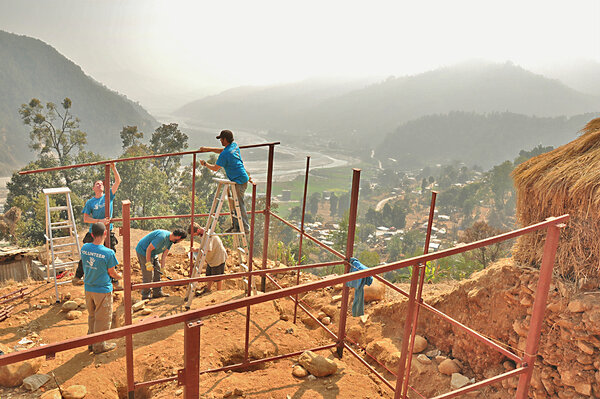
All Hands Volunteers construct 50 transitional homes on a plot overlooking the Indravati River in Sindhupalchowk district, Nepal, after the 2015 earthquake. Courtesy of All Hands Volunteers

By living bunk-to-bunk on local food, outside the main cities, and taking local trucks instead of expat SUVs, All Hands’ workers are also its eyes and ears, picking up on a community’s specific needs. In the Philippines, for example, they learned that a savings program for local workers would be just as useful as a training class.

“With All Hands, we have friendships in the community,” April Jelinek, a volunteer after the 2010 Haiti earthquake, told Campbell for a 2015 book about the group’s evolution. “We didn’t do something for Haitians,” added Ms. Jelinek. “We did it for Jean-Marc, Emanuel, Pierre and César.”

Like many volunteers, Thompson couldn’t say goodbye. “At the end of the day, my body was tired – but my brain was on fire,” she says. Today, she’s All Hands’ US director of rebuild and recovery, managing flood relief in Louisiana, Texas, and South Carolina.

Then again, she had an extra incentive: her now-husband, whom she met when she showed him around on his first day on-site in Indonesia. As soon as their daughter begins to crawl, the next generation of the “Good (for Nothing) Club” will be in motion.

For Campbell, the most important rebuild isn’t of homes or schools. It’s of hope – not only that lives can be put back together, but that everybody has it in himself or herself to go and help.

A good Samaritan looks out for his or her neighbor, he says, but “it’s very different to help someone who’s totally disconnected from you … picking yourself up, and going to Ecuador, and sleeping on a bunk, and working for two weeks just to dig out and start rebuilding a school for people you never knew and you’ll never know again.”

When someone’s home has fallen down, “it’s very straightforward,” Thompson says. “Piece by piece, with your own bare hands, you fix it…. How can you step away from that?”


Disaster Management: NEMA assures of collaboration with media

The National Emergency Management Agency (NEMA), has stressed the need for continuous support from stakeholders in the country, also assuring of its continuous collaboration with the media for active disaster mitigation and management.

The North West Zonal Coordinator of the agency, Alhaji Musa Ilalah gave this assurance Thursday in Kaduna during a courtesy call on him by officials of Nigerian Union of Journalists (NUJ), Kaduna Council led by the Chairman, Comrade Garba Muhammed.

Ilalah said no organisation can operate and succeed in vacuum without utilizing the media, hence, NEMA would always partner the media to ensure its aims and objectives are achieved seamlessly.

According to him, promoting disaster management and mitigation was a task that requires all critical stakeholders and the media attention.

He asserted that NEMA, North West has enjoyed a tremendous partnership with the media in Kaduna.

He said the agency’s stakeholder network was large such that even a peasant farmer in a remote village could be utilised to achieve the agency’s objectives, and as such he can be utilized.

“The media in Kaduna has always aided NEMA with useful advice and the heeding to the advice by the agency has gone a long way in saving of lives and property,” he stressed.

Ilalah said one of the greatest challenges of the agency was funding, but they are working within available means to make best use of the limited resources.

“Our goal is to ensure free disaster environment through proactive measures in collaboration with other agencies through mass sensitisation and street campaigns to avert and mitigate disaster.

“As a team, we can make better impact and achieve more results,” he asserted.

In his remarks, the chairman of Kaduna State NUJ, Comrade Garba Muhammad stressed the importance of taking the media along in the agency’s activities.

He applauded the prompt response of the agency to calls and cry for assistance, especially the recent visit to internally displaced persons (IDPs) camps within Kaduna to evaluate their conditions and needs.

Death toll from Indonesia floods, landslides rises to 47, disaster agency says

Rescuers were searching through wrecked houses and mounds of earth for 15 villagers still missing after days of rain triggered the landslips and flash floods on mountainous Java island over the weekend.

They were using excavators to hunt for survivors in more accessible areas, and in more remote places were digging through debris with their bare hands and shovels.

Disaster agency spokesman Sutopo Purwo Nugroho said 47 people were confirmed dead, 15 were missing and 14 had suffered injuries.

Hundreds of homes were badly damaged, with some completely flattened.

He said a La Nina weather system, which typically causes unseasonably heavy rains, could have contributed to the flooding.

Java, which should be entering the dry season, has been hit by torrential downpours in recent weeks.

“This June there’s still heavy rainfall which is causing floods and landslides,” Mr Nugroho said, warning La Nina was set to strengthen in the coming months, increasing the risk of disasters.

Indonesia and other parts of Asia had been affected by a strong El Nino, which brings drought and sizzling temperatures.

La Nina often follows an El Nino phenomenon.

Mr Nugroho also blamed inadequate preparations, saying his agency had warned local authorities that heavy rains were coming but it was not clear if they had taken action.

Evacuation centres, equipped with temporary shelters and kitchens, have been set up near the disaster zones.

source: http://www.abc.net.au

Indonesia’s Central Java hit by deadly floods and landslides, at least 35 people killed

Flooded area in Solo, Central Java

Flash flooding and landslides in Indonesia have killed 35 people and left more than two dozen others missing, officials say, with mud avalanches burying people inside their homes.

Torrential rain since Saturday has triggered serious flooding across Central Java, with thousands of homes inundated, said disaster agency spokesman Sutopo Purwo Nugroho.

“The number of casualties from floods and landslides in Central Java is 35 people dead, 25 people missing and 14 injured,” Mr Sutopo said in a statement.

Footage aired by local broadcasters showed villagers sitting on their roofs to escape the rising water, their cars and homes submerged in brown water.

Areas prone to landslides in the densely-populated province were the worst hit, with drivers swept off roads and dozens of homes destroyed by fast-moving walls of mud, rock and water.

In one district, five people were buried in their homes as a landslide swept through the village. In another, nine people were killed as they tried to clear rubble from a road.

“Suddenly a huge landslide struck the cars and people on the street. Nine bodies were retrieved,” Mr Sutopo said in a statement.

Search and rescue crews are combing villages for missing people, Mr Sutopo added.

Temporary shelters have been erected to help those evacuated from the disaster zone.

Landslides are not uncommon in Indonesia.

Last month, 15 students holidaying at a popular tourist spot in western Indonesia were killed when a landslide swept through their camp ground.


source: abc.net.au