Kenya should improve disaster preparedness urgently

The horrific Huruma building collapse, in which 23 people have so far been confirmed dead, has once again exposed Kenya’s glaring ineptitude in dealing with disasters.

Four days after the seven-storey building fell to the ground like a deck of cards, rescue workers were still digging through the rubble, hoping against hope to pull another person out alive. Over 60 people are still unaccounted for and most are believed to be buried under the collapsed building. We are not in any way insinuating that it is easy to sift through the tonnes of concrete and metal to bring out the victims. In fact, we salute all those who have spent sleepless nights working hard to save lives. However, we are concerned because Kenya seems to have learnt little despite being a victim of very many disasters. One of these was the August 7, 1998 Al Qaeda bombing of the US Embassy in Nairobi, which killed 291 people and wounded about 5,000. Understandably, Kenya was clearly overwhelmed by the magnitude of the disaster and therefore the help of international rescue experts, among them the Israelis, was most welcome. The Israelis once again came to our rescue in 2006 when a building collapsed in downtown Nairobi killing 14 people. But these tragedies, and many others, have not taught us much.
Read more at: http://www.standardmedia.co.ke

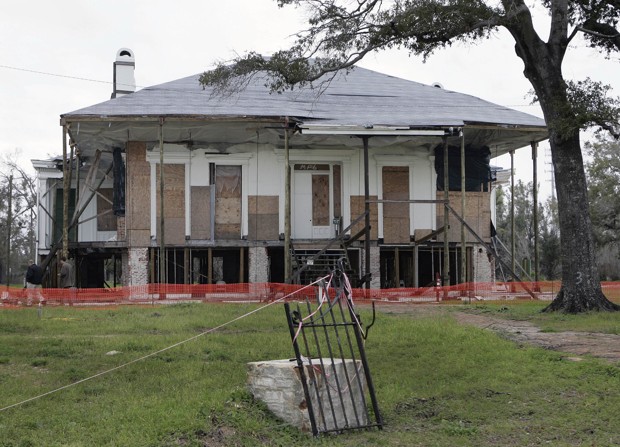
Why Historic Preservation Needs to Be Part of Disaster Planning

Image AP Photo/Bill Haber

Almost two thirds of all states lack historic preservation strategies in their hazard-mitigation plans.

Natural disasters have taken a heavy toll on historic landmarks around the U.S. When Hurricane Katrina swept through parts of New Orleans in 2005, floods damaged 19th- and 20th-century buildings, causing some to collapse. High winds smashed windows and stripped away the outer layers of houses, shops, and museums. More recently, Hurricane Sandy took down monuments in the 1849 Evergreens Cemetery in Brooklyn and damaged the electrical system of the Fraunces Tavern Museum—which dates back to the American Revolution—in Manhattan.

Between rising sea levels, predictions of increasingly extreme weather patterns, and the Big Onealways looming over the West, the U.S. is bracing itself for more naturaldisasters. But a recent report out of the University of Colorado Denver and University of Kentucky finds that the U.S. may not be as prepared as it could be to protect historic sites from floods, wildfires, and tornadoes. In fact, almost two thirds of all states lack historic-preservation goals and strategies in their disaster plans.

“It’s such an important issue because so many historic resources were built  before modern flood regulations and modern building codes, so they’re located in areas that are prone to these kind of disasters,” says Andrew Rumbach, a professor of planning and design at University of Colorado Denver, and one of the study’s researchers. “When you [saw] them in Hurricane Katrina, which destroyed thousands of historic resources, it was a real loss. The preservation community tried to save as much as they could and restore it back with historical integrity.”

To study how well disaster management is integrated intostate preservation plans (and vice-versa), Rumbach and his colleague Douglas Appler, a professor of historic preservation at University of Kentucky, analyzed the historic-preservation and hazard-mitigation plans of all 50 states. These documents, which are updated every five years or so, lay out goals and strategies to help guide local governments and organizations in times of crisis. The results were published this week in the Journal of the American Planning Association.

Not only are they important for community identity … but also they’re often very important for local economies.

In the first set of documents, on preservation, the researchers sought out words like “emergency,” “disaster,” and “hazard.” In the second, they looked to see if historic preservation was explicitly discussed, and whether a representative from the preservation department was included in the disaster-planning process.

They found that two-thirds of states explicitly mentioned emergency preparedness in their preservation plans, and 25 states included specific policies, initiatives, and plan objectives. But 60 percent of all states lack specific preservation strategies in their hazard-mitigation plans. And only 13 states included specific goals and strategies that mentioned protecting historic resources.

Yet the interests of historic preservationists and disaster planners do overlap. Protecting historic resources—structures, sites, and landscapes that have been nationally registered—are important for disaster resilience, Rumbach tells CityLab. “Not only are they important for community identity, and for people’s sense of belonging, and why they value their communities, but also they’re often very important for local economies.” (New Orleans, famous for its historic attractions, drew more than 9.5 million tourists in 2014 and added $6.8 billion to its local economy, for example.)

Although local communities mayhave their own preservation and disaster-mitigation plans, Appler says it’s still important for states to have both in place. “The state is a guidance document, identifying areas that should be of concern or special focus for local plans,” he says. “Then [the local agencies] could develop guidance for people who live in historic districts—what you can do to prevent damage to your house in the case of flooding, and who they should contact.”

Rumbach adds that states can be particularly helpful in small cities where the local communities may not necessarily have the capacity to plan for natural disasters themselves.

Beauvoir, the retirement home of Confederate President Jefferson Davis, shows damage caused by Hurricane Katrina near Biloxi, Mississippi. (AP Photo/Bill Haber)

Using publicly available spatial data, the researchers also mapped out historic sites that were vulnerable to flooding in three states: Kentucky, Florida, and Colorado. They found that 15 percent of the 3,380 historic sites listed for Kentucky are located in the state’s 100-year or 500-year floodplain, meaning the area has either a 1 percent or 0.2 percent chance, respectively, of being flooded on any given year.  Roughly of quarter of the 1,700 sites in Florida are found inside 100-year and 500-year floodplains.

But there’s room for improvement in the data. Appler and Rumbach calculated that only 6.8 percent of Colorado’s 1,480 National Register sites are located in an area vulnerable to flooding, but that’s in part because more than half of the counties’ floodplain data are not available through FEMA’s National Flood Hazard Layer.

The good news is that there are at least two programs that can help states better connect the two areas of planning: the National Park Service’s Certified Local Government Program and the National Main Street Program, which are partnerships between national and state agencies and local governments that focuse on historic preservation. Communities that have these programs in place already have a good infrastructure to protect historic sites.

They “can be very useful when we start thinking about how these two areas of planning [historic preservation and disaster planning] are going to by linked,” says Appler. “They know the historic resources, and the people who are involved in those two programs are publicly inclined and are willing to contribute their time for the betterment of the community.”

“Our study is really looking forward into the future,” adds Rumbach, “and saying, ‘What can communities who have a lot of historic resources that may be at risk from disasters can do to better plan for them?’ ”

Pakistan Flooding Kills at Least 45; Bad Weather Hampering Rescue Efforts

At least 45 people have died in northwestern Pakistan as torrential rains triggered flash floods, local officials said, and bad weather is hampering further search and rescue efforts. 

Several districts of Khyber Pakhtunkhwa province were hit hard by the flooding after the heavy rain began overnight Saturday, Pakistani national disaster management official Latif ur Rehman said.

Rehman told the Australian Broadcasting Company that rescue workers had not been able to reach three affected districts in the far-flung mountainous north of the province.

“Bad weather is the main reason, we are yet unable to send helicopters to these areas,” Rehman said.

Rehman told ABC there have been reports that at least 180 houses had been destroyed in those areas.

“We need to get bodies and the injured out from under the rubble and provide food and tents to the survivors,” Rehman said, adding that four truckloads of supplies had been sent to affected districts.

At least 34 people have been admitted to hospitals with injuries, he said.

Sky News reports that a bridge connecting the villages of Toormang and Shalfalam over the Panjkora River has been partially swept away by the heavy flooding. 

Flash floods are commonly triggered during South Asia’s summer monsoon season. Pre-monsoon rains like the current downpour frequently cause damage in Pakistan — particularly in rural villages with minimal infrastructure.

Residents of scores of villages close to rivers were given warnings to vacate and leave for safer places, Rehman said.

“We’re left on our own. Nobody from the government is coming to help us,” said Habib Khan, a resident of the northern Swat valley, talking to a local TV news channel.

The channel showed damaged houses and submerged streets in the valley and other parts of the northwestern province.

cite from: https://weather.com/safety/floods/news/pakistan-floods-latest-news

Indonesia Rawan Bencana, Negara Wajib Siapkan SAR

BANYUMAS — Indonesia merupakan salah satu negara di dunia yang sangat rawan bencana alam. Gempa bumi, tanah longsor, banjir, angin puting beliung, serta gunung meletus kerap terjadi di wilayah Indonesia. Tingginya potensi bencana alam membuat Indonesia membutuhkan tindakan Search and Rescue (SAR) atau Pencarian dan Pertolongan.

Pernyataan itu diungkapkan Anggota DPR RI dari Fraksi Partai Gerindra Novita Wijayanti saat acara Sosialisasi Undang-Undang No 29 Tahun 2014 tentang Pencarian dan Pertolongan di Kecamatan Ajibarang, Banyumas, Jawa Tengah, Selasa (5/4).

“SAR adalah segala usaha dan kegiatan mencari, menolong, menyelamatkan dan mengevakuasi manusia yang menghadapi keadaan darurat dan atau bahaya dalam kecelakaan atau kondisi membahayakan manusia,” ujar Novita dalam keterangannya,  Selasa (5/4)/

Menurut dia, di Indonesia SAR diatur dalam Undang-Undang No 29 Tahun 2014. Anggota DPR RI dari daerah pemilihan Jateng VIII itu menegaskan, penyelenggaraan SAR merupakan kewajiban negara. Hal itu, kata dia, tercantum pada Pasal 5 ayat (1) UU SAR.

“Pemerintah juga bertanggung jawab terhadap penyediaan dan pengembangan sumber daya manusia di bidang SAR. Selain itu pemerintah pusat dan pemerintah daerah bertanggung jawab mengalokasikan dana penyelenggaraan SAR yang berasal dari APBN. APBD serta sumber dana lain yang sah dan tidak mengikat,” tegas Novita.

Novita memaparkan, operasi SAR terdiri dari dua tahap. Pertama, pelaksanaan operasi pencarian dan pertolongan. Pada tahap ini, kata dia, dilakukan dengan penyusunan rencana yang efektif dan efisien yang meliputi: identifikasi situasi lokasi, perhitungan lokasi kecelakaan, bencana/kondisi membahayakan, titik koordinat posisi, petugas dan peralatan SAR dan bentuk operasi SAR, serta evakuasi.

Kedua, kata dia, penghentian pelaksanaan operasi SAR. Menurut Novita, operasi SAR dihentikan apabila seluruh korban telah ditemukan, ditolong, dan dievakuasi. Selain itu, operasi SAR dihentika setelah jangka 7 hari pelaksanaan operasi SAR tidak ada tanda-tanda korban ditemukan.

“Setelah dinilai tidak efektif berdasarkan pertimbangan teknis dari hasil evaluasi koordinastor misi SAR,” paparnya.
Terkait masalah bencana alam yang sering melanda Kabupaten Cilacap dan Banyumas serta Banjarnegara, Novita menuturkan, sudah seharusnya Undang-Undang No. 29 Tahun 2014 Tentang Pencarian dan Pertolongan disosialisasikan kepada masyarakat di daerah yang rawan terhadap bencana alam.

“Ini penting sebagai langkah antisipasi,” tegasnya.

sumber: REPUBLIKA.CO.ID

Training on first aid and disaster preparedness

KATHMANDU: The staff and students of different colleges of Nepal, USA and Germany travelled to various places of the country to train communities and school teachers about cardiopulmonary resuscitation (CPR), first aid and disaster preparedness, with the help of Clinic Nepal.

The students and teachers from Florida State University, USA, Technical University, Munich, Germany, Tribhuvan University, Nepal and Pulchowk Campus, Nepal took part in the programme held from March 5 to 11.

It was a good opportunity for people to gain significant knowledge about what to do before, during, and after disasters such as earthquakes, flood, fire mishaps, et cetera. They also learnt about things they need to do to treat wounds and basic care during medical emergency.

On the first day, the training was conducted in Daldale of Nawalparasi for a group of women and school children. The team then conducted a four-day-long training in Meghauli of Chitwan. Members of local youth clubs, school children, women’s group and teachers among others took part in the programme.

Information regarding water and sanitation, hygiene, infrastructures, mental health were also provided during the training by the students of Florida University, Tribhuvan University and Pulchowk Campus respectively.

The participating students from different countries also got opportunity to exchange ideas and knowledge.

Applying Interagency Concepts from Domestic Disaster Response to Foreign HA/DR

A Warm Sunny Day

It is a warm and sunny October evening in Cilegon, Indonesia. As the small city of 416,000 moves through its afternoon rush a strong shake is felt.  It stops, after two minutes, and then a loud explosion is heard coming from the west, with a large mushroom cloud enveloping the sky. Traffic on National Highway 3 is at a standstill.  People are getting out of their cars trying to determine what has just happened.  Some of them realizing that the explosion has come from the Sunda Strait abandon their vehicles, and start running south up a hill, as a thirty meter tsunami appears on the horizon heading towards the coast. Those who survive the tsunami are then enveloped in a cloud of burning ash.

Several hours later, local authorities are overwhelmed, and the Indonesian military is completely overwhelmed.  Reinforcements are being flown in from other parts of the country. The low-lying areas of Cilegon are completely destroyed, and more than 1,500 towns and villages in both Banten and Lampung Provinces are going. At least five million people are estimated to be dead. The Prime Minister accepts an offer of aid from the Ambassador of the United States. At this point, the close to ten million more people who survived the disaster lack access to food, clean water, or housing.  Furthermore, weather reports are showing that the first storm of the monsoon season will reach the affected area within the next 72 hours. Meanwhile, an Amphibious Ready Group transiting the Malacca Straits receives orders to sail to Cilegon. Its orders also indicate that the ARG Commander is to assume command of the Joint Task Force being formed from U.S. military personnel.
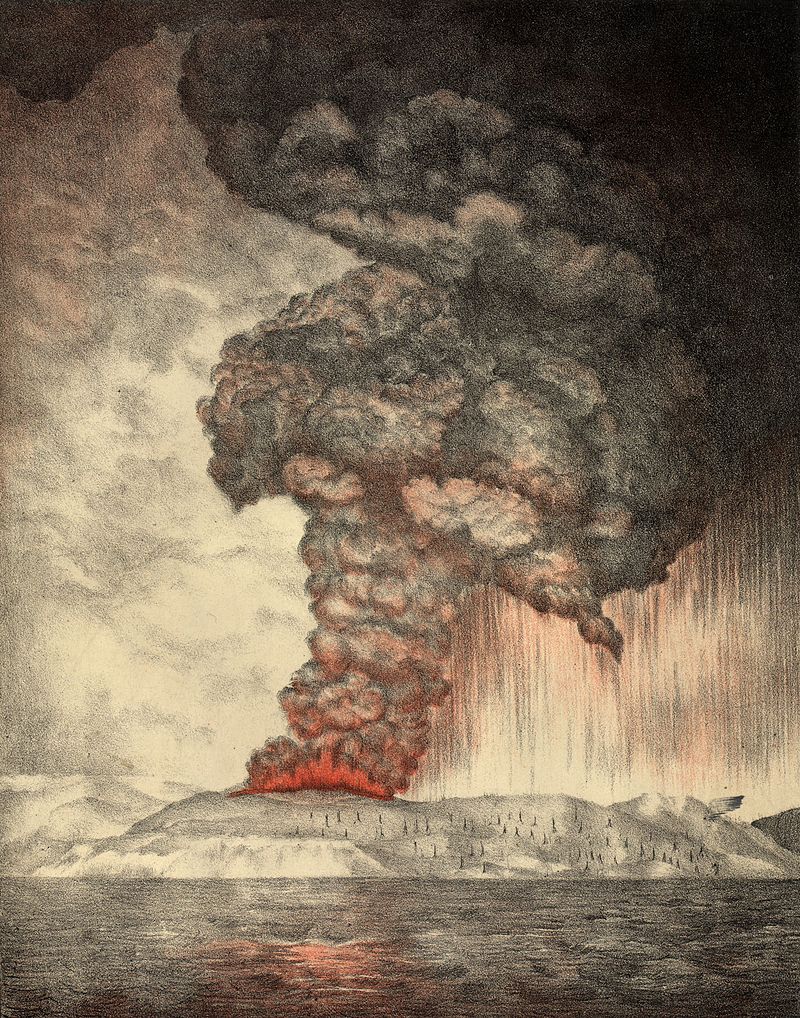
litho1888 Lithograph of 1883 Eruption of Krakatoa: Parker & Coward. Source: Wikipedia.

This disaster has happened before. The last major explosion of Krakatoa occurred in 1883, causing a pyroclastic flow with a 50 km radius, and sent a thirty meter high tsunami across the Sunda Strait in all directions. The noise of the explosion was heard as far away as Alice Springs, Australia, and Mauritius.  Skeletons found laying on pumice were found washing ashore in East Africa for several years afterwards. The official death toll was around thirty-six thousand. The area around Krakatoa has a significantly higher population today, and major eruptions of the mountain have been recorded as occurring between every 100-250 years.[1] It is not uncommon for disasters of a large magnitude to be followed by a subsequent event that exacerbate the conditions for survival, such as monsoon events, like Winter Storm Athena that followed a month after Hurricane Sandy.[2]

Introduction

In the scenario described above it is very likely that the assistance of the United States will be requested by the host nation, and it is very likely that in an archipelagic nation, such as Indonesia naval forces will be the first to arrive. It is also distinctly possible that a Naval or Marine officer will be appointed as Joint Task Force Commander. The doctrine on how to respond to disasters or provide humanitarian assistance depends on where a Joint Task Force is responding and whether or not it is inside or outside the United States. 

For Domestic Disaster Response/Humanitarian Assistance missions there is a set framework in the form of the Incident Command System (ICS), the National Incident Management System (NIMS), Multiagency Coordination System (MACS), and National Response Framework (NRF). These include a common operating language and procedures that allow for integration of responding agencies and unity of effort.[3] The major proponent of doctrine for domestic response within the Department of Defense is U.S. Northern Command.[4] The military forces that most commonly exercise these missions are within State Military Forces such as theArmy & Air National Guard, as well as State Defense Forces[5] and Naval Militias in those states that have such organizations.[6]

When it comes to Foreign Disaster Response and Humanitarian Assistance, there is no common operating language, procedures, and organizational structures.  Instead, the doctrine that is put forward for foreign response displays the common organizational structures needed for integration- namely where a commander should deploy Liaison Officers. However, this doctrine does not integrate common operating language and procedures to better facilitate the mission. Meanwhile, other agencies of the Federal Government, especially U.S. Agency for International Development’s Office of Foreign Disaster Assistance, not only utilize ICS and MACS in their response doctrine, but teach that doctrine to host nation response forces.[7]

Current Doctrine on Defense Support to Civil Authorities

During a domestic disaster response/humanitarian assistance operation, utilized doctrine focuses on Defense Support to Civil Authorities (DSCA) that is largely controlled by U.S. Northern Command (NORTHCOM).  The design of the DSCA mission is largely built around supporting the United States’ federalist system.  The most important laws relating to this doctrine are the Stafford Act of 1988, the Insurrection Act of 1807, and the Posse Comitatus Act of 1869. 

The concept here is that all disasters are local disasters first.  Under the Stafford Act and other supporting state legislation, when local governments are responding to a disaster and their resources become overwhelmed, they must first request assistance from surrounding counties under Emergency Mutual Assistance Compacts (EMAC).  If those resources become overwhelmed, a County Executive may request the Governor to declare a State of Emergency, which then allows the Governor to allocate funding and deploy resources to support the affected area.  In turn, if a state’s resources become overwhelmed, then the Governor will request EMAC resources from other states.  If those resources become overwhelmed, a Governor may request the President to declare a Federal State of Emergency, which allows federal resources to be allocated to the response.  During a State of Emergency declared by a Governor, State Military Forces may be utilized in the response- during a Federal State of Emergency, National Guard forces operating under Title 32 USC (Militia of the United States) orders may be utilized.[8]
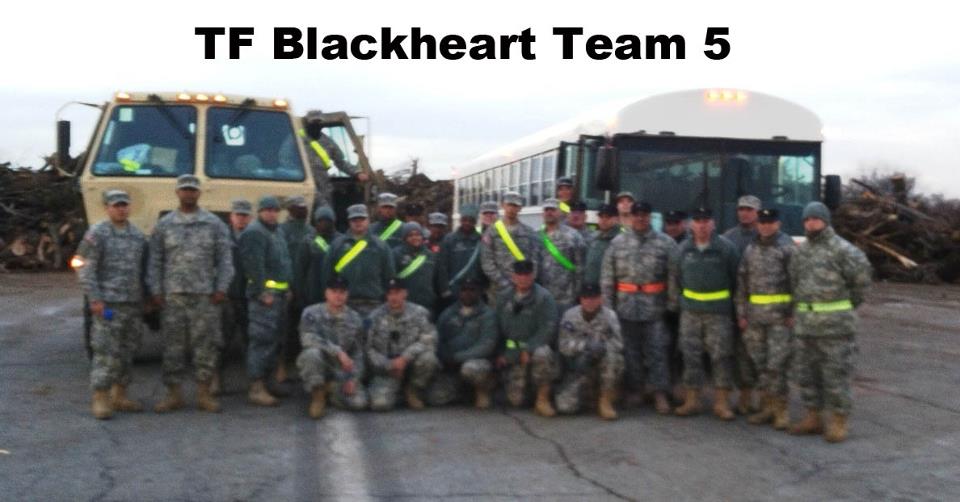
3TF Blackheart Team 5 (Joint NY ARNG/NY State Guard Platoon) at the end of Operation Hurricane Sandy Phase IV, 16 December 2012). Photo taken at FOB Floyd (Floyd Bennett Field, Brooklyn, NY), Source: Author.

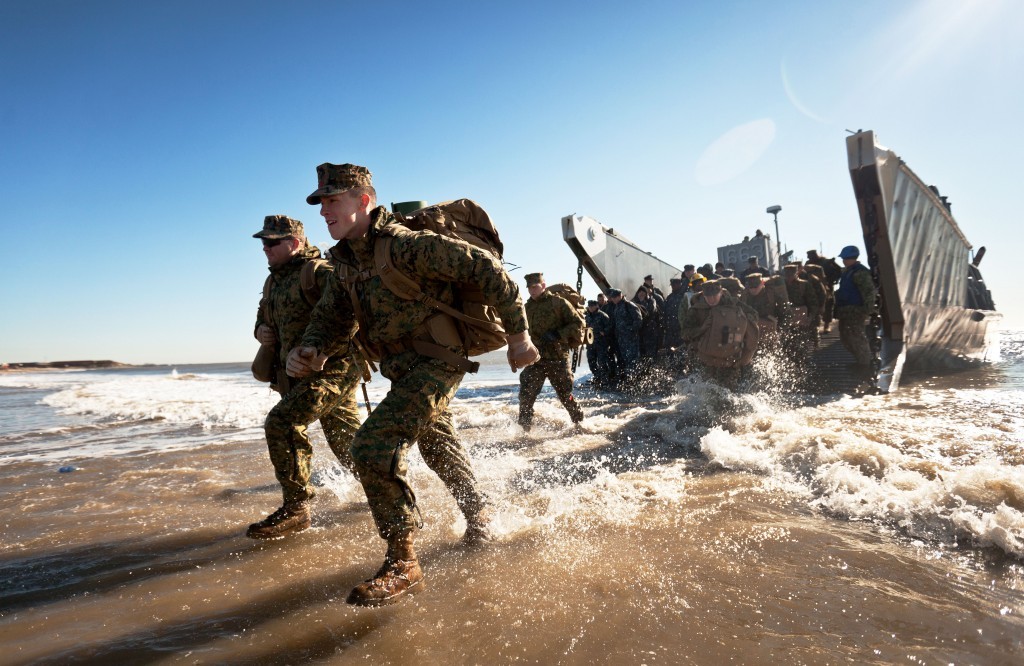
Under the Posse Comitatus Act of 1869, there are limits to how the Armed Forces of the United States operating under Title 10 USC may be utilized for domestic response missions. [9]  Title 10 forces cannot be used for direct response or humanitarian assistance, but can be used for various support activities.   For example, during the response to Hurricane Sandy, Marines from the Wasp Amphibious Ready Group conducted an amphibious landing at Breezy Point, Far Rockaway, Queens, and began distributing meals and heater packs.[10] However, they were later withdrawn due to issues with the Posse Comitatus Act.  Around the same time Joint Task Force Sandy (New York Army National Guard 53rd Troop Command) troops began arriving.[11] Meanwhile, the U.S. Army 19th Engineer Battalion’s Headquarters Company and two Engineer Companies deployed from Fort Knox, Kentucky, where they conducted pumping operations to mitigate flooding of twenty-seven stories of subterranean infrastructure across New York City, and the 249th Engineer Battalion provided prime power services, along with general support from the U.S. Army Corps of Engineers’ New York District.[12] 
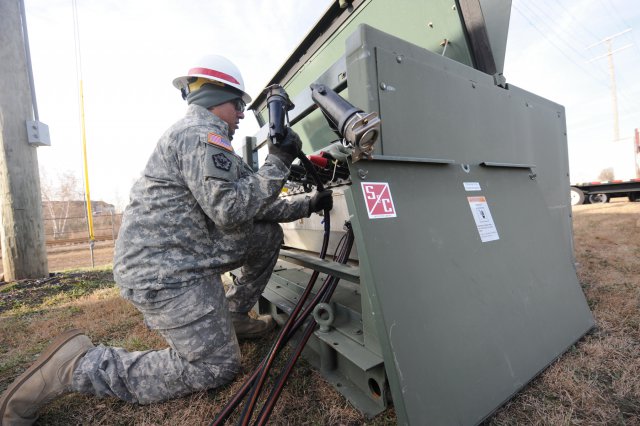
9999A Regular Army soldier from the 249th Engineer Battalion (Prime Power), U.S. Army Corps of Engineers, turns on a generator in Lakehurst, NJ, after Hurricane Sandy. Source: U.S. Army. 1212Marines from the 26th MEU conduct an amphibious landing in the Breezy Point neighborhood of Far Rockaway, Queens, NY. Source: Department of Defense.
The provisions of the Insurrection Act of 1807 allow for the exceptions where Title 10 troops may be used for response to a disaster.  In these provisions a disaster would have to lead to law and order to break down.  Since all disasters are local, first Title 32 troops- both in the state of disaster, as well as those called in under EMAC must be unable to enforce order, and then federal troops can be utilized after the President has declared a Federal State of Emergency.[13] A great example of Title 10 troops being deployed to enforce law and order after a natural disaster was when the 82nd Airborne Division was deployed in the aftermath of Hurricane Katrina.  This occurred primarily due to the failures of the initial response, and the fact that half of the Louisiana Army National Guard (256th Infantry Brigade Combat Team), was deployed to Iraq at the time.[14]
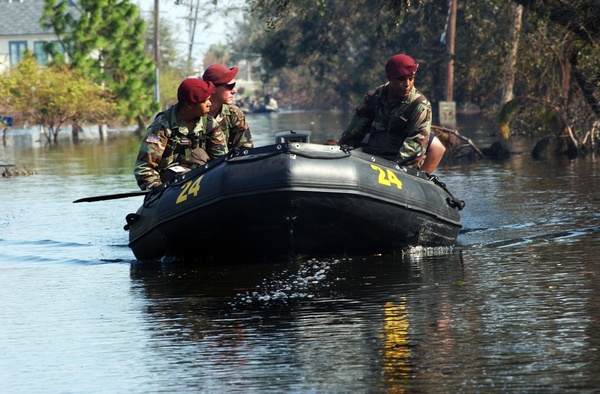
1422Soldiers from the 82nd Airborne Division conducting Search & Rescue Operations in flooded sections of New Orleans. Source: Department of Defense.

In order to facilitate the integration of military forces at all levels, the common operating language of ICS, MACS, and NRF, are taught to National Guard troops, and troops assigned to U.S. Northern Command.  Incident Command System is organization at the tactical and operational level that allows for personnel from multiple agencies to integrate into mission-specific organizations to facilitate unity of effort- led by an Incident Commander.  For example, during the response to the Deepwater Horizon oil spill, an ICS organization was created utilizing all agencies of the U.S. Government and the Incident Commander was Admiral Thad Allen, USCG (Ret).[15] 
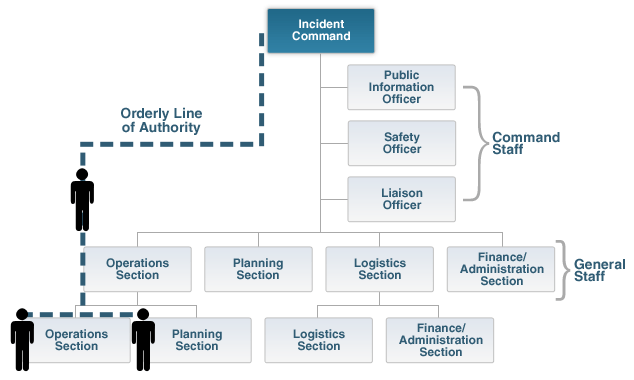
7ICS Organization Chart. Source: Federal Emergency Management Agency.

The Multiagency Coordination System (MACS) is the policy working group of the response. Such a group is facilitated by an Emergency Operations Center, and consists of policymakers with the ability to make strategic decisions.  Their mission is to implement policies that assist the ICS organization responding to the disaster to better accomplish their mission. Conversely the National Response Framework (NRF) is a document that establishes agency responsibilities and roles in a variety of disaster responses.[16]  

Current Doctrine for Foreign Humanitarian Assistance/Disaster Response            

The doctrine for Foreign Humanitarian Assistance/Disaster Response is similar to the doctrine for Defense Support to Civil Authorities, but there is no common operating language or framework. The doctrine first looks at how a host nation requests assistance and how a mission is assigned to military forces in an area.  When a disaster occurs, the host nation government requests assistance from the United States through the Ambassador. The Ambassador, through the Department of State, provides that request to the President, who approves or denies it. From that point the lead agency for coordination is the U.S. Agency for International Development through its Office of Foreign Disaster Assistance, which is similar to the role FEMA plays in domestic response. 
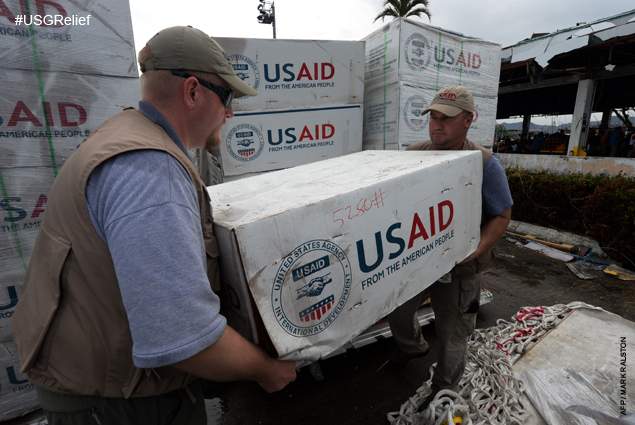
888Members of USAID’s Disaster Assistance Response Team loading aid boxes onto a U.S. Navy Seahawk Helicopter at Tacloban Airport on 17 November 2013. Source: U.S. Agency for International Development.

From this point it is determined if defense support will be needed for the mission- if so it is requested through the Department of Defense, who in turn tasks the mission to the appropriate Geographic Combatant Command.  In turn, the Geographic Combatant Commander will appoint a JTF Commander, who will provide resources.  Once the Joint Task Force arrives on site, it must integrate with other agencies of the U.S. Government, host nation forces, and any International/NGO forces.  How that integration occurs is completely up to ad-hocracy, coming up with an organizational structure on the fly.[17] 

The doctrine primarily focuses on where to deploy Liaison Officers.  It recommends deployment to a series of coordination centers for: the host nation Government, the U.S. Embassy, UN Country Team/Mission Headquarters, Information Centers, Intelligence Centers, and the list goes on.  Most importantly, the focus is that the U.S. Government Joint/Interagency Task Force responding to this disaster has to respond immediately, but go through the entire process of integration and develop a common operating language simultaneously. 
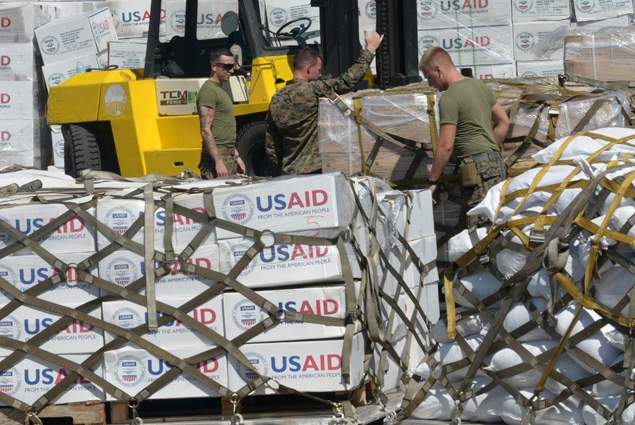
854Marines in Manila, Philippines, loading pallets of USAID relief boxes onto a KC-130 to be delivered to victims of Super Typhoon Haiyan in Tacloban on 15 November 2013. Source: U.S. Agency for International Development.

Recommendations for ICS Doctrine in Foreign Humanitarian Assistance/Disaster Response

ICS doctrine should be adapted to Foreign Humanitarian Assistance/Disaster Response, in order to help increase the efficiency of U.S. Armed Services response to foreign disasters.  ICS is already being utilized by civilian U.S. Government agencies for their response doctrine, especially the USAID, which is the federal coordinating agency for foreign disaster response. The federalist system of disaster response currently utilized in statutes and doctrine is similar to foreign response. The United States is after all a supranational organization of fifty sovereign states (who have given up little chunks of their sovereignty).  Each state has its own government structure and security forces (including military forces) that operate under the orders of a Governor, and the United States Government cannot intervene without the request of that Governor (except for limited circumstances). Such a system can be in place for international response.

A basic ICS education should be taught to all service members who may be deployed on a foreign HA/DR mission. This is a very simple syllabus, and could be taught over short periods of time, and would include curriculum already available through the FEMA Independent Study Program. The various centers where LNOs can be deployed can simply be defined as Emergency Operations Centers, and JTF Commanders can integrate at a minimum with other U.S. Government Agencies in an ICS Organizational HQ. The Ambassador, USAID Response Team, and Global Combatant Command Response Team can serve as a MAC Group for U.S. Government Response, and integrate with the Host Nation’s policymaking group. A Joint Interagency Task Force at the Global Combatant Command can serve as a reach back center for the MAC Group, and in turn reach back to National Command Authority in Washington. 

In order to facilitate an integrated doctrine for both Defense Support to Civil Authorities and foreign HA/DR, it would be important to centralize proponency for that doctrine. The best place to do so would be within the Political-Military Affairs Branch of the J-5 Directorate (Strategic Plans & Policy) of the Joint Staff. At a minimum, integrating this common operating language and structure into the doctrine for Foreign HA/DR will allow U.S. Military Forces to integrate with other U.S. Government agencies.  Domestic and foreign disaster assistance should utilize doctrine that is built around integrating military forces into a whole of government response, whether or not they are forces from the National Guard under state control integrating with state and federal agencies or federal troops integrating with host nation response agencies during a disaster.

Conclusion

Both domestic and foreign Disaster Response/Humanitarian Assistance missions are essentially the same mission, but simply occur in different spaces. Both missions should have the same doctrine, in order to help U.S. military forces integrate with other response forces quickly in order to more efficiently respond to disasters. Integrating the ICS, MACS, and NRF doctrine from FEMA into the training for active duty forces that may perform HA/DR abroad will help achieve the goals of that mission. 

Robert C. Rasmussen is a Second Lieutenant in the New York State Guard, and currently serves as the Aide-de-Camp to the Commanding General of the New York State Guard.  He holds a MA in International Relations and a CAS in Security Studies from Syracuse University, and BA in International Relations & Geography from SUNY Geneseo.  He served on State Active Duty in support of Operation Hurricane Sandy from November 2012-January 2013.  His views are his own and do not reflect those of the New York State Division of Military & Naval Affairs.

[1] Dunk, Marcus,  “Will Krakatoa Rock the World Again?  Last Time It Killed Thousands and Changed the Weather for Five Years, Now It Could Be Even More Deadlier…”  Daily Mail Online,  31 July 2009, http://www.dailymail.co.uk/news/article-1203028/Will-Krakatoa-rock-world-Last-time-killed-thousands-changed-weather-years-deadlier.html.

[2] Author participated in disaster relief operations attached to Task Force Blackheart (642nd Aviation Support Battalion, NY ARNG) and Team Sandy (Joint Task Force Empire Shield) from 19 November 2012-22 January 2013.

[3] Federal Emergency Management Agency, “National Incident Management System,” https://www.fema.gov/national-incident-management-system

[4] Department of Defense, “Joint Publication 3-28: Defense Support to Civil Authorities,” http://www.dtic.mil/doctrine/new_pubs/jp3_28.pdf, 31 July 2013.

[5] Department of Defense Inspector General, “Evaluation of Department of Defense Interaction with State Defense Forces,” 30 April 2014, http://www.dodig.mil/pubs/documents/DODIG-2014-065.pdf

[6] McNeil, Deano, “Naval Militia: an Overlooked Domestic Emergency Response Option,” In Homeland Security, 30 April 2015, http://inhomelandsecurity.com/naval-militia-an-overlooked-domestic-emergency-response-option/

[7] U.S. Agency for International Development, “Disaster Risk Reduction- East Asia & the Pacific,” 30 September 2012, https://www.usaid.gov/sites/default/files/documents/1866/eastasia_drr_fs01_09-30-2012.pdf

[8] Federal Emergency Management Agency, “IS-700: Introduction to the National Incident Management System,”  31 October 2013, https://training.fema.gov/is/courseoverview.aspx?code=IS-702.a

[9] National Guard Association of the United States, “NGAUS Fact Sheet: Understanding the Guard’s Duty Status,” http://www.ngaus.org/sites/default/files/Guard%20Statues.pdf.

[10] II Marine Expeditionary Force, “Marines Land at Breezy Point,” 9 November 2012, https://www.youtube.com/watch?v=XZhZFRRgtWg.

[11] Author served with the New York State Guard Element of Headquarters, Joint Task Force Sandy from 3-19 November 2012.

[12] U.S. Army Corps of Engineers New York District, “Army Corps Responds to Hurricane Sandy,” New York District Times, January 2013, http://www.nan.usace.army.mil/Portals/37/docs/nydistricttimes/2013/New%20York%20District%20Times%20Hurricane%20Sandy%20Edition.pdf

[13] Brinkerhoff, John, “Understanding the Posse Comitatus Act and the Insurrection Act,” Defense Technical Information Center, 2008, http://www.dtic.mil/dtic/tr/fulltext/u2/a494995.pdf

[14] Department of the Army, “The Army Responds to Hurricane Katrina,” 10 September 2010,  http://www.army.mil/article/45029/The_Army_response_to_Hurricane_Katrina/

[15] Marine Log, “Thad Allen Named National Incident Commander for Deepwater Horizon Spill,” 1 May 2010,  http://www.marinelog.com/DOCS/NEWSMMIX/2010may00010.html.

[16] Federal Emergency Management Agency, “IS-701: NIMS Multiagency Coordination System,”  12 October 2010, https://training.fema.gov/is/courseoverview.aspx?code=IS-701.a

[17] Department of Defense, “Joint Publication 3-29: Foreign Humanitarian Assistance,” 3 January 2014, http://www.dtic.mil/doctrine/new_pubs/jp3_29.pdf

Featured Image: Soldiers assist residents displaced by Hurricane Sandy in Hoboken, N.J., Oct. 31, 2012. The soldiers are assigned to the New Jersey National Guard. U.S. Army photo by Spc. Joseph Davis.

Students need disaster preparedness skills

Mr Khamis Arazak, the Coordinator for ‘Disaster Preparedness and Management Commission (DPMC)’ in Pemba, said that children in schools at all levels should understand the need for disaster preparedness so that they can rescue themselves or help others in case of disasters while at home or in school.

“Natural disasters and those caused by man are becoming common. We have decided to educate children in schools so that they remain well prepared,” said Mr Arazak. Students at the Benjamin William Mkapa College of Education at the State University of Zanzibar (SUZA) were among the students in Pemba to benefit from the disaster preparedness awareness campaign.

He said lack of knowledge about disaster preparedness remains a big challenge among communities in Zanzibar and that his office has decided to run an awareness campaign so that people including children can be in a better position to respond to disasters.

Mr Makame Khatib Makame from DPMC told the students at SUZA that a house or a village can be hit by disasters if it is located in a risky area.

“Causes of disasters are many including climate change, improper disposal of wastes, political unrests, environmental ruin by sand digging and felling of trees. Ms Jokha Hakim Seif, a students’ president, commended the (DPMC) for the awareness programmes, saying it should be extended to villages.

Preparing for disaster in Tokyo / Apartment residents take initiative in preparedness

http://crossroads.org/images/full/MI-Disaster%20Preparedness%20Team%20-Emergency-Checklist-Web-LG.jpg

The Rune Kichijoji 14-story apartment, located in the Kichijoji-Minami district of Musashino, Tokyo, is home to approximately 150 households. One weekday afternoon in late February, walkie-talkie training was held at the apartment for members of its self-appointed disaster-preparedness committee. About 30 members participated: two or three per floor, with most of them women in their 60s and 70s.

Five years ago, in the aftermath of the Great East Japan Earthquake, the building’s elevators stopped working. “What will happen if an even worse quake hits?” said worried resident Keiko Adachi, 64. In response to her appeals, the committee was formed in 2013.

Adachi was partly spurred by a disaster-preparedness session held by the city, at which she was told, “If a building isn’t damaged, we want residents to stay at home instead of going to a shelter.”

The committee took half a year to create two handbooks: a general one for residents and one for committee members. They contain important points to note in times of disaster, such as “the elevators, water and toilets will be out of service” and “every household will be expected to store their own food and water supplies.” They also provide instructions on using the emergency dialing service.

Residents formulated an emergency action plan. If a quake measuring at least lower 5 on the Japanese seismic intensity scale of 7 hits, the committee will establish a task force headquarters in the assembly hall on the building’s first floor.

The cost of the 14 walkie-talkies, one for each floor, that the committee purchased was covered by the apartment’s administrative fees and Land, Infrastructure, Transport and Tourism Ministry subsidies.

The apartment was constructed 38 years ago, and has long seen strong interaction among its residents through events such as parties in the assembly hall.

“The planning is like an extension of our everyday chitchat, so we’ve been able to keep it up and move forward,” Adachi said with a smile.

Shelters prioritized     

According to a 2013 Tokyo metropolitan government survey, there are 133,000 apartments in Tokyo. Housing estimates compiled by the Internal Affairs and Communications Ministry the same year say that 3 million households, or 46 percent of the overall total, live in apartments. In Chuo Ward, the percentage is 88 percent.

If the power goes out and elevators stop functioning, residents of a building will need to go up and down the stairs in order to access restroom facilities and water supplies. Shelters will have priority for aid supplies, and it is not believed such supplies will be distributed to apartments.

Rune Kichijoji’s initiative is being supported by the Mansion Life Continuity Association based in Chiyoda Ward, Tokyo. Its managing director, Taro Iida, 73, said: “Authorities will concentrate lifesaving efforts on areas with a high density of wooden residences, and apartments won’t receive assistance until later. Residents of apartments need to train on a regular basis and store emergency reserves so they can survive on their own.”

Tokias is a 20-story condominium located near JR Minami-Senju Station in Arakawa Ward, Tokyo. One Sunday in late February, about 15 residents whose ages ranged from middle school age to their 90s gathered in the first-floor meeting room to discuss plans.

“When you are unaware of what kind of people are living in a place, you can’t guess whether there might be injured people in a given room,” one of them said. After it was decided that the residents should meet and become acquainted with one another, a meet-and-greet event was proposed.

The building is 11 years old and has 620 households. Yuji Hirasawa, 52, became the community association’s chairman in 2008. In exchanging information with other apartments, Hirasawa became aware of the importance of making an effort in disaster preparedness. In 2014, he began his second term as chairman and launched a variety of initiatives.

To draw up a list of the building’s residents, he revised the management agreement so it requires residents to provide occupant information annually. He also introduced a system for residents to confirm their safety via the Internet.

There is still much to be done. About 300 people gather every October for the disaster drill — a big increase compared to previous years, which attracted only dozens of residents — but the overall participation rate is still only 17 percent. According to a survey conducted among the tenants in December, only 60 percent have stockpiled enough food and water for three days.

Hirasawa said passionately: “We don’t have a goal in addressing disaster preparedness. I’m just going to stay tenacious and keep calling everyone together. Little by little, I want to create a disaster-preparedness plan that suits our needs here at Tokias.

Japan a ‘model of disaster preparedness’, says UN chief

UN Secretary General Ban Ki-moon on Thursday held up Japan’s disaster preparedness efforts as a model to the world ahead of the fifth anniversary of the earthquake and tsunami that devastated large parts of the country’s northeast.

“The rest of the world has much to learn from Japan, if we are to make progress on saving lives and livelihoods, and reducing disaster losses,” he said in a statement.

On March 11, 2011 a magnitude-9.0 earthquake and ensuing tsunami struck northeastern Japan wreaking havoc as more than 15,000 were killed and more than 2,500 still remain unaccounted for in the hardest hit prefectures. The natural catastrophe also led to nuclear meltdowns at the Fukushima Daiichi nuclear power plant.

The “unprecedented” disaster, he said, taught the world a great deal about “the changing nature of exposure to risk and disaster”.

Visitors look out at the evacuation zone area surrounding the Fukushima nuclear power plant. Photo: Bloomberg“After Fukushima, it became clear that we are in a new era in which technology and natural disasters can combine to create danger of a previously unimaginable scale.”

An outcome of the cataclysmic event helped shape the so-called Sendai Framework for Disaster Risk Reduction, which was adopted as an international guideline of action at a UN conference in Sendai, Japan, last March.

“Japan has shown the world how important it is to pause for reflection, to examine the lessons learned from past calamities and to raise public awareness of the importance of prevention and mitigation,” he also said.

Last year at a plenary session the General Assembly adopted a resolution to mark November 5 as World Tsunami Awareness Day. The date was picked to coincide with a day in 1854 when a Japanese farmer in Hiromura village set his rice sheaves on fire to warn neighbours of the incoming tsunami, thus saving countless lives.

Abbott issues disaster declaration in 17 counties hit by weekend rain, flooding

Jose Santivanez stands in flood water as he fishes at River Park in Chandler, Texas Saturday March 12, 2016. Rainy conditions did not stop several dozen fishers from coming to the park, situated along the Niches River. (Sarah A. Miller/Tyler Morning Telegraph via AP) MANDATORY CREDIT (REV-SHARE)

AUSTIN — Gov. Greg Abbott has declared a state of disaster in 17 counties hit by severe rain and flooding.

In a statement issued Monday, Abbott said the state is assisting with evacuations in three East Texas counties and stands ready to assist in swift water rescues.

Heavy rains last week forced the evacuation of hundreds of people in East Texas, as floodwaters rose in several Gulf Coast states.

His declaration covers the following counties: Angelina, Erath, Gregg, Hardin, Harrison, Hood, Jasper, Jefferson, Liberty, Madison, Marion, Newton, Orange, Parker, Sabine, San Augustine and Tyler