Reportase hari 1 Workshop dan Simulasi Hospital Disaster Plan RSUD Ungaran

pembukaan 1

Reportase hari 1

Workshop dan Simulasi Hospital Disaster Plan RSUD Ungaran, Jawa Tengah

Ungaran, 9-10 Agutus 2016

pembukaan 1

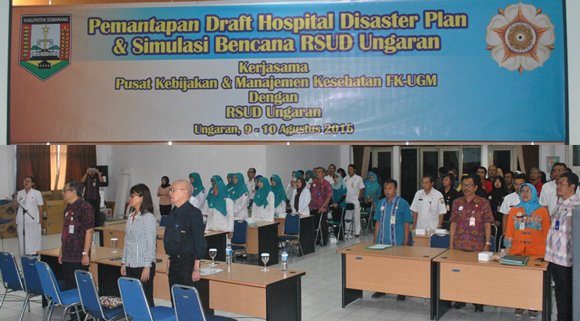
Kali ini, Tim Manajemen Bencana, Pusat Kebijakan Manajemen Kesehatan kembali mengadakan seminar dan workshop HDP. RSUD Ungaran kali ini memilih paket pemantapan HDP (review dan revisi) serta simulasi untuk menguji dokumen HDP yang sudah dimiliki.
Sekurangnya, ada 75 peserta yang mendapat seminar dan sosialisasi HDP di RSUD Ungaran kali ini. Peserta terdiri dari unsur pimpinan, pelayanan, perencanaan, logistik, rumah tangga, hingga keamanan.
pembukaan 2 

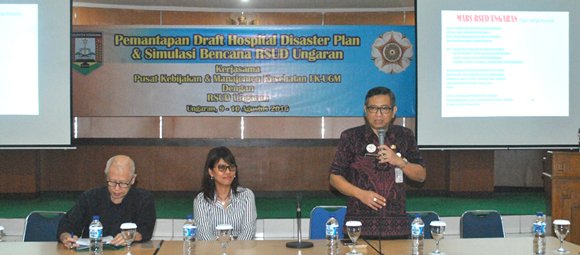
Sambutan sekaligus pembukaan langsung disampaikan oleh Direktur RSUD Ungaran. Beliau menyambut dengan baik antusias pokja bencana di rumah sakit untuk menyelenggarakan kegiatan ini sehingga rumah sakit lebih mengetahui hal-hal apa saja yang masih kurang dan harus dilengkapi oleh rumah sakit untuk siaga dalam menghadapi bencana. Beliau sangat berharap seluruh peserta mengikuti dengan baik proses seminar dan workshop hari ini, serta mengetahui dokumen HDP yang telah dimiliki oleh RSUD Ungaran. Sambutan di tutup dengan menyematkan yel yel RSUD Ungaran.

Materi pertama disampaikan oleh dr. Hendro Wartatmo, Sp.BD. Beliau dapat disebut sebagai aktivis bencana yang dimiliki oleh RSUP Dr. Sardjito Yogyakarta. Sepak terjang beliau dalam kegawatdaruratan telah teruji selama 13 tahun menjadi ketua IGD dan sejak 2014 telah terlibat dalam banyak penanggulangan bencana nasional di Indonesia sebagai tim medis yang dikirimkan ke daerah bencana.

Selalu menarik dari apa yang disampaikan beliau. HDP itu dapat diciptakan dengan baik tanpa rumah sakit terkena bencana dahulu asalkan tidak persis meniru HDP rumah sakit lain, melainkan menyesuaikan dengan kondisi rumah sakit. Dalam pengorganisasian bencana, yang perlu diperhatikan adalah siapa yang menjadi komandan bencana? tidak harus direktur, melainkan orang yang mampu atau menguasai untuk memimpin 4 bagian di bawahnya (logistik, perencanaan, keuangan, dan operasional) pada saat bencana. Selain itu, dalam menyususn pengorganisasian bencana, struktur bukanlah hal yang baru, melainkan mencocokkan kegiatan harian menjadi situasi bencana. Akan lebih baik jika berdasarkan jabatan dari pada nama personal.
pembukaan 3

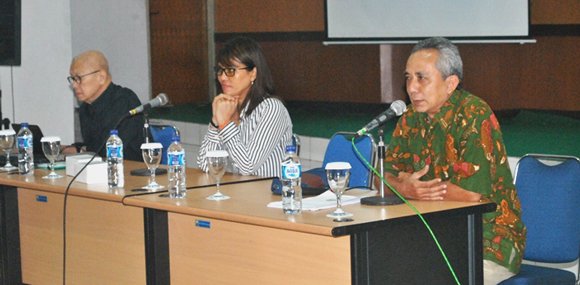
Paparan berikutnya dari dr. Bella Donna, M.Kes. Beliau menyampaikan mengenai pengorganisasian dan fasilitas HDP. Menyambung penjelasan dr. Hendro, untuk membuat pengorganisasian saat bencana dapat menggunakan metode cross walk. Kita bisa menyandingkan struktur organisasi situasi normal dengan pengorganisasian yang akan diaktifkan pada saat bencana saja.

Pada point fasilitas, beliau menjelaskan mengenai fungsi ruangan yang disiapkan jika terjadi becnana. Termasuk, hal dan alat apa saja yang harus ada pada ruangan-ruangan atau fasilitas tersebut. Misalnya Pos Komando, carilah ruangan yang aman yang jauh dari bagian operasional, digunakan untuk rapat dan koordinasi, di dalamnya tersedia peta daerah, denah rumah sakit, dan kartu tugas.

Terakhir, paparan dari dr. Sulanto Saleh Danu, Sp.FK yang menjelaskan mengenai manajemen logistik pada saat bencana. logistik pada dasarnya terbagi menjadi tiga, yaitu logistik personal, logistik tim, dan logistik operasional. Jika kita berbicara mengenai HDP maka akan lebih banyak dibahas mengenai logistik operasional. Bagaimana tim logistik mampu merencanaan kebutuhan logistik dan menjamin ketersediaannya jika terjadi bencana.

Setelah istirahat siang, kegiatan dilanjutkan kembali dengan satu paparan mengenai komponen-komponen HDP oleh dr. Bella Donna, M.Kes. Komponen HDP pada dasarnya seperti daftar isi sebuah dokumen. Apa saja yang direncakan harus masuk dalam dokumen tersebut sehingga siapapun yang akan menggunakannya suatu saat bisa langsung digunakan.
pembukaan 4

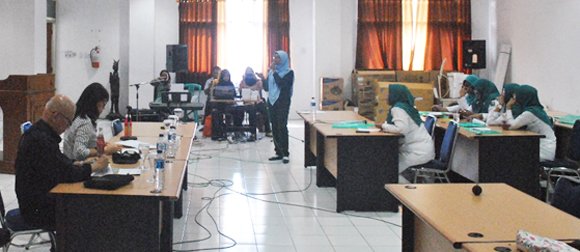
Satu jam kemudian, dr. Dewi dari RSUD Ungaran memberikan sosialisasi dokumen HDP RSUD Ungaran. Analisis situasi rumah sakit terhada ancaman bahaya di Ungaran telah masuk pada latar belakang, termasuk SOP yang coba disusun dan tupoksi pada pengorganisasian HDP. Namun, seperti poin fasilitas dan bagan pengorganisasian masih perlu ditambahkan lagi. Harapannya, pada saat simulasi esok, rumah sakit mampu menjalankan HDP mereka. Apapun hasilnya akan menjadi masukan yang berharga bagi perkembangan HDP RSUD Ungaran.

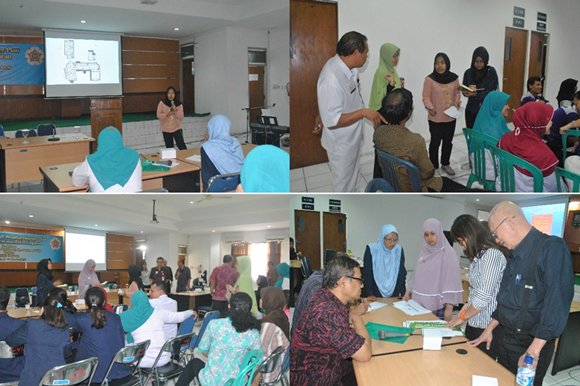
Kegiatan terakhir hari ini adalah penjelasan skenario simulasi oleh Madelina Ariani, MPH. Kemudian, kelas dibagi menjadi dua tim yakni tim HDP dan tim korban. Tim korban terdiri dari petugas, staff, dan relawan dari mahasiswa magang. Sedangkan tim HDP juga dibantu oleh staff rumah sakit yang esok bertugas dalam simulasi ini. Kasus simulasi yang akan digunakan esok adalah simulasi kebakaran. Skenario ini akan terus mendapat suntikan kasus selama berlangsung nanti.
pembukaan 5

Report Day 2 Insarag 2016

day-2-insarag

Report Day 2: Tuesday July, 26 2016

Coverage from the Kalasan Room
Center for Health Policy and Management (CHPM), Faculty of Medicine, Universitas Gadjah Mada-Jogja.

INSARAG ASIA PACIFIC REGIONAL EARTHQUAKE RESPONSE EXERCISE

Yogyakarta, 25-28 July 2016


Emergency Medical Team (EMT) Group Discussion

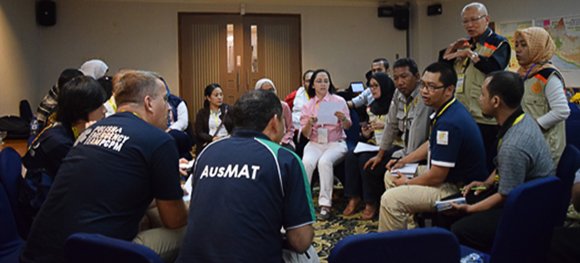
EMT meeting day two was held in Tuesday, July 26, 2016 in Kalasan Room, Inna Garuda Hotel,Yogyakarta.  This session purpose to discuss how they will act in simulation process for tomorrow. This team consist of player, local government and emergency medical team. This team agreed that all of EMT international should registered in Ministry of Health (MoH), Indonesia Republic. If they already registered, it will make a simple way if Indonesia need EMT International (when natural disaster came).

day-2-insarag

The second session was presentation from 4 speaker, from Health Crisis Center MoH, Pusat Penanganan Krisis/PKK or Health Crisis Center Central Java Regional, DIY Province Health Office, and lesson learnt from Faculty of Medicine, UGM. dr. Ira C Tresna explain about the position of MoH and team for tomorrow simulation. MoH will accept all of EMT international and distribute them to disaster area. The next speaker, Haris Kurniawan, SKM (Health Crisis Center, Central Java Regional) describe that HCC Regional is extension of the hand’ of MoH. Haris and team claim that they was a group of crazy people that respected. In short term, HCC Central Java will make a training for volunteers about basic life support and water rescue.

dr. Anung Trihadi from Health district office, DIY Province recite about Standard Operating and Procedure (SOP) when emergency disaster came. MoH will base in Health district office, DIY Province, and MoH will command HCC, EMT international, call center 118, BPBD (Local Disaster Management Agency), BNPB (National Disaster Management Agency) and another team or volunteers.

dr-hendroLesson learnt from Faculty of Medicine, UGM explained by dr. Hendro Wartatmo, Sp. BD. Hendro was lecturer in UGM, a doctor and Disaster Working Group member in FoM UGM. He told about Merapi eruption and Bantul earthquake. Merapi eruption causing mental and physics. It is happen because major explosion would occur in 2006. That’s why preparedness is never enough. We already knew that Merapi always gave us a slowdown lava before.
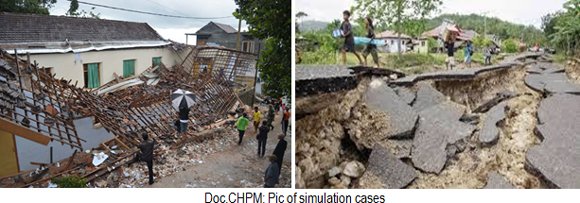
Bantul earthquake made a huge movement to health disaster team in DIY. It was valuable experience in disaster management. Why? Because when Bantul earthquake, Hendro saw an emergency hospital from EMT international on the center of main road. And it was recorded 400 operations are performed in the first 30 days after the earthquake but the data is not detail. So, the conclusion is, in disaster management we are not lack of resources but lack of coordination.

In the middle day session, Supriyadi, Klaten, Central Java, one of the former SAR and Klaten Red Cross volunteers share experiences about what is most important in a disaster and hopes disabilities to be more involved in decision making in the treatment of victims. Supriyadi suffered physical trauma, spinal fractures so use a wheelchair to move. Experience when an earthquake occurs, he has a basic self-rescue, then it could escape, but there are his children who were aged 1 year at that time, then Supriyadi save his son, he became earthquake victims. Currently, many countries that have ratified the CRTF and Sendai Framework, which is a joint agreement to reduce the risk of catastrophic risks. There are 3 points of Sendai Frmework, ie the threats, vulnerabilities and capacities. Disability is currently regarded as a vulnerability, Supriyadi hope each country involving disability opinion as input to determine policy. They also have the capability to reduce the risk of disaster. They are now involved in decision making and policy. It used to be only separated groups of children and gender segregation before.  But now, the existing data classified only age and gender. After Indonesia ratified the Sendai Framework, disability data collection has been done the appropriate form. However, our home work is how the business of international EMT team to be able to work together with the inclusion of persons with disabilities?
 
emt-coordination

After Supriyadi’s sharing session, the next session of the group is split into 4 groups discussion: for Logistics, Coordination, Culture, Clinical cases with facilitator dr. Ali Haedar, SP. EM, dr. Cristrijogo Sumartono W, Sp. An, KAR, Alfrinna Hanny, MN, and dr. Surya Prananda Airlangga, Sp. An, M. Kes, KIC.
Some list of questions that raised during the discussion are:

  • Is there a cultural shock when registration EMT International to Indonesia?
  • If there are cultural differences, what to prepare?
  • Does it need a permit if a male doctor checking female?
  • Do customs check of EMT international drug arrivals?
  • Is there a cultural prohibition if the foreign teams will help?

The results of the group discussions will be used for international EMT simulation which will be held tomorrow (Wednesday, July 27, 2016) with hundreds of health care workers and other volunteers from Indonesia and abroad.

Report Day 3 Insarag 2016

day3 1 insarag

Report Day 3: Wednesday July, 27 2016

Coverage from the Kalasan Room
Center for Health Policy and Management (CHPM), Faculty of Medicine, Universitas Gadjah Mada-Jogja.

INSARAG ASIA PACIFIC REGIONAL EARTHQUAKE RESPONSE EXERCISE

Yogyakarta, 25-28 July 2016


Simulation Day 1

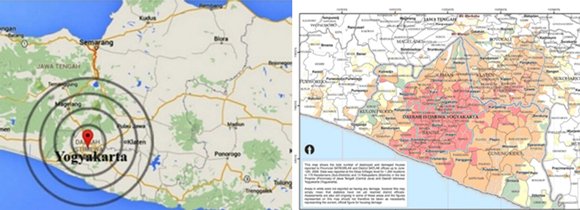
An earthquake has struck Yogyakarta on Tuesday night 26 July 2016 and shudder three district in Special Region of Yogyakarta, more precisely the earthquake hit Bantul district, Sleman district, and Yogyakarta municipality. Communications were cut off, thousands of people have died and the wounded have been taken to the hospital for medical assistance.

day3 1 insarag

An Earthquake is a sudden and violent shaking of the ground, sometimes causing great destruction, as a result of movements within the earth’s crust or volcanic action. Such natural phenomenon happens frequently in an area that is close to volcanic mountain and also in the areas that is surrounded by vast oceans.

National Search and Rescue Agency Republic of Indonesia in collaboration with the local or international EMT (Emergency Medical Team) are immediately dispatched to the affected areas, to evacuate and carry out medical assistance to relief the emergency situation caused by the earthquake.  
day3 2 insarag

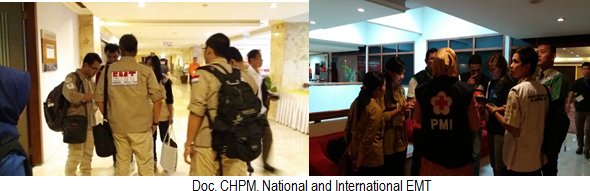
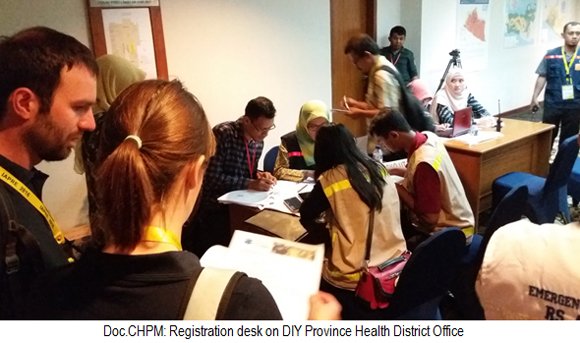
All of the EMT, both national and international, are directed to registration booth in the Yogyakarta Special Region Public Health Center before carrying out their duties. This is to allow initial assessment of the needs, current situation and to decide the most appropriate measures in responding to the emergency situation.

day3 3 insarag

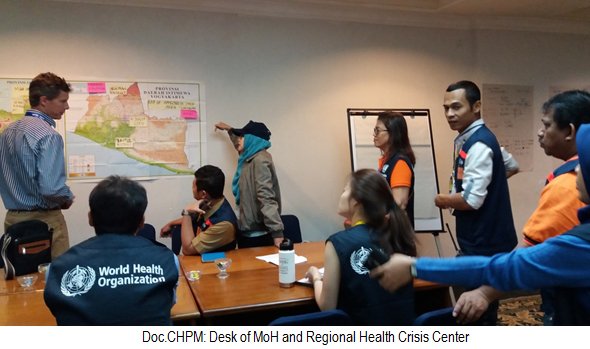
When the EMT team has finished the pre-registration in the Public Health center in DIY, they are directed to the minister of health office to know the current situation. The EMT is then directed to the district health office representative of the affected areas (Sleman health district, Bantul health district, and Yogyakarta health office); those who received assignment from the health district concerning the number of the EMT personnel needed to be deployed are directed to the data management room.

day3 4 insarag

After conducting field duties, the EMT team writes a daily report that will be returned to the corresponding district health office to allow monitoring EMT needs and in order to meet challenges in the field such as human resources needs, drugs, and determine medical assistance. After the EMT team has carried out their duties, they quickly return to the health district to report their finding in the field and update the current situation in the affected area.
Earthquake can happen at any time without any warning. However, the epicenter tends to occur in certain areas such as pacific tectonic plates. This is known as the ring of fire due to the great number of volcanic mountains.

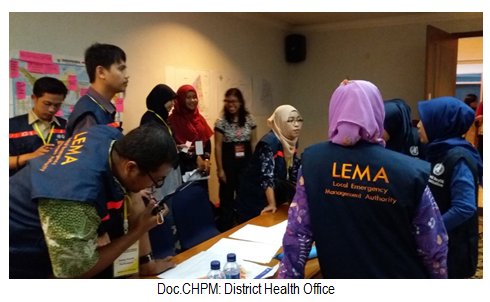
Doc.CHPM: District Health Office

day3 6 insarag
 

Report Day 4 Insarag 2016

day4 1 insarag emt simulation

Report Day 4: Thursday July, 28 2016

Coverage from the Kalasan Room
Center for Health Policy and Management (CHPM), Faculty of Medicine, Universitas Gadjah Mada-Jogja.

INSARAG ASIA PACIFIC REGIONAL EARTHQUAKE RESPONSE EXERCISE

Yogyakarta, 25-28 July 2016


Simulation Day 2

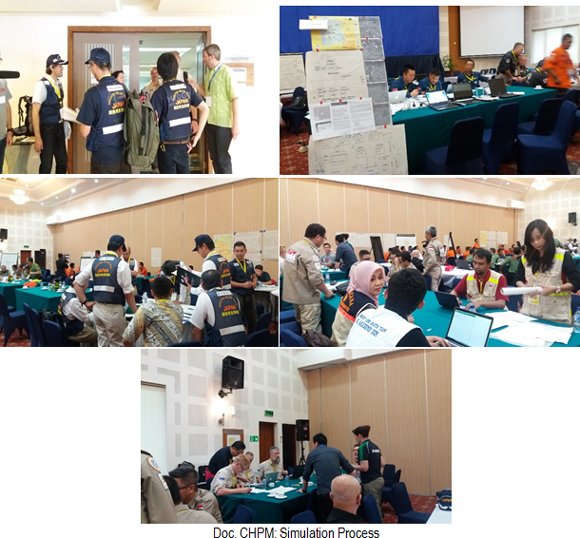
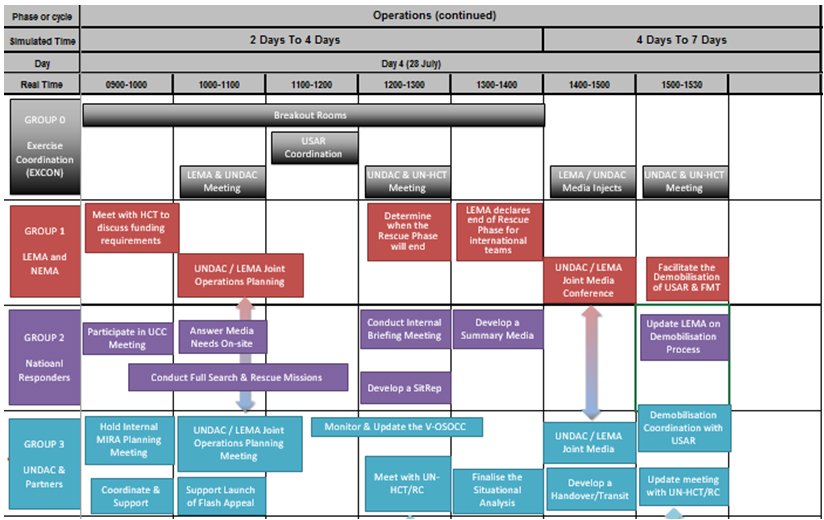
Simulation of Emergency Medical Team second day was held on Thursday (28 July 2016) from 08:00 AM until 17:00 PM. One of the teams who enthusiastically followed the simulation with members groups from Indonesia, Malaysia and Poland. The team originally headed public health sector, where the situation is 14 days after the disaster, where still many problem, such as water shortage, many emerging disease (malaria, dysentery, diarrhea and others). Then, the team towards sectors A, B, C and D. During the journey to the whole sector, the members do sharing experience.

day4 1 insarag emt simulation

In this group, representatives of Muhammadiyah Disaster Management Center (MDMC) communicating even when disaster happen, many people are waiting in line for free medicines and vitamins from the health post. When in sector B, many of the participants draw the same conclusion, when a disaster occurs, the uniform becomes a problem in itself, because many volunteers who are not in uniform.
                                   
Doc. CHPM FoM UGM Participant from Poland
This first task from this simulation on the second day that must be done is to examine the entire sector participants, identify needs and find the best strategy for dealing with victims and disaster management. Besides this, the team must provide feedback to the Ministry of Health in the end of simulation.
After about 30 minutes had passed, all participants sat together again with the Ministry of Health to report a number of obstacles encountered when walking visited many sectors earlier. Ashraf, a participant from Malaysia ask if there are doctors and health workers who provide services illegally, then where to report or what to do? The Ministry of Health confirms the parties, the Ministry of Health will conduct a sweep on the fourth day and will provide escort for health workers illegal.
Representatives of MDMC ask, there have been cases in one of the sectors that the vaccine runs out and there is no vaccine cold chain, then what to do? The Ministry of Health represented by Central Java Regional PPK answered teams MDMC please contact the Yogyakarta Provincial Health Office, if not there, then contact the Ministry of Health directly. Representatives from Airlangga University in the Post asking his case ketamine, antibiotics and adrenaline stolen, one of the concerns raised is that these drugs will be misused by irresponsible people. Ministry of Health to clarify the case of theft of this kind, the Ministry of Health will contact the cluster security (police and military) and it will be investigated.
Participants of the International EMT then asked the volunteers after 14 days at the site, whether local governments still need help and their aid? Ministry of Health states do not require assistance from all of the EMT (national and international) and will activate all health professionals and local health facilities that exist.

day4 2 insarag emt simulation

Participants of Yakkum Emergency Unit (YEU) asked if there were any casualties or patients with spinal cord injury, how work arounds? Ministry of Health explained that the patient can be referred to the state-run rehabilitation center in Bantul and Solo. The government will also ask the help of the military and police in the transfer.

Representatives of MDMC back asking if there is a patient with a psychiatric disorder, Should MDMC team to be done? Central Java Regional PPK stated, please contact RS Grhasia Pakem (Sleman) to care for these patients. This is a special hospital for psychiatric disorders.

Question of the representation Panembahan Senopati Hospital is that if there are three bodies that have not been well identified, what to do? The Ministry of Health stated, immediately contact the Department of Health and the local Regional PPK, these two institutions that will connect to the police, where the DVI will help.

After a long discussion and fun, participants take a rest for an hour and then back again to the discussion room. The themes discussed next is a matter of what the final findings of the whole circuit simulation is an emergency medical team. The Ministry of Health stated, there are some crucial matters summarized from many EMT International reporting to the Post Ministry of Health, including: clean water, infrastructure damaged and the limited vaccine.

Thus, the Ministry of Health provides a number of solutions. First, the supply of clean water taps Inside Commander will cooperate in providing them. Then the damaged infrastructure, the Ministry will contact the Ministry of Public Works. Lastly, the vaccine will be promoted and distributed. Closing statement of the Regional PPK is the data from field hospital / emergency no longer exists referred patients.

Harris Kurniawan, SKM as the representative of regional PPK stated simulating international EMT’s provide a lot of new experiences, one of which is the management organization of EMT and how to receive and distribute foreign aid to Indonesia, both human resources, as well as other drugs.

Representatives of Poland states, we (EMT international) should have been contact with the volunteers or local NGO before the international EMT dating because of differences in language and culture. In fact, the information related to the disaster area is dominated local volunteers. Representatives from China asserted, international EMT simulation is very useful and hope in the future, we all international volunteers could become one family.

EMT International of China and Japan agreed to, the current constraints EMT team of international is when registering at the local post where when interacting with people in Indonesia who lack good English skills. International EMT China and Japan said they were very stressed at the beginning of his arrival in Indonesia.

Closing statement of the representative of the international EMT is the difficulty of collecting daily reports, what’s being done every day for providing services at the site. At the end of the session, the Ministry of Health requested that all international EMT register how many patients who were transferred from the emergency hospital as well as tools, or anything that will be donated to the Indonesian authorities.

Closing INSARAG International Simulation EMT 2016

Closing of the international EMT simulations have been conducted on Thursday, July 28th, 2016 at 16:00 pm at the Inna Garuda Hotel. Delivered closing remarks of the three parties, from INSARAG, UNOCHA and BASARNAS. In addition, the handover keepsake simulation to four volunteers are representatives of China, Indonesia (BASARNAS), ASEAN and Australia Rapid Statement Med. Party UNOCHA stated international EMT simulation is very challenging and fun. UNOCHA also expressed great gratitude for outstanding hospitality BASARNAS.


Report Day 1 EMT Session

pembukaan-insarag

Report Day 1 EMT Session, Monday July, 25 2016

Coverage from the Nakula Sadewa Room
Center for Health Policy and Management (CHPM), Faculty of Medicine, Universitas Gadjah Mada-Jogja.

INSARAG ASIA PACIFIC REGIONAL EARTHQUAKE RESPONSE EXERCISE

Yogyakarta, 25-28 July 2016


Emergency Medical Team Session

Our country is considered by many as a country that is plagued with disasters. These disasters are either caused by natural disasters such as earthquake, floods, tsunami, and many other causes or from human activities such as bombing terrors, civil unrest, fire or even accidents at work due to human negligence. As part of the ERT (Emergency Response Team), the Medical Emergency Response Team (EMT) focuses on providing medical assistance to the disaster victim.

pembukaan-insarag 

ERP (Emergency Response Plan)  management system is always needed and must ready to be implemented in the event of an emergency, therefore it is advised that every corporation incorporate ERP management system as early as possible. One of the many ways to learn it is through dissemination and Emergency Response Plan exercises, followed by routine and continuous exercises.

It is hoped that through this exercise, participants will acquire knowledge in meaning disaster and conduct emergency techniques accurately. The purposes of the exercise are as follows:

  • To coordinate Emergency Planning efforts/ERP (Emergency Response Plan) therefore efficiency and effectiveness can achieved in managing emergency.
  • To have the proper understanding with the logistics of things concerning with ERP (Emergency Response Plan) as a system that is always needed and implemented in the event of an emergency therefore emergency response can be carried out quickly and with precision.
  • To understand the risk of emergency situation and exercise preparedness in managing emergency situation therefore anxiety and panic can be managed.
  • To be better prepared in reducing the risk of more loses in the event of an emergency.  
  • To manage procedures in conducting Emergency Response thus reducing company loss.
  • To ensure that control measures and ERP (Emergency Response Plan) is well organized.

Report Day 1 – INSARAG ASIA PACIFIC REGIONAL EARTHQUAKE RESPONSE EXERCISE

insasrag-2016-opening

Report Day 1, Monday July, 25 2016
Nakula Sadewa Room, Inna Garuda Hotel

INSARAG ASIA PACIFIC REGIONAL EARTHQUAKE RESPONSE EXERCISE

Yogyakarta, 25-28 July 2016


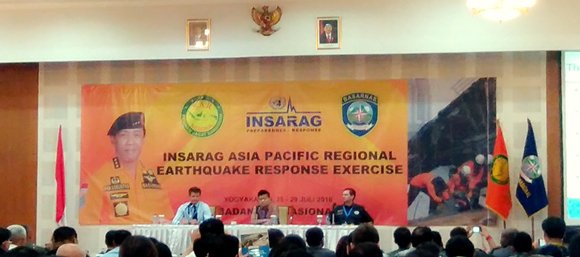
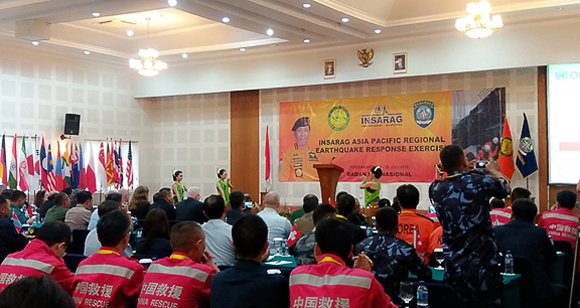
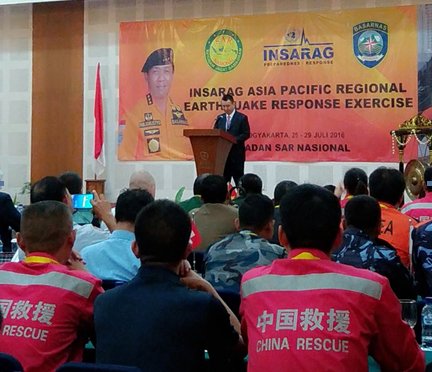
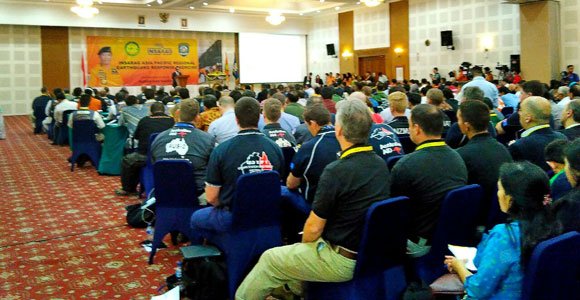
INSARAG Asia Pacific Regional Earthquake Response Exercise was held in Inna Garuda Hotel, Malioboro on Monday, July 25, 2016. The opening ceremony begins with the singing of the Indonesian national anthem by all of the INSARAG participants, and then followed by Gambyong traditional dance.
 
insasrag-2016-opening

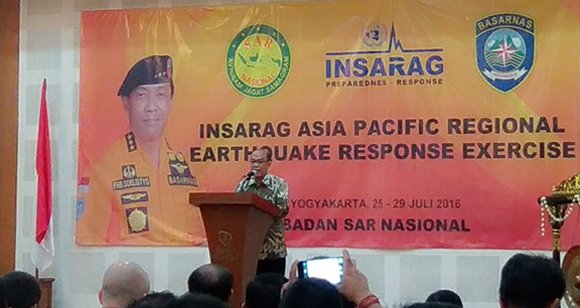
The opening speech came from Mr. Gatot as the Yogyakarta Special Region representative. In his speech, he was very pleased to have the INSARAG Asia Pacific Regional Earthquake Response Exercise held in Yogyakarta. This exercise would increase the capabilities of community of Search and Rescue Agencies especially in managing with earthquakes disaster. This exercise would also create awareness both for the people and the government in Yogyakarta Special Region in managing and providing relief aid due to earthquakes disaster. Furthermore, the regional government views this exercise as an opportunity for Yogyakarta to become the local representative for Indonesia in the international community.
 
insasrag-2016-opening-speech

Mr.Zhao Ming, as the head of INSARAG Asia Pacific Regional added that reflecting from the Banda Aceh tsunami in 2004, Indonesia has demonstrated the ability as a nation capable in dealing with unexpected challenges emerged from such natural disaster.  As a developing country and as a nation that is plagued with natural disaster, it is hoped that through this exercise, Indonesia would like to be ready in managing all kinds of natural disaster.  
Mr.Zhao-Ming---insarag

Mr.Oliver Lacey Hall, Head of OCHA Indonesia/ASEAN Liaison Officer stated that through this exercise it enables a nation to reinforce its safety lines and relief aid, especially Indonesia. As a nation, Indonesia has to be ready at all times to deal with natural disaster.
 

Supporting statement arise also from the head of the Indonesia Search and Rescue Agency (BASARNAS), Air Marshall Mr. FHB Soelistyo, he conceded that there is an opportunity to cooperate and coordinate with other nations and continue its commitment for humanity. It is hoped that in the near future this development of readiness will be maintained and developed along with Indonesia’s regional partner and it can also become a valuable experience and an opportunity for collaboration with the regional government that is hit with the natural disaster as a response to the Indonesian people concerning health and safety in the event of a disaster.

International Simulation for Emergency Medical Team (EMT) Coordination 2016

border-page

Term of Reference

International Simulation for

Emergency Medical Team (EMT) Coordination 

In INSARAG Earthquake Regional Exercise

25-28 July 2016

border-page

pembukaan-emt-international 

Presented by

Disaster Management Division, Center for Health Policy and Management
In Collaboration with WHO representative Indonesia and Health Crisis Center, Ministry of Health Republic of Indonesia


Introduction

Disaster management is need multidiscipline approach. Various disciplines and sectors need to be involved. Health sector is the most important aspect in victim’s aid and health care services during disaster. However, it was realized that the coordination is important to safe victim from search, rescue, and aid both from disaster location, health post, and health facilities.

Following the EAS Australia-Indonesia Rapid Disaster Response Workshop in 2013, the Indonesian National Disaster Management Authority and EMA, in collaboration with the World Health Organization (WHO), hosted a two-day follow-up workshop in Bali, Indonesia on 11-12 June 2014. The workshop provided the opportunity to share country-specific feedback on the Foreign Medical Team (FMT) document among EAS countries, provided preliminary feedback to WHO on options to progress implementation of the FMT concept and enabled solutions to be identified to issues around FMT deployment from the Typhoon Haiyan response. This event also to determine guidelines for FMT deployments and streamlining protocols for assistance in major disasters. Outcomes of the workshop will continue to improve existing disaster response arrangements in the EAS region, assisting countries to better self-manage disasters in their own territories; assist with responding to disasters elsewhere in the region; and better receive, coordinate and integrate international assistance when national capabilities are overwhelmed.

Moreover, there is a Reception and Departure Center (DC) mechanism for international assistance which is an OCHA’s frontline coordination function. RDC will set up at the point of arrival of the affected country (sea port/country road border/arrival airport) by the United Nations Disaster Assessment and Coordination (UNDAC) team or first arriving USAR teams. In recent response to the Philippines Typhoon (2013) and the Nepal Earthquake (2015), RDC had difficulties in logistics limitation (e.g. internet connection) and in responding to the requests from member states (e.g. negotiation of landing permission). In relation with national mechanism of Indonesia, similar post like RDC are regulated in by National Disaster Management Agency (BNPB) in their regulation no.22 year 2010.
Haiti Earthquake reported that there were many Search and Rescue teams and Emergency Medical Team (EMT) involved but from 2000 victims, only 100 victims that could be safe. In another situation, Disaster Victims Identifications teams has difficult to identify death victim because victim’s identity has gone by previous savior team.

Chaos and problems surely happened when disaster, but it can diminished if each sectors has ability to good coordination, sharing their role appropriately, and working in one command. Based on this, in 2015 Local Authority for Disaster Management (BPBD) Special Region of Yogyakarta (DIY) has been initiated to publish Government Regulation (Pergub) regarding the coordination in search, aid, and rescue disaster victims that regulating the role of BASARNAS (National of Search and Rescue Agency), DVI DIY, Center for Health Assistant (PUSBANKES) DIY, Red Cross Indonesia (PMI) DIY. Furthermore, DIY Health District Office had compiled SOP for disaster health management such as activated health cluster and organized domestic and international EMT based on experiences of Jogja Earthquake 2006 and Mount Merapi Eruption 2010. These regulations are need testing to know operational or not.

Related with The INSARAG Earthquake regional Exercise on July 2016 will be our opportunity to test and simulate the collaboration between national and international EMT using both UNOCHA’s RDC integrated with local BNPB/BPBD mechanism. The objectives is involving the local partners and   introducing the international and national RDC and EMT framework as well as to facilitate INSARAG Earthquake Regional Exercise 25-28 July 2016.

Outputs:

The outputs are:
1.    Simulation
2.    Evaluation form

Committee:

The team who initiate and guide overall activities from CHPM FoM UGM, DIY Health District Office, BPBD DIY:

  CHPM FoM UGM

  1. dr. Hendro Wartatmo, Sp.BD(K)BD
  2. dr. Handoyo Pramusinto, Sp.BS
  3. dr. Bella Donna, M.Kes
  4. Syahirul Alim, SKp, Ns, M.Sc, PhD
  5. Madelina Ariani, SKM, MPH

  DIY Health District Office

  1. dr. Anung
  2. Kudiyana, SKM, MSc

  PUSBANKES (Center for Health Assitant)

  1. Sutono, SKp, MSc

  BPBD DIY

  1. Danang Samsu, ST
  2. Enaryaka, SKp  

Participants:

1. Player as Local Government

  • BPBD DIY
  • Health District Office DIY
  • Health Crisis Center, Ministry of Health
  • Health Crisis Center, Central Java Regional
  • Health District Office Sleman
  • Health District Office Kota Jogja
  • Health District Office Bantul
  • Sleman Public Hospital
  • Bantul Public Hospital
  • Kota Jogja Public Hospital
  • Dr. Sardjito Hospital

2. Player as EMT Team

a. EMT in DIY

  • Disaster working group of Faculty of Medicine UGM (Sardjito Hospital, Academic UGM Hospital, and Faculty of Medicine UGM)
  • Muhammadiyah Disaster Management Center (MDMC)/ Muhammadiyah Hospital
  • Yakkum Emergency Unit (YEU)
  • PMI
  • Pusbankes

b. EMT in Central Java

  • Health Crisis Center Regional
  • Health District Office of Central Java province
  • Hospital

c. EMT in East Java

  • Health Crisis Center Regional
  • Faculty of Medicine, Brawijaya University
  • Hospital d. EMT in Bali
  • Health Crisis Center Regional
  • Hospital

e. International EMT

  • Singapura
  • Malaysia
  • Thailand
  • Filiphina
  • Brunei
  • Myanmar
  • Laos
  • Vietnam
  • Kambodja
  • Timor Leste
  • Australia
  • China
  • Japan
  • South Korea
  • America
  • New Zealand
  • India
  • Rusia

Place, Time and Activity Plan
Blue sign for all cluster program
Yellow sign for Health Cluster Activities

Saturday, 23 July – Arrival of EXCONs

Time

Event

Responsible / Venue

All Day

Arrival of EXCONs (Jogjakarta airport)

BASARNAS


Sunday, 24 July – Arrival of Participants

Time

Event

Responsible / Venue

All Day

Arrival of Participants (Jogjakarta airport)

BASARNAS

All Day

EXCONs and Host Country only – Preparation for Exercise

BASARNAS, EXCONs, FCSS

Monday, 25 July – Opening and Preparatory Workshop

Time

Event

Responsible / Venue

0900-1000

Official Opening of the INSARAG Asia-Pacific Regional Earthquake Response Exercise

(Speeches)

– Governor of Jogjakarta (tbc)

– Mr. Zhao Ming, China, INSARAG Asia-Pacific Regional Chair (tbc)

– Mr. Oliver Lacey-Hall, Head, OCHA Indonesia/ASEAN Liaison office (tbc)

– Air Marshal FHB Soelistyo, S.Sos, Head of National SAR Agency of the Republic of Indonesia

Group Photo

Indonesia, China, OCHA

Opening Video


Opening Report

1000-1030

Coffee Break

BASARNAS

1030-1045

Participants Introduction and Adoption of the Agenda and Exercise Overview

  • Objectives of the Exercise
  • History of the INSARAG Ex.
  • Simulation Exercise – Tasks and Injects

Yosuke Okita (FCSS)

1045-1115

Role and Responsibility: International USAR team

  • INSARAG Guidelines Vol. I Policy
  • INSARAG Mandate
  • IEC
  • USAR Response Cycle (Mobilization-Operation-Demobilisation and Beyond the Rubble)
  • INSARAG Global Meeting and Abu Dhabi Declaration
  • World Humanitarian Summit and INSARAG

New Zealand (Regional Vice-Chair 2016)

1115-1145

Role and Responsibility: Emergency Medical team (EMT)

  • EMT operations
  • EMT classification

WHO or international medical team in the region

Presentation Material

1145-1300

Lunch

BASARNAS

1300-1330

Role and Responsibility: HCT and OCHA Country office

  • Contingency Planning
  • Disaster Profile of Indonesia

OCHA Indonesia/HCT

1330-1400

Role and Responsibility: UNDAC

  • UNDAC Overview
  • OSOCC Concept
  • USAR Coordination (not too in detail)
  • Role of UNDAC Partner (DHL, MapAction, etc)

UNDAC member or OCHA, DHL, MapAction

1400-1430

Role and Responsibility: ASEAN and AHA Centre

  • AADMER and AADMER Work Program 2016-20
  • ERAT team

AHA Centre

143-1500

Coffee Break

BASARNAS

1500-1600

Panel Discussion: Domestic Capacity Building in Indonesia

  Facilitator: Rajan Gengaje (OCHA-ROAP)

  Panel:

  • BASARNAS (Rescue Special Unit, SAR Goes to School Project)
  • Indonesian Red Cross (First Responders Training)
  • Donor country (Japan)

Each panel will have 10-minute presentation followed by Q&A session.

1600-1700

KOBO Toolbox

Winston Chang (FCSS)


Report Day 1


1730-2200

Welcome Dinner

BASARNAS

Tuesday, 26 July – Tour to Mt. Merapi and Breakout sessions

Time

Event

Responsible / Venue

07.30-13.00

Tour to Mt. Merapi and observation of USAR Field Exercise and/or a local hospital (No need to bring PPE.)

BASARNAS

13.00-14.00

Lunch

BASARNAS

14.00-14.30

INSARAG Guidelines Overview (USAR Coordination – Basics)

  • INSARAG Guidelines VOl. II-B Operations
  • INSARAG Guidelines Vol. III Field Guide
  • ASR and Sectorisation

Mario Simaz (Switzerland), Tsukasa Katsube (Japan)

14.30-14.40

Earthquake Alert and Scenario Briefing – Simex starts

BASARNAS, EXCONs

14.40-15.00

Coffee Break

BASARNAS

15.00-17.00

Breakout sessions

(1) International USAR teams

  • Detail of USAR Coordination Cell
  • Team Fact Sheet and Virtual OSOCC
  • Marking and Forms

(2) UNDAC team, AHA Centre/ERAT, Partners

  • Virtual OSOCC Management
  • Preparation for deployment
  • Plan of Action

(3) EMTs

  • EMT Coordination
  • Team Fact Sheet and Virtual OSOCC

(4) HCT and OCHA Indonesia office

  • Activation of Contingency Plan
  • Support of the LEMA

(5) LEMA and National Responders

  • Activation of National Response Plan
  • Request for International Assistance (by 1700)

(1700 Technical Break; Dinner: own arrangement)

IEC-classified team in AP

UNDAC/ERAT EXCONs

WHO or EMT in the region

OCHA

BASARNAS

EMT Coordination Report

EMT Coordination Video

Wednesday, 27 July – Simulation Exercise

Time

Event

Responsible / Venue

08.00-

Simulation Exercise starts


08.00-17.00

Simulation Exercise

  • RDC (will be performed at the exercise venue)
  • BoO set up
  • USAR Operations and Coordination
  • OSOCC Meeting
  • Media Briefing, etc.

(Coffee and Lunch will be provided during the Simex)

(1700 Technical Break; Dinner: own arrangement)

BASARNAS, EXCONs

Report Day 3

Thursday, 28 July – Simulation Exercise, Closing

Time

Event

Responsible / Venue

08.00-15.00

Simulation Exercise continued

(1500 Technical Break)

(Lunch and coffee provided during the Simex)

BASARNAS, EXCONs

15.00-16.00

Debriefing by each group and plenary

End of Simulation Exercise

BASARNAS, EXCONs

16.00-17.00

Closing Ceremony

(Speeches)

– Air Marshal FHB Soelistyo, S.Sos, Head of National SAR Agency of the Republic of Indonesia

– Mr. Dewey Perks, USA

– INSARAG Regional Group (tbc)

(Dinner: own arrangement)

Video Simulation Exercise

Report Day 4


Friday, 29 July – Departure of participants

Time

Event

Responsible / Venue

All day

Departure of participants

BASARNAS

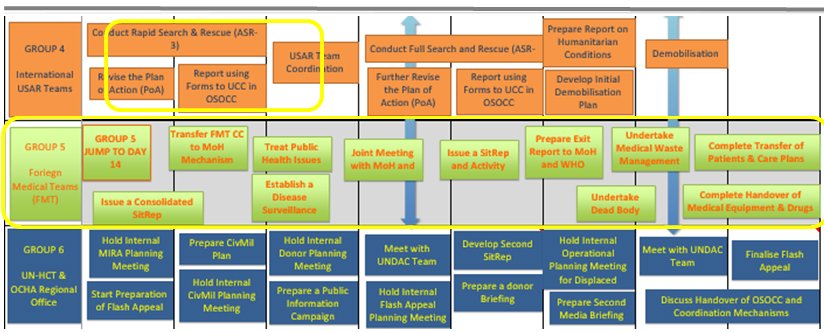
Scenario for health cluster

simulasi-2

Earthquake struck Special Region of Yogyakarta and Central Java on xx xx xxx at bout 07:55:03 WIB for 57 seconds. The magnitude 5.9 SR. Indonesia Agency for Meteorology, Climatology, and Geophysics (BMKG) has reported that the moment magnitude of this earthquake is 6.2 SR. Many sub districts and districts has damaged and destroyed.

Simulation will be held on July 27-28 with notice as bellow:
1.    Day one (July 27, 2016) as 2 – 4 days after earthquake
2.    Day two (July 28, 2016) as 4 – 15 days after earthquake

Health cluster will be activated from day one under IC of DIY (BPBD). And for EMT jump to 2-4 days after event to start health care services, medical services, and public health services.

simulasi-3

simulasi-4

Closing

Thus the proposal for International Simulation for Emergency Medical Team (EMT) Coordination in INSARAG Eatrhquake Regional Exercise 25-28 July 2016. We expect if this cooperation will be realized, would be a mutually beneficial cooperation to create the toughness of health personnel in disaster management as well as coordination with other sectors.

{jcomments on}

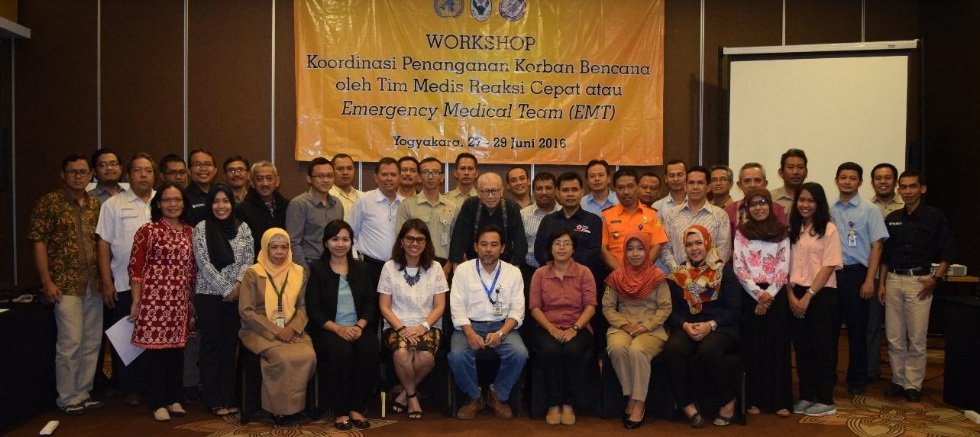
Workshop Koordinasi Penanganan Korban Bencana oleh Tim Medis Reaksi Cepat

border-page

Term of Reference

Workshop Koordinasi Penanganan Korban Bencana oleh Tim Medis Reaksi Cepat

(Emergency Medical Team (EMT))

Yogyakarta, 27-29 Juni 2016

border-page

emt-2016

Latar Belakang

Penanganan bencana merupakan penanganan yang multidisiplin. Berbagai bidang keilmuan dan sektor terlibat didalamnya. Begitu juga dengan sektor kesehatan yang merupakan inti dalam upaya penyelamatan korban serta pemberian layanan kesehatan pada masa bencana. Namun, sangat disadari pentingnya upaya koordinasi dengan tujuan penyelamatan korban sejak tahap pencarian, pertolongan, hingga upaya penyelamatan baik dari tempat kejadian, pos kesehatan, hingga fasilitas kesehatan.

Dilaporkan pada kejadian gempa Haiti, banyak SDM SAR dan EMT yang terlibat, dari 2000 korban, hanya 100 korban yang mampu diselamatkan. Kejadian lain terjadi, dimana sulitnya tim DVI untuk identifikasi korban meninggal karena identitas korban sudah hilang oleh tim yang menyelamatkan sebelumnya.

Kekacauan atau masalah seperti ini dalam kebencanaan pasti terjadi tetapi dapat diminimalkan tingkat kekacauannya apabila masing-masing pelaksana mampu saling berkoordinasi, membagi peran dengan baik, dan dikoordinatori oleh satu komando. Terkait hal ini pada tahun 2015, BPBD DIY menginisiasi terbentuknya sebuah Pergub mengenai koordinasi penanganan pencarian, pertolongan, dan pencarian korban yang mengatur peran BASARNAS, DVI, PUSBANKES, dan PMI yang ada di DIY. Hal ini tentunya masih perlu didukung dengan SOP-SOP dan Form kebutuhan lainnya yang siap pakai jika suatu saat terjadi bencana.

Selain itu, akan diadakan simulasi internasional mengenai EMT di Yogyakarta pada tanggal 25-28 Juli 2016 yang diselenggarakan oleh BASARNAS, WHO Indonesia bekerjasama dengan INSARAG. Untuk itu, EMT Yogyakarta dan daerah Jawa sekitar diharapkan dapat berpartisipasi. Terlebih untuk Yogyakarta yang sudah memiliki peraturan mengenai hal ini untuk dapat diterapkan pada simulasi tersebut.

Tujuan

Tujuan dari kegiatan ini adalah untuk:

  1. Mengidentifikasi partner lokal dalam hal ini Tim Medis Reaksi Cepat (EMT)
  2. Mensosialisasikan peraturan mengenai koordinasi penanganan pencarian, pertolongan, dan penyelamatan korban bencana
  3. Mempersiapkan simulasi internasional pada 25-28 Juli 2016.

report-icon Luaran Kegiatan

Luaran kegiatan ini berupa dokumen peraturan untuk koordinasi penanganan terkait pencarian, pertolongan, dan penyelamatan korban sektor kesehatan, berupa:

  1. SOP
  2. Formdan Checklist

monitor Bentuk Kegiatan

Secara umum bentuk kegiatan berupa seminar dan workshop.

Peserta Workshop:

EMT yang ada di DIY

  • Dinkes DIY
  • Pokja Bencana FK UGM (RS. Sardjito, RS Akademik, FK UGM)
  • MDMC (RS Muhammadiyah)
  • YEU
  • Dompet Dhuafa
  • BPBD DIY
  • BPBD Kabupaten/Kota
  • Dinkes kabupaten/Kota
  • PMI

EMT yang ada di Jawa Tengah

  • PPK Regional
  • Dinkes Jawa Tengah
  • BPBD Jateng

EMT yang ada di Jawa Timur

  • PPK Regional Jatim
  • FK Brawijaya

Undangan

  • WHO Indonesia
  • Pusat Krisis Kesehatan Kemenkes
  • BASARNAS
  • SAR DIY
  • BNPB

agenda Jadwal

Hari 1: Senin, 27 Juni 2016

Waktu

Kegiatan

Keterangan

12.00 – 13.00

Registrasi Peserta

Panitia

14.00 – 14.30

Pembukaan 

PKMK FK UGM: Sekertaris Pusat PKMK FK UGM

14.30 – 15.00

15.00 – 15.30

15.30 – 16.00

16.00 – 16.30

16.30 – 17.00

a.    Standar Emergency Medical Team di Indonesia

     Materi

b.    Sosialisasi Pergub DIY tentang koordinasi penanganan pencarian, pertolongan, dan penyelamatan korban

      Materi

c.    Sosialisasi peraturan (SOP) penanganan bencana bidang kesehatan di DIY

d.    Fungsi dan peran SAR dalam penanggulangan bencana

     Materi

 e.    Diskusi panel

a.    WHO Indonesia

b.    BPBD DIY


c.    Dinkes DIY

d.    BASARNAS


e.    Pembahas PKK (Pusat Krisis Kesehatan)

Hari 2: Selasa, 28 Juni 2016

Waktu

Kegiatan

Keterangan

09.00 – 10.30

Implementasi koordinasi Tim Medis Reaksi Cepat pada respon akut dalam bencana

 Materi 

Diskusi mengenai pengalaman EMT pada penanggulangan bencana di Indonesia atau ke luar negeri

PKMK FK UGM

10.30

Istirahat

10.30 – 12.00

Diskusi parallel pembahasan Sop dan form

Fasilitator Dibagi tiga kelompok

12.00 – 13.00

Istirahat

Peserta

13.00 – 14.00

Presentasi hasil diskusi

Peserta

14.00 – 14.30

Sosialisasi kegiatan simulasi 25-28 Juli 2016

PKMK FK UGM

14.30 – 15.00

Persiapan dan diskusi skenario simulasi

Hari 3: Rabu, 29 Juni 2016

Waktu

Kegiatan

Keterangan

09.00 – 10.00

Pemaparan rangkuman hasil diskusi hari pertama

PKMK FK UGM

10.00 – 11.30

Diskusi skenario simulasi

PKMK FK UGM

11.30 – 12.00

Penutupan

Panitia

12.00

Istirahat dan check out

Panitia

{jcomments on}

Seminar Nasional HDP 2016

border-page

SEMINAR NASIONAL
HOSPITAL DISASTER PLAN

(PENYUSUNAN RENCANA PENANGGULANGAN BENCANA DI RUMAH SAKIT)

Rabu, 7 September 2016
Ruang Senat Gd. KPTU lantai 2 FK UGM

Diselenggarakan oleh
Divisi Manajemen Bencana Pusat Kebijakan Manajemen Kesehatan (PKMK) FK UGM
bekerjasama dengan Kelompok Kerja (Pokja) Bencana FK UGM 

border-page

 Latar Belakang

Dalam kejadian bencana alam, fasilitas kritis termasuk rumah sakit harus mampu melindungi masyarakat dan korban bencana, terutama pada saat tanggap darurat. Kemampuan rumah sakit untuk tetap berfungsi tanpa gangguan dalam kondisi darurat adalah persoalan hidup dan mati. Menjadi hal yang sangat penting untuk semua rumah sakit memiliki perencanaan penanggulangan bencana di rumah sakit.

Perencanaan Penanggulangan Bencana di Rumah Sakit atau Hospital Disaster Plan (HDP) menentukan kualitas pelayanan pada masa respon. Seyogyanya respon yang bagus akan menghasilkan dampak yang bagus, dalam hal ini adalah menurunnya morbiditas dan mortalitas korban bencana. Seperti yang tertuang dalam buku Hospital Preparedness for Emergency and Disaster (HOPE) salah satu tujuan penyusunan rencana penanggulangan bencana di rumah sakit adalah untuk menurunkan morbiditas dan mortalitas yang tidak perlu pada saat bencana.

Begitu penting rencana penanggulangan bencana bagi rumah sakit ini didukung oleh adanya Undang-undang RI No.44 Tahun 2009 tentang rumah sakit, khususnya pada pasal 29 yang salah satu poinnya berbunyi bahwa “Rumah sakit mempunyai Kewajiban memiliki sistem pencegahan kecelakaan dan penanggulangan bencana”. Selain itu, dalam Pembahasan Akreditasi Rumah sakit tahun 2012 pada elemen penilaian akreditasi pada Standar Manajemen Fasilitas dan Keselamatan (MFK) mengenai Kesiapan menghadapi bencana pada Standar MFK 6 yang berbunyi “Rumah Sakit membuat rencana manajemen kedaruratan dan program penanganan kedaruratan komunitas, wabah dan bencana baik bencana alam atau bencana lainnya”. Salah satu elemen penilaian MFK 6 adalah rumahsakit telah mengidentifikasi bencana internal dan eksternal yang besar, seperti keadaaan darurat di masyarakat, wabah, dan bencana alam atau bencana lainnya serta kajadian wabah yang bisa menyebabkan terjadinya risiko yang signifikan.

Terkait dengan rencana penanggulangan bencana di rumah sakit, bagaimana kebijakannya, pelaksanaanya, penilaiannya akan dibahas dalam seminar ini. Begitu juga dengan konsep dan nomenklatur dalam penyebutannya serta konsep mana yang saat ini menjadi rujukan dalam menyusun Hospital Disaster Plan? Dengan seminar Nasional Hospital Disaster Plan harapannya dapat mengumpulkan sebanyak-banyaknya rumah sakit di seluruh wilayah Indonesia sehingga dapat bersama-sama mengetahui dan berdiskusi pengalaman dalam membuat atau mengembangkan Hospital Disaster Plan

 Tujuan Kegiatan

  1. Terciptanya kesepahaman yang sama dalam konsep Hospital Disaster Plan
  2. Mengetahuai kebijakan, pelaksanaan, dan penilaian untuk Hospital Disaster Plan baik secara nasional dan internasional
  3. Mensosialisasikan lebih luas mengenai Hospital Disaster Plan

 Peserta

Seminar ini mengharapkan kehadiran rekan-rekan dari:

  1. Lingkungan Kementerian Kesehatan
  2. Pusat Krisis Kesehatan, regional dan sub regional
  3. Pengurus PERSI diseluruh wilayah
  4. Manajemen dan Tim Penanggulanan Bencana di Rumah Sakit
  5. Dinas Kesehatan Provinsi dan Kabupaten Kota di Indonesia
  6. Fakultas Kedokteran, Fakultas Ilmu Kesehatan Masyarakat, dan Stikes yang mengembangkan kurikulum bencana kesehatan
  7. Mahasiswa S2 dan S3 yang tertarik dengan isu manajemen bencana kesehatan
  8. Peneliti bidang manajemen bencana dan manajemen rumah sakit
  9. LSM yang bergerak di bidang bencana dan emergensi
  10. Pemerhati Bencana, dan
  11. Perseorangan


place Tempat/Waktu

Waktu      : Rabu, 7 September 2016
Jam         : Pukul 08.00-13.00 WIB
Tempat    : Auditorium FK UGM

Waktu

Kegiatan

Narasumber

08.00 – 08.30

Registrasi

08.30 – 08.40

Pembacaan Safety Briefing

08.40– 09.00

Sambutan oleh Kepala Divisi Manajemen Bencana PKMK FK UGM :

dr. Bella Donna, M.Kes

09.00 – 09.15

Tea Break

09.15 – 09. 45

Pembicara 1: Wewenang dan kepentingan mengenai Hospital Disaster Plan bagi penanganan bencana dan krisis kesehatan daerah di Indonesia

Dr. Ina Agustina Isturini

Kasubid Evaluasi Pusat Krisis Kesehatan

Kementrian Kesehatan RI

  Materi


09.45 – 10.15

Pembicara : Hubungan K3 dan Hospital Disaster Plan

Susi Runtiawati,BE, SE, MM  

Kepala Bidang sarana dan Prasarana RS Sardjito

   Materi


10.15 – 10.45

Diskusi

Moderator: dr. Bella Donna, M.Kes

10.45 – 11.15

11.15 – 11.45

Pembicara 4: Penerapan Hospital Disaster Plan di Indonesia

  Dr. Adib A Yahya, MARS

  PERSI

  Materi


11.45 – 12.15

Pembicara 5: Pemahaman konsep HICS (Hospital Incident Command System) pada koordinasi respon di rumah sakit pada saat bencana

Dr. Hendro Wartatmo, SpBKBD

  Pokja Bencana FK UGM

  Materi


12.15 – 12.45

Diskusi

Moderator: dr. Handoyo Pramusinto, Sp. BS

1.     45 – 13.00

Penutupan

13.00

Makan Siang


Fasilitas

  • Seminar kit
  • SKP IDI/PERSAKMI
  • Makan siang dan coffe break

Biaya registrasi

  1. Peserta langsung                : Rp. 500.000,00/orang
  2. Peserta Webinar                 : Rp. 300.000,00 /orang
  3. Peserta Webinar Instansi     : Rp. 1.000.000,00/ instansi (dengan peserta yang akan mendapatkan sertifikat sebanyak 5 orang).

Pendaftaran peserta dapat dilakukan online melalui website bencana kesehatan www.bencana-kesehatan.net atau secara offline dengan mengemail ke [email protected].

Pembayaran peserta dapat dilakukan dengan cara tunai di gedung sekretariat atau melalui transfer ke rekening panitia :
Bank BNI, no.Rek: 0203024192, atas nama: Pusat Kebijakan Manajemen Kesehatan Fakultas Kedokteran UGM
(Bukti setor wajib di fax ke +62274 549425/ email ke [email protected])


 Sekretariat

Pusat Kebijakan Manajemen Kesehatan Fakultas Kedokteran UGM

Gedung IKM Lantai 2 Sayap Utara, Jalan Farmako Sekip Utara, Yogyakarta 55281 Indonesia
Phone/fax: +62 274 549425
Email: [email protected]

Contact person:

Dewi Catur Wulandari
Mobile: +62 818 263653
Email: [email protected]   
Madelina Ariani
Mobile: +62 878 1569 1175
Email: [email protected]


Waktu

Kegiatan

Narasumber

08.00 – 08.30

Registrasi

08.30 – 08.40

Pembacaan Safety Briefing

08.40  – 09.00

Sambutan oleh Kepala Divisi Manajemen Bencana PKMK FK UGM :

dr. Bella Donna, M.Kes

09.00 – 09.15

Tea Break

09.15 – 09. 45

Pembicara 1: Wewenang dan kepentingan mengenai Hospital Disaster Plan bagi penanganan bencana dan krisis kesehatan daerah di Indonesia

Dr. Ina Agustina Isturini

Kasubid Evaluasi Pusat Krisis Kesehatan

Kementrian Kesehatan RI

09.45 – 10.15

Pembicara : Hubungan K3 dan Hospital Disaster Plan

Susi Runtiawati,BE, SE, MM  

Kepala Bidang sarana dan Prasarana RS Sardjito

10.15 – 10.45

Diskusi

Moderator: dr. Bella Donna, M.Kes

10.45 – 11.15

11.15 – 11.45

Pembicara 4: Penerapan Hospital Disaster Plan di Indonesia

Dr. Adib A Yahya, MARS

PERSI

11.45 – 12.15

Pembicara 5: Pemahaman konsep HICS (Hospital Incident Command System) pada koordinasi respon di rumah sakit pada saat bencana

Dr. Hendro Wartatmo, SpBKBD

Pokja Bencana FK UGM

12.15 – 12.45

Diskusi

Moderator: dr. Handoyo Pramusinto, Sp. BS

1.    45 – 13.00

Penutupan

13.00

Makan Siang

Reportase Sesi 1: Seminar Persiapan Rumah Sakit Dalam Penanggulangan Bencana

sesi-1

Reportase Sesi 1:

Seminar Persiapan Rumah Sakit Dalam Penanggulangan Bencana

sesi-1

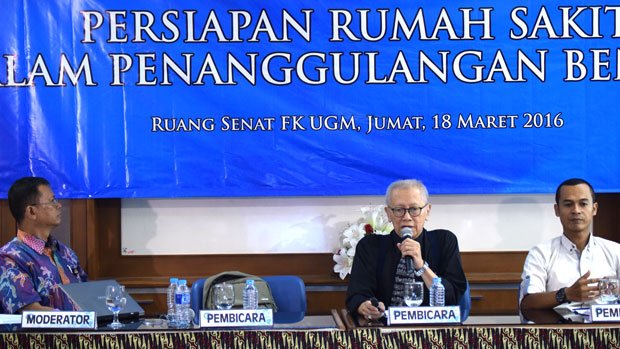
Dalam rangka Annual Scientific Meeting (ASM) 2016 FK UGM, Pokja Bencana Kesehatan bekerjasama dengan PKMK FK UGM turut berpartisipasi melalui penyelenggaraan seminar sehari dengan tema Persiapan Rumah Sakit dalam Penanggulangan Bencana. Kegiatan ini digelar di FK UGM Jumat 18 Maret 2016.

Dalam sambutannya, Dekan FK UGM, Prof. DR. dr. Teguh Aryandono, SpB(K)Onk mengapresiasi kegiatan ini karena perlu kiranya sikap sadar bencana dipraktekkan oleh semua pihak, terutama di negara Indonesia yang merupakan daerah bencana. Dekan FK UGM juga berharap Hospital Disaster Plan (HDP) ini dimiliki oleh rumah sakit di seluruh Indonesia, agar risiko bencana dapat diminimalisir.

Membuka sesi 1, dr. Handoyo Pramusinto, SpBS selaku moderator menjelaskan bahwa sekitar 70% rumah sakit yang ada di DIY memang sudah memiliki HDP, tetapi bagaimana standar dan kualitas HDP nya perlu dievaluasi lagi?.

Sementara itu, bergabung via Webinar (teleconference) dari Jakarta pembicara Sesi 1 dr. Achmad Yurianto selaku Kepala Pusat Krisis Kesehatan Kemenkes RI, yang mempresentasikan tentang Klaster Kesehatan. HDP muncul karena terjadinya pergeseran paradigma dalam pengelolaan bencana, yang sebelumnya lebih difokuskan pada penanggulangan pasca bencana, kini bergeser ke manajemen risiko pra bencana yang ternyata lebih efektif dalam pengurangan risiko. Kaitannya dengan sistem klaster, sistem klaster dibuat berdasarkan keputusan kepala BNPB no. 173 tahun 2014, agar tidak terjadi tumpang tindih dalam proses penanggulangan bencana sehingga masing-masing pihak terkait dapat bekerja secara cepat, tepat, dan akurat sesuai tupoksi masing-masing. Saat ini terdapat 8 klaster dalam mekanisme PRB, dan klaster kesehatan termasuk salah satu diantaranya. Tugas utama klaster kesehatan meliputi layanan kesehatan, DVI, kesehatan reproduksi, kesehatan jiwa, gizi, air, dan sanitasi. Namun dari sistem klaster ini permasalahan yang masih ada diantaranya belum dibuatnya ketentuan terkait tata kerja antar klaster sehingga overlap masih kerap terjadi, dan belum disosialisasikan ke tingkat pemda sehingga koordinasi dengan lembaga lain terkait di tingkat daerah masih kurang baik.

Kemudian Kudiana, SKM,MSc dari Dinkes DIY menyebutkan bahwa Hospital Disaster Plan (HDP) telah diatur dalam Permenkes No. 64 tahun 2013; yang esensinya memperkuat koordinasi dan kemitraan antar sumber daya, optimalisasi sarana prasarana yang ada, dan informasi penanggulangan krisis kesehatan secara cepat-tepat-akurat. Bahkan menurut Permenkes No.12 tahun 2012, HDP sudah masuk dalam DEP Akreditasi rumah sakit. Adapun peran Dinkes dalam HDP adalah mendorong terbentuknya HDP di rumah sakit di wilayahnya dengan memberikan pelatihan HDP bagi rumah sakit.

Berdasarkan pengalaman saat turun langsung ke lapangan pasca bencana, dr. Sulanto Saleh Danu, SpFK selaku konsultan bencana kesehatan dari PKMK FK UGM menjelaskan, bahwa dari sisi kesehatan ada 2 hal yang perlu diperhatikan. Yakni setelah terjadi krisis atau bencana, apakah rumah sakitnya hancur atau rumah sakitnya utuh tetapi menerima banyak korban bencana. Hal ini penting untuk merumuskan HDP yang tepat untuk masing-masing wilayah karena karakteristik bencana antar wilayah tentunya berbeda. Dr. Sulanto juga membagikan berbagai pengalaman menarik selama mendampingi pembuatan HDP, mulai dari fase persiapan yang ternyata tidak semua RS siap karena hanya ingin memiliki HDP sebagai syarat akreditasi, baik dari sisi infrastruktur maupun tingkat pengetahuan SDM nya. Hal-hal tersebut diharapkan dapat menjadi lesson learned agar rumah sakit dapat memperbaiki HDP nya.

Berbagai pertanyaan turut mewarnai sesi diskusi, seperti bagaimana efektivitas SPGDT online yang saat ini sedang dirintis oleh Dinkes DIY? Perumusan anggaran PRB? Koordinasi klaster kesehatan dengan lembaga lain antar klaster? Serta mengapa simulasi bencana yang sepertinya sudah sangat baik tidak sejalan dengan praktek di lapangan saat bencana terjadi?.

Reportase oleh Edna